Real-Life Case Studies: How Surveillance Technology Solved Criminal Cases
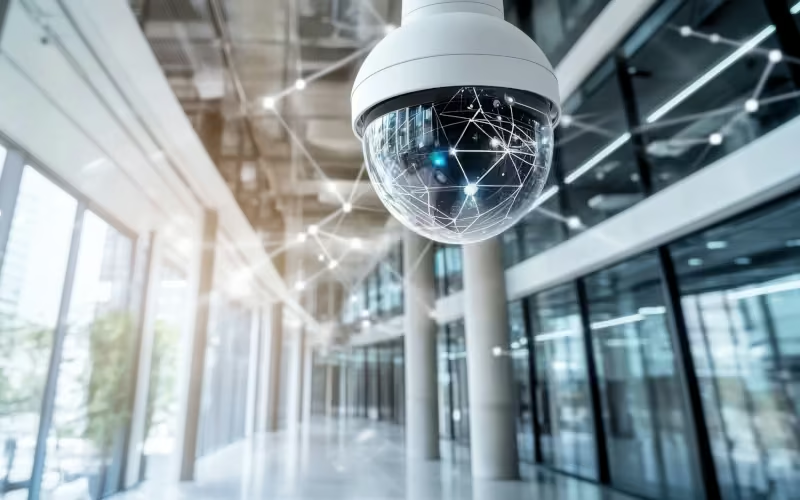
Surveillance technology continues to prove its value by helping solve major cases, from a kidnapping rescue in Philadelphia to catching cattle rustlers in Florida. The provided examples also show how footage from cameras has helped identify an employee stealing from a business and a suspect stealing lumber from a construction site. LVT's mobile systems make it easier than ever to protect what matters most by providing the crucial evidence needed to solve crimes.
Lights, Camera, Justice: Real-Life Cases Solved by Surveillance Technology
You know the scene—grainy footage, a shadowy figure, a detective leaning in closer to the screen. But this isn’t just a plotline from your favorite crime drama. In real life, surveillance technology has played a starring role in solving some truly wild and unexpected cases. From high-stakes heists to neighborhood mysteries, today’s cameras for surveillance do more than just record—they help crack cases wide open.
In this post, we're diving into real-life examples where surveillance technologies turned the tide, helped support public safety, brought criminals to justice, and gave new meaning to “caught on camera.” Let's take a look at some cases where the lens didn't just capture the moment—it changed the outcome. From traditional video surveillance to newer tools like facial recognition, artificial intelligence, and other surveillance tools, these technologies show how visual evidence can help investigators move faster when every detail matters.
From Evidence to Prevention: Building Site‑Wide Security
These stories prove that cameras don't just capture events—they drive outcomes. Organizations that evolve isolated devices into site‑wide security gain full site visibility and faster resolution. Standardizing a site security program across locations turns ad‑hoc cameras into site security solutions that deliver complete site protection. For municipalities, campuses, commercial properties, and City Departments, well-planned video surveillance programs can also support clearer impact and use policies by defining how surveillance technologies are deployed, monitored, and reviewed.
Security Footage Leads to Rescue in Philadelphia Kidnapping
In 2014, a young woman was kidnapped off the streets of Philadelphia while walking home after dark. The 22-year-old, Carlesha Freeland-Gaither, was attacked and forced into the back of a car. Fortunately, several surveillance cameras would play a critical role in her rescue.
A nearby man heard her screams and rushed to the scene just in time to witness the tail end of the abduction. He immediately called the police, providing the first crucial lead. Investigators quickly gathered security footage from a nearby building, which revealed both the make of the vehicle and its license plate number.
Further evidence led investigators to check surveillance footage a few miles north of the city. These key pieces of video evidence helped law enforcement issue an alert to the public, detailing the suspect vehicle and its possible location. In public safety investigations like this, surveillance technologies can help law enforcement connect vehicle details, location clues, and witness reports without relying on a single source of evidence. In other cases, tools such as Facial Recognition Technology or facial recognition software may be evaluated under strict policies, but here, the decisive evidence came from camera footage and vehicle identification.
Three days later, the beaten-up Ford Taurus was spotted in a parking lot in Jessup, Maryland. Law enforcement rushed to the scene, rescuing Freeland-Gaither. She was saved, taken to the hospital, and eventually reunited with her family, thanks in large part to the watchful eyes of surveillance equipment.
Coordinated site‑wide video surveillance across public and private feeds demonstrates why enterprise site security benefits from interoperable evidence workflows. Whether footage comes from mobile units, fixed cameras, or closed-circuit television cameras, connected surveillance tools make it easier to review events, share evidence, and support faster response. evidence workflows
Rustlers Caught Red-Handed
On his quiet property in Auburndale, Florida, Ed Davis had grown used to losing livestock to thieves. On one occasion, cattle rustlers stole cows from a second pasture while officers were still searching the first. But in December 2011, after discovering that about a dozen of his prized Hereford cattle had vanished, Davis took matters into his own hands.
He kept an around-the-clock watch over the remaining herd, but it wasn't until a surveillance camera captured a clue that the case truly broke. Footage from a nearby traffic light caught a white 1989 Dodge pickup truck running a red light at 3 a.m.—the same day the cattle disappeared. The truck was pulling a trailer loaded with cows that matched the markings of Hereford stock. While this case relied on traffic camera footage, similar investigations today may also involve an Automated License Plate Reader or automatic license plate readers to help identify vehicles connected to theft, trespassing, or other property crimes.
Detectives traced the vehicle to a previously convicted livestock thief. With the help of authorities in nearby counties, they also connected the case to another man who was already wanted for similar crimes.
Thanks to one well-placed surveillance camera and some sharp detective work, the cattle rustlers were brought to justice, ending a long and frustrating chapter for the determined Florida rancher.
A well‑placed traffic camera at a traffic light functioned as part of a virtual security perimeter, surfacing the lead that cracked the case—an approach enterprises can replicate with perimeter security solutions. For businesses managing remote properties, location-based alerts and other location-tracking technologies can also help teams understand where activity is happening and respond before losses escalate.
This Transaction Has Been Declined
In Washington City, Utah, well-placed covert surveillance equipment helped uncover an internal theft that had quietly added up to thousands of dollars. The suspect? A 73-year-old cashier.
In March 2024, staff members flagged a suspicious transaction at a cash register, prompting them to check the surveillance footage they had in place. Video surveillance clips showed the cashier in question pocketing cash from customer transactions instead of placing it in the register.
Officers involved with the criminal investigation reviewed several video surveillance clips, including one where a customer handed the cashier a $100 bill. Rather than depositing the money into the drawer, he slid it into his own pocket. As loss prevention staff dug deeper into previous shifts, they found at least seven separate incidents that totaled more than $4,400 in stolen cash. The footage also gave the business a clearer internal audit trail, showing how targeted security measures can help identify repeated losses that may otherwise go unnoticed.
This case proves that even quiet crimes behind a register don't stay hidden for long when the cameras are rolling. Covert monitoring closes gaps in site security management and complements perimeter cameras with interior coverage.
Boston Marathon Bombers Identified Through Surveillance
One of the most famous crimes to be solved through security footage occurred on April 15, 2013, when two bombs exploded near the finish line of the Boston Marathon. Tragically, three people were killed and more than 260 injured. This launched one of the most intense manhunts in U.S. history. Surveillance footage was key in cracking the case.
Almost immediately, federal agents and local law enforcement began gathering footage from nearby security cameras. One particular video from a department store provided a crucial lead. It showed two young men walking through the crowd carrying backpacks, and one of them placing his bag on the ground near the site of the second explosion. Large-scale public safety incidents often require teams to review massive amounts of footage quickly, which is why surveillance technologies, artificial intelligence, and organized evidence workflows are increasingly discussed as part of modern investigative response.
Over the next couple of days, the FBI pored over hours of video and photographic evidence. Just three days after the attack, the FBI released surveillance images and videos of the two suspects, asking for the public's help in identifying them. Within hours, tips poured in. The case is often discussed alongside broader conversations about Face Recognition Technology, live facial recognition technology, and how agencies balance investigative speed with privacy and civil liberties.
That night, the suspects were found. Without the security footage capturing those key moments at the marathon finish line, authorities likely wouldn’t have identified the suspects as quickly as they did. High‑density, multi‑agency video created de‑facto complete site coverage, accelerating suspect identification.
Nailed It: Surveillance Hammers Down on Job Site Theft
As housing prices climb across Utah, so too does the cost of construction materials—and unfortunately, so has the temptation to steal them. Nilson Homes, a Utah-based general contractor, has seen a spike in thefts at its construction sites. The remote and quiet nature of construction sites often makes them a prime target for theft. But thanks to strategically placed security cameras, the company has been able to fight back.
In one incident, surveillance equipment captured a suspect stealing lumber and metal scraps from an active site. The video, which has since racked up over 100,000 views on social media, shows the suspect casually loading a truck—apparently unaware that their actions were being recorded in crystal-clear detail. For remote jobsites, mobile surveillance units, imaging devices, and geolocation tracking can help security teams verify where incidents occur, document what happened, and provide law enforcement with clearer evidence.
The company reported that thefts like this have become a pattern over the past year. While the situation might be frustrating, technology is helping to turn the tide. One of the company's contractors has been able to track down 100% of thefts caught on tape. These often end in felony arrests. Remote projects need site perimeter protection and exterior perimeter monitoring tied to portable units for facility-wide security. Unlike temporary tools such as an Unmanned Aircraft System or Domestic Drones, fixed mobile security units can stay deployed on-site to provide continuous visibility across high-risk areas.
Crime Solved—Thanks to the Camera
Responsible Surveillance Supports Safer Communities
As more organizations and municipalities adopt surveillance technologies, the conversation is no longer just about what cameras can capture. It is also about how surveillance tools are used, who has access to footage, and how policies protect privacy and civil liberties.In cities like New York, public agencies, City Departments, and the New York City Council have discussed surveillance impact and use policy requirements, public comments, transparency law, and community oversight as part of broader conversations about public safety technology.
These impact and use policies can help define how tools such as Body Worn Cameras, facial recognition, biometric surveillance technology, automatic license plate readers, and video surveillance systems are evaluated before deployment.
For businesses, the lesson is clear: effective security depends on both reliable technology and responsible use. LVT's mobile surveillance units help organizations capture security footage, strengthen site visibility, and support law enforcement when evidence is needed—while giving teams a scalable way to manage surveillance across locations. From bustling city streets to rural ranches and retail stores, these real-life cases prove just how powerful surveillance equipment can be in solving crimes. Whether it's identifying a getaway vehicle, catching a thief in the act, or pinpointing the moment everything changed, cameras are often the silent witnesses that make justice possible.
If you're looking to take security into your own hands, LiveView Technologies (LVT) offers a smarter way to monitor and protect your space. Our proven track record speaks for itself. LVT® units have led to catching criminals at Caesars Palace and supported law enforcement at the Arcadia Police Department in keeping their community safe.
Our mobile surveillance units are designed to cover hard-to-reach areas, adapt to your needs, and capture crystal-clear security footage. As surveillance technologies continue to evolve, LVT helps organizations use practical, site-focused surveillance tools to deter crime, document incidents, and support faster response. Whether you want to prevent crime before it starts or ensure you have the evidence when it matters most, LVT ensures you stay one step ahead.