You Can Bank on It: A Guide to Better Bank Security Systems

Effective bank security systems protect more than just cash and vaults, extending coverage to entrances, ATMs, parking lots, and other vulnerable areas. By combining surveillance cameras, access controls, and AI-powered analytics, banks can identify suspicious activity, close security gaps, and better protect employees and customers. A layered security approach strengthens protection across the entire property and responds to potential threats before they become bigger, costlier issues.
When you think of a bank, an image of Greek columns and unassailability likely comes to mind. Thick vault doors, reinforced walls, surveillance cameras, alarms, and maybe even a guard standing near the entrance, stoic and unsmiling.
It's the kind of place where you'd expect someone to notice if you tried anything funny. (And for whatever reason, people still do. Every day, 3.5 banks are robbed in the U.S.)
But a bank's security risks don't begin and end at the vault. What about the customer withdrawing cash from the ATM after dark? Or the employee walking to her car after closing? What about the delivery entrance, drive-through lanes, or the parking lot where someone has been sitting in the same vehicle for the past hour?
A bank branch buzzes with employees, customers, vendors, vehicles, and sensitive information moving in and out every day. Effective bank security systems need to protect all of it, from the cash behind the counter to the cars parked outside…and that takes more than a really impressive vault door.
Start Where the Money Is
Banks have cash, and cash attracts attention. Vaults, teller stations, ATMs, cash-handling rooms, and other restricted areas are natural priorities for security. These locations need protection against theft, unauthorized access, and internal threats.
Traditional financial security systems use several layers of protection, including physical barriers, alarms, access controls, and surveillance cameras. For example, vaults and cash-handling areas may use restricted credentials, time-delay locks, intrusion detection, and audit trails to limit who can access valuable assets and when.
Cameras provide additional visibility into these locations, while alarms notify security personnel when something isn't right. But a locked vault is only one part of the whole. Someone still has to enter the building, move through the branch, and interact with employees before getting anywhere near it. In other words, they have to step in the lobby.
The Lobby
Banks face a precarious balancing act. They need to be welcoming enough for customers to conduct business but secure enough to discourage people with less-than-friendly intentions. Nobody wants to feel like they're entering a maximum-security prison just to deposit a birthday check from Grandma. The lobby is one of the most accessible areas of the branch. Customers, employees, contractors, and delivery personnel all pass through the same doors.
During busy periods, tellers and customer service representatives are focused on helping people, not necessarily watching for suspicious behavior.
Surveillance cameras fill this gap by providing security teams visibility around entrances, teller lines, waiting areas, and other public spaces. Access controls can keep customers out of employee-only areas, while panic buttons and duress alarms give staff a way to discreetly request help.
Modern video analytics help identify unusual activity in real time. Agentic AI systems give employees the freedom to do their jobs without being responsible for personally monitoring every corner of the branch.
Service Doors
Every bank has a front door, but most institutions also have employee entrances, delivery doors, service corridors, maintenance areas, or even connections to neighboring buildings. These less-visible entrances are often farther from the employees and customers who naturally provide extra eyes and ears in the lobby.
A door that rarely gets used might not receive much attention during the day. After hours, however, it could become a vulnerability. The best bank security systems combine controlled access with surveillance around these secondary entrances.
That might mean employee credentials, door-position sensors, intrusion alarms, and cameras positioned to capture activity outside the building.
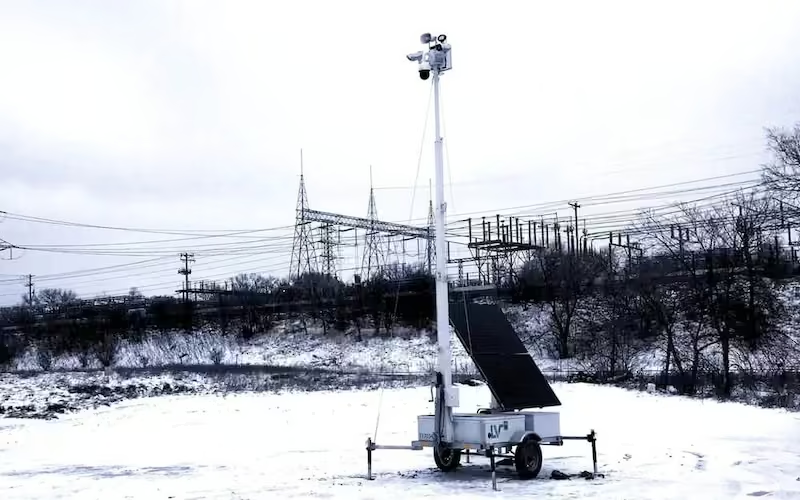
Mobile security units provide coverage in hard-to-reach places where it isn’t practical to add permanent infrastructure. No additional power, connectivity, mounting locations, or installation work required. They’re also free to move as security needs change, unlike traditional mounted cameras.
ATMs
ATMs are convenient for customers, but can be a nightmare to secure for banking institutions. Many operate outside normal business hours, and some are positioned away from the main building. As a result, customers are handling cash in locations with limited visibility or foot traffic.
Cameras can help monitor activity around ATMs, especially at standalone machines and drive-up locations, while lighting and clear sightlines make it easier for customers to see their surroundings.
Banks should also consider how landscaping, nearby structures, and parking arrangements affect visibility. An ATM tucked behind a row of overgrown shrubs might offer privacy, but it could also make it harder for customers to notice someone approaching.
Both the machine and the surrounding environment need a regular inspection. That includes watching for signs of tampering, unusual activity, and situations that could put customers at risk. Protecting the ATM is important, but protecting the person using it matters even more.
Using AI-powered cameras, real-time alerts, and active deterrents to identify suspicious activity, mobile security units discourage theft and vandalism, and help keep customers safe at standalone and drive-up ATMs.
The Parking Lot
A customer can complete a perfectly safe transaction inside the branch, walk out with cash, and find trouble before reaching their car. Employees face similar concerns, particularly when opening or closing a branch outside normal business hours.
Parking lots, sidewalks, drive-through lanes, and nearby pedestrian routes all create opportunities for theft, confrontations, vehicle break-ins, and other unwanted activity. Workplace parking lot safety is an essential part of the overall security plan.
Start with the basics: Are parking areas well-lit? Can employees see the route between the building and their vehicles? Are there isolated corners or areas blocked by landscaping? Do cameras cover the entire property or just the entrance?
Talk to branch employees about areas where they feel unsafe. Examine camera coverage and response procedures. Look for patterns that suggest certain locations need more attention.
Mobile surveillance units provide flexible camera coverage in areas where permanent infrastructure is difficult or where additional visibility is needed quickly. These units combine elevated cameras, solar power, cellular connectivity, AI-powered analytics, and active deterrence capabilities.
Security should fit the property, not the other way around.
Don't Just Record the Problem
Recording an incident isn't the same as stopping it. Imagine someone is loitering around a bank's ATM after closing. A traditional camera may capture everything that happens, giving investigators useful footage the next morning. Fantastic!
But wouldn't it be better if someone could address the situation before anything happened?
AI-powered surveillance identifies certain types of suspicious activity and sends alerts for review. Depending on the system, trained monitoring personnel can assess what's happening and determine whether additional action is necessary.
Mobile surveillance units—equipped with speakers, lights, or other deterrence capabilities—discourage unwanted activity. But just because someone is sitting in a parked car doesn’t mean they're a criminal, which is why technology and human judgment work best together. AI can help identify activity worth reviewing, while people provide the context needed to decide what happens next.
Think Swiss Cheese
The strongest approach to security for financial institutions isn't choosing between physical barriers, cameras, access control, or monitoring: it's using them together. Think of branch security as a series of layers, like Swiss cheese.
The vault protects cash and valuables. Restricted access protects employee-only spaces. Cameras provide visibility throughout the building. Alarms help employees request assistance. Exterior surveillance extends coverage to ATMs, parking areas, and entrances.
Because each layer addresses a different risk, if one layer fails the others can still provide protection.
For example, a camera might detect suspicious activity near a restricted entrance. An access-control system can help prevent unauthorized entry, while an alert gives security personnel an opportunity to investigate.
Much more useful than relying on a single locked door and hoping nobody bothers it!
Protect the Whole Branch, Not Just the Vault
Banks have spent generations figuring out how to protect money. But modern bank security systems need to do more than keep cash behind locked doors. They need to protect employees, customers, equipment, information, and the entire property where banking happens.
That means thinking beyond the teller counter and extending security to entrances, ATMs, drive-through lanes, parking lots, and other high-risk areas. The goal is to build a layered security strategy that fits each branch's risks, closes coverage gaps, and helps security teams respond before small problems become expensive, nightmarish ones.
Contact LVT (LiveView Technologies) for a free demo to learn how mobile surveillance can help extend your branch's security beyond the building and protect the areas your existing cameras may be missing.