Unlocking Full Site Coverage with LVT’s CPO George Bentinck
This webinar recap covers key takeaways from LVT’s conversation with CPO George Bentinck, including why static security creates a whack-a-mole problem, how real-time deterrence helps prevent incidents, and how LVT’s expanding solutions bring visibility and protection to more types of sites.
Security is like playing whack-a-mole, where you hit one mole and another pops up instantly. But criminals are smarter than automated plastic moles. You install a camera on the right side of the lot and they simply start hitting the left side instead.
This whack-a-mole problem was one of many topics discussed by LVT’s Chief Product Officer (CPO) George Bentinck in a recent webinar. Below are some key takeaways from that conversation.
→ Want to hear the full conversation? Watch the webinar on demand.
Criminals Adapt to Static Security
Before joining LVT, Bentinck spent eight years at his previous job building physical security products, primarily security cameras. During that time he noticed one of the biggest challenges security teams face is being limited by fixed infrastructure. A camera may cover one side of a lot, but that doesn’t mean the entire property is secure. If criminal activity moves outside of that fixed view, the original problem has been displaced, not solved.
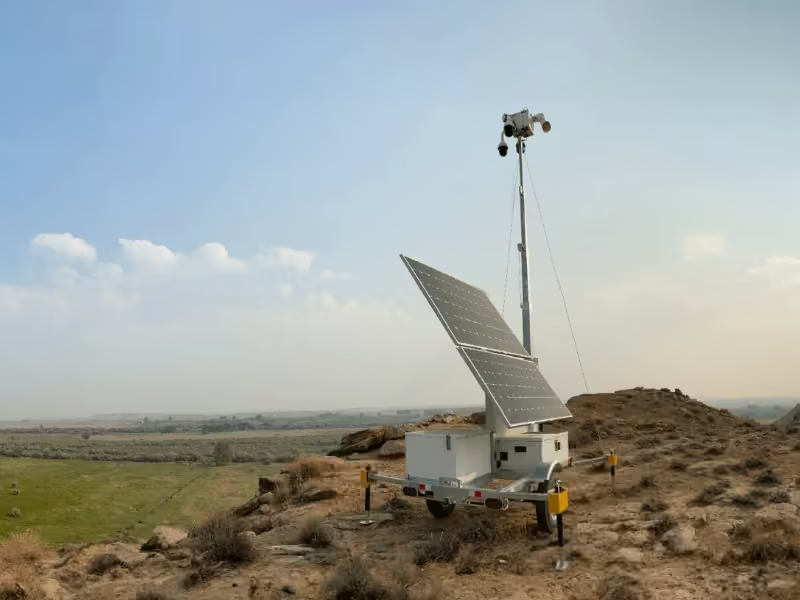
LVT’s mobile security unit offered a different approach than the one Bentinck was used to: a visible, rapidly deployable deterrent that could be placed where risk was actually happening.
“I used to spend all my time putting stuff in buildings, and now I’m outside the building. A lot of the problems begin outside the building, and having some mitigation strategy, having something that’s going to help with that, is really valuable,” he explained.
Technology Should Extend Security Teams, Not Replace Them
Security teams are responsible for an enormous range of issues—fraud, investigations, employee safety, customer safety, trespassing, loitering, panhandling, vandalism and more. Some of those issues require human expertise, but others are repetitive, high-volume problems that drain time and attention. According to Bentinck, technology gives people more capacity to focus on the former.
“I’ve not come across many organizations that eliminated the people with the technology. They took the people and put them on more valuable things.”
With the right tools, personnel can stop wasting their time on every trespasser, loiterer, or nuisance incident and focus instead on investigating fraud, improving safety or responding to issues with higher stakes.
Seeing a Problem Is Good But Stopping It Is Better
Cameras show what happened when an incident occurs—and that evidence is valuable—but Bentinck emphasized the value of preventing incidents. He shared an example: if someone appears to be preparing to commit a crime but a spotlight moves toward them, “You see them immediately question their decision-making about whether or not they should carry on with what they were about to do. It’s really quite something.”
Deterrence happens in real time. Evidence gathering, police reports, and prosecution all may come later, but a spotlight, strobe, live talk-down, or other in-the-moment deterrent can interrupt the decision before damage is done.
Real-time deterrence also helps address the whack-a-mole problem. If a site’s security responses become predictable, criminals can adapt. An intelligent, responsive system makes that harder.
LVT Is Expanding Where Security Can Go
The mobile security unit has been and will continue to be a core part of LVT’s security offering, but Bentinck also talked about the need to bring LVT’s capabilities to more types of sites and more types of problems.
Some properties don’t have room for a mobile security unit. Others may need coverage around a building, at a vehicle entrance or in a remote area with limited connectivity. In some environments, a highly visible security presence reassures people. In others, it may negatively affect how customers perceive the site.
Bentinck used convenience stores as one example. A store may need better visibility or deterrence, but in a small lot, giving up a parking space can affect the business. He also pointed to distribution centers, where teams may need coverage at the front and back of a building or better control over vehicle access.
A security system should fit your site, not the other way around.
That’s why LVT has expanded beyond the mobile security unit into additional solutions, including:
- Live Unit Surround: Live Unit Surround mounts to a building and uses multiple camera heads to provide coverage around the property. It’s a great solution for sites that need visibility and deterrence capabilities but do not have the space, layout, or environment for a mobile security unit.
- GuardGate: GuardGate helps sites control and audit vehicle access without relying on a permanent guard shack or traditional gate infrastructure. It can be especially useful for distribution centers and other vehicle-heavy sites where teams need better visibility into who is coming and going.
- License plate recognition: License plate recognition technology captures plate information as vehicles enter, exit, or drive around your site, and gives security teams searchable vehicle data they can use to investigate incidents or identify patterns.
- Satellite connectivity: Satellite connectivity helps bring visibility and deterrence to remote sites where cellular service may be limited. That can be especially valuable in areas where there are few people nearby to respond quickly if something happens.
Each of these solutions addresses a different version of the same problem: getting visibility and deterrence wherever, whenever, and however you need it.
The whack-a-mole problem isn’t going away, but luckily, security systems just keep getting better and better. If you’re interested in learning how LVT could help keep your site secure, contact us for a demo. Or, if you’d like to listen to the full conversation, watch the webinar on demand.

%20(1).avif)
%20(1).avif)
