Unlocking Full Site Coverage

Security teams today are facing a capacity problem. When Overburdened and constantly asked to do more with less, managing multiple properties can feel like a game of whack-a-mole against threats like theft, vagrancy, loitering, and vandalism. While traditional security infrastructure relies heavily on local law enforcement or expensive physical guards, modern organizations are discovering a smarter, more efficient way to protect their people and property.
In this exclusive on-demand discussion, LiveView Technologies (LVT) Chief Product Officer George Bentinck shares a simple strategy for achieving complete site security without breaking your budget. You will discover how industry leaders are moving away from traditional setups to build proactive, comprehensive physical security coverage that acts as a force multiplier for their teams. Learn how to bridge the gap between physical property management and digital intelligence, turning your on-site hardware into your company’s most valuable source of data.
Featured Speakers

George Bentinck
George Bentinck, Chief Product Officer, will lead LVT’s product strategy as it executes on the vision for actionable intelligence for the physical world. Bentinck most recently served as vice president of product management, IoT and edge intelligence, at Cisco Meraki.
Erase Your Layout Gaps with Full Site Coverage
Deploying security technology at your most problematic locations is a great start, but the best-performing organizations don’t just wait around for a crisis to happen. Gaps in your physical layout leave room for bad actors to find a way in. To maximize safety and efficiency, you need a strategy that surrounds your locations with distributed deterrence, automatically offloading high-volume, low-severity incidents to intelligent tech so your team can focus on what matters most.
In this session, we’ll walk you through securing everything from small, busy convenience stores to massive distribution centers and remote critical infrastructure. We’ll showcase how modern, rapidly deployable hardware solves spatial and logistical challenges at each location.
Key takeaways from this webinar include:
- Overcoming the Capacity Crisis: How to shift minor events (like loitering or panhandling) over to technology-handled systems, freeing up human expertise for high-severity issues.
- Rapidly Deployable Security Ecosystems: A look into tailoring hardware to your specific site needs—including LVT Mobile Security Units (MSUs), Live Unit Surround, LPR, and GuardGate.
- Unlocking Site Intelligence: How to harness your physical infrastructure to drive intelligent deterrence, improve employee safety, and gain efficiencies in your operations.
Full Transcript
Michael Riordan:
Hello, everyone. Thank you for joining us today for our webinar on achieving full site coverage and how that lays the foundation for intelligent site management. I'm Michael Rudin and I'm a product marketer here at LVT. And before we dive in, I wanted to cover some housekeeping rules with everyone. So first, we welcome any and all questions. If you happen to have a question at any point during our presentation, please submit it in the Q&A panel in Zoom and we will answer to the best of our ability. Second, we are recording this webinar today so you will be able to access a recording after the presentation for reference if you'd like that. And third, we are running a giveaway promotion. So if you are happening to join this webinar, you are eligible. We are giving away 10 gun saves. So our team will follow up with you after the broadcast if you are one of those 10 lucky winners.
So with that covered, let's dive in. I'm super excited to be joined today by LVT's Chief Product Officer, George Benting. How are you doing today, George?
George Bentinck:
I'm good. Thank you, Michael. This is my first LVT webinar, so go gentle with me.
Michael Riordan:
No worries. I'm excited.
George Bentinck:
I'm disappointed that this is my first, considering although I am new, I've been here six months, maybe I'm just going to have to catch up and do a few more webinars quickly after this one.
Michael Riordan:
I think that's the plan.
George Bentinck:
All right. Let's go to the next slide. Let's get into some of the details. Now, maybe just a quick intro on myself as part of the perspective I have on the information we're going to share and the progress we're making in the security domain at LVT, which was I come from a company called Cisco. You might be familiar with it. It's one of the largest networking companies in the world, essentially invented the internet, but I spent eight years there building physical security products, primarily security cameras. And so as we look at the type of security challenges that teams face in the public sector, in enterprises, in all sorts of businesses, there is a real capacity problem. And this whack-a-mole graphic I think somewhat represents my customer's lived experience in past roles and in the current role here where you apply a solution to the problem and the problem goes somewhere else or a different problem turns up because the solution you apply was really specific, that one was there and then it doesn't help you with other things.
And so one of the things that appealed to me joining LVT, and if we go to the next slide, was the game-changing proposition of the mobile security unit that LVT invented. It is funny because I spent all my time putting stuff in buildings and now I'm outside the building and I never worked or really cared about trying to do stuff outside the building in my prior role because it was really, really hard. And yet that's where a lot of this starts. A lot of the problems begin outside the building and having some mitigation strategy, having something that's going to help with that is really valuable. And then the second piece is the static nature of what I could do in my prior role, which was you put a camera on the outside of the building. You know what happens? The problem moves outside of the view of the camera or somewhere else.
And so the rapidly deployable nature of LVT's mobile security unit, it made so much sense to me. I saw how valuable it could be to customers I'd worked with in the past and how on the face of it, it looks quite straightforward. You have a trailer with some cameras on it, but I know it's brutally hard to make that thing reliable, that thing really effective, that thing have intelligence so you're not overwhelmed with an infinite number of alerts or a whole load of low value information. And that was the compelling reason for me to come join because that was something to build on. That was real value we could go take advantage of and customers being able to deploy into their hotspots into some cases declared war zones and seeing the immediate benefit. I haven't seen some of the intensiveness of the positivity of the customer quotes.
So maybe if we go to the next slide on the customer quotes, to be in a place where customer is essentially saying it's a hundred% effective, it's hard to almost believe what's a hundred percent? It's virtually nothing. But time and time again, customers with problems, lots of different ones as you saw on the whack-a-mole slide, they bring in the LVT MSU and it stops. And that's an incredible position to be in as a supplier of safety and security technology, that immediate impact is phenomenal. But there are some places where an MSU is not the right fit and what we're going to be going through and what I'm excited to share is our team's journey on expanding that coverage and efficacy of the LVT proposition to more places and in more ways. Totally.
Michael Riordan:
They're thinking they know that what may be an okay good site today could become this problem site tomorrow because criminals are crafty, they'll find a way. So thinking ahead, they know that more sites covered by deterrence, by our dynamic deterrence equals more time saved for their people because if they can offload more and more events to technology so they can stop crime before it happens, they can stop lower severity events like panhandling or vagrancy or what have you, they now have that capacity for their people to focus on what really matters. The really critical events that require that human intervention, that human response, and then they save all that time and money that would've been spent on potential case building prosecution because they've prevented some of these smaller mid-level incidents. So really full site coverage as we move toward this orientation of being able to provide better coverage deterrence in more places, to your point, means more events handled by technology, more capacity for your people.
George Bentinck:
And I think that's a critical part for me is I've not really come across too many organizations that eliminated the people with the technology. It's just they took the people and put them on more valuable things. And when you have complicated fraud in your business, for example, that requires a lot of investigation, time, people, effort. And so when those resources are also trying to prevent some of this lower severity, but customer or operational impacting incidents, you're not putting your expensive, high value, high impact resources in the best place. That's a great technology offload. And I think I was talking a little earlier on a little social thing we're doing about how I'm continuously impressed and maybe impressed is the wrong word, but it's the one I'm going to go with, of how ingenious different forms of crime are, especially with some of the large increases in gas prices right now, incentivizing more gas theft and innovation around that, you want to be on top of that.
And so having technology be a real supporting partner and the fact that you can go prosecute to a case is not the thing deterring people from doing it because it's like a very long tail effect is actually something giving people second thought, preventing them to come on site if they wanted to try and do something is really high value totally.
So the MSU, I talked about it at the beginning is just this amazing thing that can be parachuted in from the sky to your problem site and have incredible impact, but this is a full site coverage webinar and the MSU, although it can cover a huge amount of space and can see a long way, sites aren't just a nice rectangular black piece of land. There's lots of other things on them and sometimes they're not the perfect fit and you might need to compromise on some of the outcomes you want to get the full capability either in potentially some of your space. I think we're going to go into that in a little more detail, but it's something where can we take the properties that really work of the MSU and make it happen elsewhere in other formats? And I think that's part of the growth of LVT, which is look at all the value we've created and make it applicable to more sites, more customers, and in other formats so that we continue to be a leader.
So if we go to the next slide, I think we can dig into those in a bit more detail, which is I talked about the space. So you're a small convenience store. You're expecting people to drop in, buy a few things and go, you have four parking spots and MSU take you up a parking spot is direct revenue impact. And so that's not something that you're going to want to give up easily. And we want to make sure that those customers get an effective deterverance, coverage, security solution, even if that is a limitation. The other thing is when you have ... So the Polar Opposite, really big site, big distribution center, huge warehouse, you're going to want to see both the front and the back of that. And as great as an MSU is, it's not 70 foot high. We haven't quite cracked the 70 foot high tower problem just yet.
And so you are going to end up with one or two, well, not one, but two units to cover both sides. And that's obviously great, but if that site is a permanent site, is that the most cost-effective way to do it? You can solve it. We can provide that solution, but I'd want the customer that wants to have that permanently to have a much more affordable option because we've optimized for their deployment model, which is the building and a large site. The other one is the customer-facing environments and you do want it to provide deterrence by looking like it has an impact on the environment, but maybe the trailer, the mobile security unit itself is too much. You talked about increasing the coverage to the lower severity sites. Maybe that's not what a customer's going to want to have then like an MSU because it might bring into some of their customer's minds.
Is this a problem site because it had a high level of deterrence deployed at it, which might not be the reality. Where highly problem sites, we see people gravitate to the deterrences like the place they want to park their car, for example, because they know it has an effect of providing a security bubble. And so dialing these in to fit the particular customer use case is what I think we're going to be talking about to the next couple of slides.
Michael Riordan:
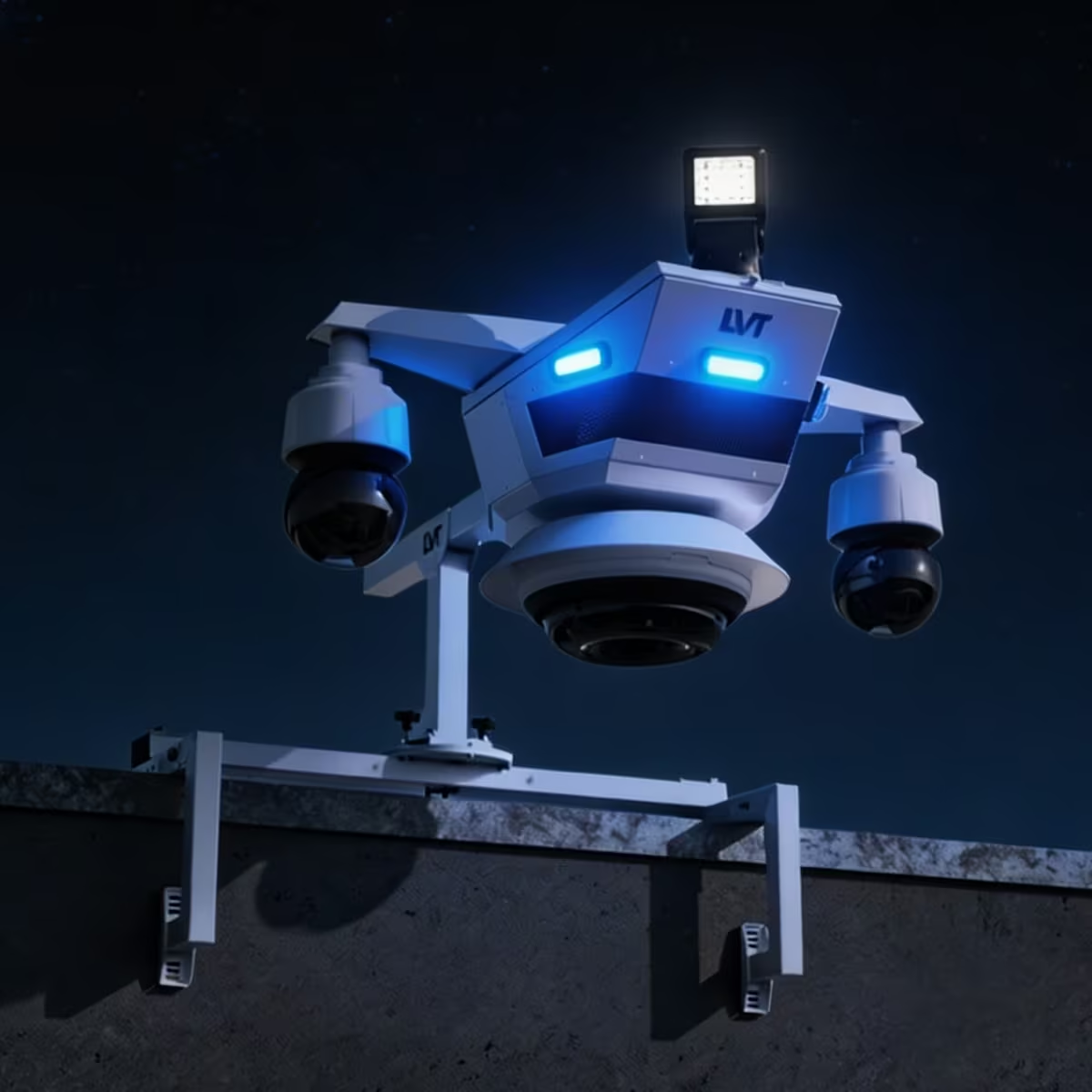
Yeah, let's dive into live units around. So we took some of that feedback and some of those considerations that we heard from a range of companies around the different approach that's potentially needed for some of their sites and we came up with Surround, which as you can see, is a building mounted solution with a central hub in multiple heads. And as you'll see on those heads, up to three cameras with the deterrence that you already may be familiar with from the MSU. So speaker, strobes, spotlight-
George Bentinck:
It's like a no compromise. You've got all of the best of what we offer in this new form factor. It's not like we've cut some things off to fit it into this form factor or make it more affordable. You get the best of what we offered today and what we'll support in the future, but now in this new form factor. Yeah, totally.
Michael Riordan:
And as you can see here in context, we can do one camera. So the multi-sensor panoramic that you see there is the typical central camera and these heads can be deployed up to 300 or so feet from that central hub. So you can get, as George was referencing earlier, if you want to see front and back, you can spread out. And best of all, the deterrence is also spread out. So we get that coverage, we get that visibility and we get the distributed deterrents.
George Bentinck:
I sort of forced the marketing team to put in a photo. Renders are very beautiful, but I want to believe it's actually deployed on one of our facilities and just shows the configurable nature of it. We haven't got the two arms on the side. The two arms on the side obviously give you a lot more camera options. You can have the PTZs to provide more coverage, but also increase its visual impact factor. And if you want to tone that down a bit, then you can take those off, just go for the quad imager there, get a whole load of coverage, but something that's maybe a little tone down for the sites where you want that.
Michael Riordan:
And like we mentioned, this is a building-mounted solution, so it can be installed on the wall or roof without taking up that precious real estate, especially if you don't want to sacrifice a parking spot for an MSU. It has kind of a similar look, but a new look as our live unit that you would see mounted on the MSU and the distributed deterrents that we consider a prerequisite. And like you mentioned, flexible configuration, two to four heads, on to three cameras really designed to fit the needs of your site in terms of coverage profile.
George Bentinck:
I do see have a question from Edwin. Edwin, thanks very much. The rest of you on the call do ask questions. This is your opportunity. So I'm going to read out the question with this, will this still be a fully standalone unit, self-powered, et cetera? Does the light change positions too? So this isn't a solar battery powered unit, this is going to be mains powered, so 110 to the unit. That means that yes, you're going to need to get that power in there, but drastically simplifies all of the things you're going to have on top of the roof. So it's not self-powered. This is one that's wide and connected to a building for power. Does the light change position? My assumption is you're meaning the PT spotlight. PT stands for what, Michael?
Michael Riordan:
Pan-tilt.
George Bentinck:
Pan-tilt. So yes, it moves. And so this can move around. I saw a really great piece of video from one of our customer sites where the MSU was there and there was a crime about to happen. And as we talked about, sometimes people get used to things. The spotlight moved to them and you could see them immediately question their decision-making about whether or not they should carry on with what they were about to do and try and stop. And that was really quite something. So it is a little bit a whack-a-mole game, not only on Wayput things, but also some of the capabilities we deliver. I'm pleased to say I think we're on the cutting edge of all of those capabilities so that when that criminal end gets used to a particular thing, they get surprised by the next thing, which we already have available.
Michael Riordan:
Totally. And speaking of new things, Surround is just one drumbeat that we've had recently at ISC West where we showcased a lot of new offerings that reflect this broader coverage portfolio.
George Bentinck:
And it's exciting to see a slide, which is not just one or two things now. We're sort of growing this out. I hope to come back relatively soon with even more things on that slide that we have in the works that I won't share with you just yet, sorry. But I think especially LPR, which is a real intelligence element that you can add to your coverage plan is getting a lot of excitement from customers. I don't believe we're going into that in great depth in this webinar, but I'm sure there's others that you can attend where we'll go through that in more detail. But I think some of the headline items for me are very complimentary to our other product offerings on here, but also we put you in charge. So your data is your data. We are not trying to monetize that or do anything else with that.
This is for you to implement your particular security posture to operate your organization. And so it's very customer centric is the way I put that particular product proposition compared to maybe some others that are out there. All right, let's go to the next slide.
Michael Riordan:
All right, now let's dive into some actual site examples, some scenarios of different challenges.
George Bentinck:
Okay, let's paint a picture.
Michael Riordan:
Yeah,
George Bentinck:
Let's
Michael Riordan:
Paint a picture of what may happen at different sites and we're using some archetypes here. So hopefully at least one of these three examples will- And if they
George Bentinck:
Are, put it in the question, we'll try and troubleshoot it live
Michael Riordan:
Will resonate and let us know. But first we're going to dive into a distribution center, so more of a large and complex site, convenience store, small and busy, and critical infrastructure. So more of a remote sterile site. So those are the three archetypes that we'll be working with. We'll talk a litle bit about the challenges that they each individually present and then we'll prescribe some potential solutions. So let's dive in. So this is actually a convenience store since.
You've mentioned this example a little earlier. As you can see, there's the actual store and then to the left is the pumps. And the convenience store just has constant coming and going and a range of problems. So there's always some riff raff in back. There's potential loitering in the front of store and they don't want to sacrifice, to your point earlier, a parking spot given the limited parking. The MSU doesn't seem to really make total sense, especially because they want to se front and back and they don't want to sacrifice that real estate because it could represent hundreds of thousands of dollars in lost revenue. Surround would be probably a great fit for this use case where we could deploy the two heads, one front of store, one back of store, and give that coverage that is needed to help stop what's going on. And as you can see here, this is the solution in context of the blinking strobe three camera deployment in the back, checking out the potential riff raff in back and really flexible can be as-
George Bentinck:
And the way we achieve that is because the intelligence is centralized, right?
Michael Riordan:
Yes, with that central hub.
George Bentinck:
And so that gets expanded with more heads. So I know let's say you wanted to start with just one or two corners, can add other heads to future points and provide that coverage. So not having to have everything you get in an MSU at every corner of your building, which would be quite an intensive technology deployment, but with all the outcomes you want is how we're able to deliver surround with the capabilities really cost-effectively.
Michael Riordan:
And as we covered, same deterrent that you'd expect, so we have that speaker, the various lights, you can do the live talk down, pre-recorded audio if you so desire. And we carried through the rapidly deployable product philosophy that's such a central point of why folks love the MSU. We've carried that through a bit with surround with this parapet mount. So we have this zero drill mount that you can install on a roof that does not penetrate the roof. It can be rapidly deployed, give you the coverage in areas where you probably wouldn't be able to get that vantage point with the MSU to your point earlier
George Bentinck:
About
Michael Riordan:
We haven't conquered the 70-foot tower, so still able to be rapidly deployed while unlocking that new vantage point that you wouldn't be able to normally have.
George Bentinck:
Yeah, it's hard to get excited by mounts. We're in a world of AI and talking about some pieces of metal doesn't seem necessarily the marketing message du jour, but it's so critical to be able to deploy these easily. Or I've been with customers and they've gone to site and they're like, "Oh, we need a cherry picker. We don't have one." And everything stops and you have to start again. So having this rapidly deployable option you can deploy and otherwise as well is a great one to have available
Michael Riordan:
And
George Bentinck:
It's not just about hardware, right?
Michael Riordan:
It's not just about hardware. It's also about getting that situational awareness, unlocking all these insights. And part of that is this new Mosaic view that we've built in our VMS because as we sort of allude to, I don't know if we said it definitively, but the panoramic camera that is typically in the center position has four different streams. So you could have a lot of streams if you have also the three cameras set up and the panoramic. So you can access now up to four streams at a time within the VMS, mix and match between the different camera views depending on the vantage points that you need to see and still access the deterrence. So you can activate deterrence remotely if need be off from the VMS, giving you now that full situational awareness front and backup store, front and backup site so that you can appropriately respond and your operators can understand what's going on fully.
George Bentinck:
I'm a big fan of this new quad image or panoramic camera because you can either have a very effective single camera deploy or you can have full coverage with the PTs able to really select specific things you care about. And if you only have PTZs, then there may be some gaps when you're zoomed in and looking at particular things where you're missing contextual coverage. And from my experience, I'm after you want context coverage and then you want the closeups for identity and you could end up sacrificing a bit of that if you only have one type. And so this new camera is not just for surround is also going to be available on the MSU. So that's a capability that you can have deployed either on building with surround or on the MSU. So just calling out that it's not unique to surround. I feel we've got a question.
Do you want to take this one, Michael?
Michael Riordan:
Yes. So does the single camera offer thermal analytics or just optical?
George Bentinck:
So it depends what cameras you choose during the design phase. You can choose a bispectral mic. So that comes with thermal and optical. There is no thermal on the panoramic quad imager, that's just your normal optical style camera. But for the PTZs at the pre-sales design stage of the solution, you can pick which one you want to have.
Michael Riordan:
Great question. Now let's dive into another scenario. So this is the distribution center and I'll walk through it real quick. So you have a distribution center relatively new. They haven't yet figured out if they want to install potential infrastructure for guards at the front where there's trucks coming and going for verification purposes. They're talking through that, unsure if they want to invest in the time with the permitting, the infrastructure, the trenching, and potentially devoting tens of hundreds of thousands of dollars to also then staff with guards. And on top of that, there's encampments in the back just spilling over into some activity in the back parking lot with potential break-ins. So there's just a lot going on at this site. They're trying to make sense of what to do. And you can look, this is fairly large. It could end up being two or three MSUs normally, but you could have surround, potentially cover.
George Bentinck:
Yeah, this to me is one of those really straightforward surround use cases. This is going to be a site that's probably going to attract attention for an extended period of time. And with the size that you have, having something permanently mounted on the building, which is gaining the efficiencies of that centralized intelligence in a surround deployment, this is a straightforward win for me for surround.
Michael Riordan:
And then it's another win for Guardgate, which is an offering that we haven't discussed much at all throughout this webinar.
George Bentinck:
We have not. We cheated a little bit and we sort of previewed it on the slide with the other products, but we glossed over it because we're going to talk about it now.
Michael Riordan:
And we have a little video that walks through it.
George Bentinck:
Yeah, let's go through that.
Michael Riordan:
So again, sort of rapidly deployable access control solution has this gate arm and intercom tied back to our VMS, as we talked about, where you can verify who's potentially approaching the gate, decide if you want to let them in all recorded, same deterrence capabilities that we talked about before.
George Bentinck:
I love this product. We were at ISUS this year and if that was the one that grabbed everyone's attention and people saying, "When can I have two was this? " I think it just really helps solve a problem that isn't often an easy answer to at a very cost-effective price point compared to putting in permanent infrastructure, be that automated gates or be that a guard. It is way more cost-effective than all of those options. Plus you get a lot of the additional benefits of it being part of an MSU, some of the active deterrence, a lot of the video for coverage. And I want to call out some of the specific details in the development of this product, because I think it really highlights the care and attention the team spent on making it right. So as an example, the ARM has a toolless breakaway design.
So one of the things we learned in the product development is you have no arm at a site. You suddenly, as I said with an MSU, drop it in from the sky and suddenly there's an arm and then someone's going to drive through it within two weeks. That tends to be what happens. And so not only does the arm break away from both directions, which prevents damage to the unit and the arm being damaged, but it can be reattached without any tools. So anyone on site can pick it up and they can push it back on into the mount and it can be up and running again. We also include spare arms should someone try and drive through it like 50 miles an hour or some ridiculous speed which would damage the arm with the deployment so you're not waiting to get your site back up and running should there be a situation where the arm is really damaged.
So really trying to ensure not just the uptime of things got electricity, but the uptime of the function for your site, which is this control point and sort of auditability of access for vehicles to the site in the deployment. You don't see it in the glorious Utah sunlight in this video, but there's an LED bar on the arm as well so people can see it at night. That also has special connectors. So when it breaks away, it's not a problem and it isn't damaged. There's a lot of thoughtfulness that have gone into making this a thing you can use all the time. But I do want to call out it's not a solution to every situation. And I think that's some of the early learnings from our sales team, which is this is not designed for rush hour capacity of all your employees for your thousand person building employee parking lot.
The sort of implementation is really for more like an operational use case. You're not going to get the throughput you would need to have a thousand employees turning up at 8:00 AM to get into a building with this today. Hey, we're taking a lot of that input for the updates that will be coming, but just making sure it's well positioned is going to get you a good outcome.
Michael Riordan:
And that tool this part is so critical because I remember hearing that requiring a tool necessitates a technician coming in based on ordinances, regulations, what have you. And the wait time sometimes, you need this gate up and running.
George Bentinck:
And we could take that tool as thinking to the next slide actually with the intercom arm. So the intercom arm is repositionable. You saw that in the video is really like a, what is it, sizzle video? You're the marketing professional. You tell me how I should refer to it. But in more detail, that has a really nice design with spring loaded pins and handles. So you can have it down at a normal car SUV height or up at a big rig sort of 18-wheeler type cab height. So depending on your site need or if you need to change it, you can quickly deploy it. Notals required. Then they have the Intercom access which is tied to that VMS. We have a question from Edwin. So Edwin, your question is, can you tie the LPR camera from the previous slide to this? So auto opens and closes with it?
The answer is not today, but this is very much a thing we aspire to get done quickly.
The current workflow, you go up, you pres the button, so on engages with the person at the gate, validates who they are and then lets them in. Very high quality validation, but not very high throughput. And so for the customers with the higher throughput sites, they want more automation. The LPR is going to give us that automation. And so we're launching both products right now and we'll be starting to tie them together in a sort of more interconnected system pretty soon, but I don't have a date for you just yet. So stay tuned, attend some future webinar. Hopefully I'll be back with a launch date and you can do that. Okay. I've sort of talked about this, but this is like the visual demonstration of what that is. They press the button, it comes through to our software. It starts a live audio stream, so like a phone call basically and the video stream.
In this example, we're showing them to hold up their ID and then the person reviewing the access request, they can put in some notes, they can allow access, and then that's logged. So you've got that nice audit trail alongside it with the video from the cameras.
Michael Riordan:
You've covered it all. Great. So we've discussed now a distribution center. We've discussed a convenience store. Now let's discuss a more remote site, critical infrastructure. Sites that often need security but are in the middle of nowhere. There's not really infrastructure to support much at all in terms of security technology. So connectivity is a big question. How to have something even self-sufficient and standing is a big question. And deterrence is actually really critical because there's not a lot of people. How does one respond if something were to go wrong? So yeah, let's talk through this.
George Bentinck:
Yeah. The deterrence one is interesting because I've recently been engaging with a number of people in the energy industry around their use cases and their needs and we've been discussing what are the things that they think that they need. And deterrence came up as one which was nice to have but not one which seemed top of mind for their use case. It was more about the sort of coverage, being able to work out what happened, auditability and so on. And then we had some real world testing with a prospective customer and they had a site where they didn't know anything about what was going on then. So they deployed our system and now they know what's going on there. And because they just deployed our proof of concept, we gave them all the things to validate. And they had a moment, someone drove up to the site, got out the car and then the lights went on them and they immediately decided to get back in their car and drive off.
Now, they didn't know what they were going to go do, but the fact that it prevented that person even contemplating doing something else like climbing over the fence, seeing if there's any copper worth taking or anything else, suddenly they saw that deterrence value where previously they hadn't really thought about it in the context of remote energy sites. They're like, we just need to know what's going on. Now they're like, we need to know what's going on and we don't want people to do things. And so just this continuous lesson for me of the value of deterrence, even when you don't think it's the most important item, it's always useful.
Michael Riordan:
It always bubbles up. And we'd probably prescribe the MSU maybe two for this site so you can get the full perimeter coverage. And if you're not aware, we actually recently launched satellite connectivity. So even for the most remote sites where connectivity is a big challenge, we can now leverage satellite connectivity as well as the cellular connectivity that you may be familiar with. So really a great option, really able now to be deployed in virtually almost anywhere with line of sight to the sky. So yeah, MSUs shine through.
George Bentinck:
Now the satellite piece is great because now I'm not worrying about my 4G, 5G, LTE, all these other coverage pieces. And if we go to the next slide, this is part of our journey. So I joined LVT because of the incredible potential that the foundational technology business and capabilities that existed here could have a grander scale and it leans into things that I've been thinking about for many years around how security, site security, physical security, everyone buys it today, everyone needs it today, but it's typically always like a call center. And so you're generally wanting to do less of it if you can and spend less money on it. But it is this incredible technology platform for other things if you are more creative in thinking about what it could do. And especially as we are deep into this AI revolution today, I've seen the potential and the real value creation of when you think about that security camera as a sensor for your business and all of the information that's in that video that you don't watch because there's no security incident at that time, that has operational information in for the business.
And as a security professional, what you want is typically someone else to pay for your deployment. You want more coverage, you want to be able to see over here and here, but your budget is only so big. But when you can go access operational technology budgets and other budgets to grow your coverage because those stakeholders in the business also benefit from it, it's game-changing. You really end up with a much more capable deployment for your use cases and what you are held accountable for the business while becoming more of a strategic partner in supporting other objectives. And that's really, really powerful. So it's about thinking about how the system could be more and the way we talk about it is intelligence site management. The indoctrination of the company is going, well, intelligence site management isn't just fancy words, it really is that. There is so much that we can do beyond just security with all the information that is in the video from the cameras.
It's the intelligence for the physical world. Actionable intelligence is also on us as technology providers, solution providers to not just be like, "Here's a whole load of data, good luck." It's about you saying, "Hey, we keep having these issues with, let's say, OSHA clients because people are not wearing PPE. Can you help us with that? " Or we're having a challenge where this particular site, people are just parking the vehicles really inefficiently, so it takes forever to get them out when we need the one at the back or we're trying to move this truck or this particular piece of machinery. Can you help us understand how people are parking and storing the stuff in the yard? And there are so many of these unlocks that we have been asked to help solve. There are some we're working on today and then many we're going to be working on in the future, but that foundational layer is coverage.
If you don't have the ability to capture what's happening, you can't provide any intelligence. And this is where things like Surround is that big enabler because you get so much coverage for your one system is how we not only get more intelligence for who's coming on site with things like Guardgate and with LPR, but with Guardgate, we now have a control point. We get to implement some controls with the ARM prevents access to the site, not just for security, but maybe if I go back to the site where stuff's just being parked all over the place, this is not a site you should be parking in today because it's just going to be very complicated to extract some of the shipments that are going out later on in the day when everyone's come in and filled the front of the art. Stuff like that is really where we're going and what gets me excited day-to-day and what I have my product managers and the engineering teams in our R&D function working on, which we have to continue to be that leader in safety and security where deterrence is really providing incredible value, but we need a big picture and this is where we're going.
Now, I feel like I might have eaten into my content for this slide, but I do want to explain why and part of it is you may not know what you need now, you may not have the organizational relationships now or other things that would drive that need for outcomes from intelligent site management. And so we have these packages that you can choose. Some of them are linked to core security ones. So intelligent deterrence, very much about providing even more capability on our deterrence side of things or the intelligence investigations, which is more like after something has happened. So intelligent deterrence prevents stuff happening. If you're unfortunate enough to have something happen, have more tools, more capabilities, like advanced AI capabilities to not spend forever looking at video with nothing in it. And then we have more intelligence safety, which is not about security, it's about staff safety, customer safety and so on.
So you don't necessarily need to decide right now and you can unlock in the future with these packages, those extra capabilities that we have today, but importantly are going to be enhanced over time. And I know there's going to be a webinar going to this in more details, so I'm not going to plunder anymore of that content from that particular webinar.
Michael Riordan:
And then as you kind of mentioned, this physical security infrastructure then becomes a source of insights across your company. So tying back to what you were saying before about getting that buy-in, getting that cross-functional almost alignment in terms of understanding the potential value of this coverage.
George Bentinck:
And I've seen this firsthand, so I can't really name any customers, but I saw one where it was about just the standard safety and security use case, being able to deal with personal injury claims and stuff like that. But when the cameras were able to do footfall counting, and this was for a retailer, suddenly other departments became so interested in what that could provide. The technology became more strategic. And so the security team, they got more devices added, they got more coverage. It really worked out in their interests because sometimes it could be like, it seems like my life's going to get harder if I engage all of these other entities, but I've seen it really be the opposite. As long as it's done thoughtfully, go have that conversation and explore what your colleagues in the rest of the organization are trying to solve onsite in location, that thing where just like someone having to just drive there to see what's going on, you can solve that so quickly with LVT and that can be enough for some of the use cases.
I think we're going to wrap. So I'm going to hand back to you to cover the final slide, but this is a call to action for all of you on the webinar that haven't asked a question. All those of you who have asked a question who have more you would like to ask, this is your moment in time. So start typing and I'll hand back to you, Michael.
Michael Riordan:
Yeah, of course. So as George mentioned, we will be having another webinar in about two weeks on June 16th led by my colleague, Tim, where he will be discussing the moral application of workplace safety with a specific focus on deterrence, the intelligent deterrence and the intelligence safety pieces that George mentioned earlier. So he'll be doing a deep dive into SafeNow, which if you're not familiar, is a mobile application for activating the LBT units remotely, specifically for staff that may be say coming and going with a shift change and want to have the unit armed as well as AI talkdown, which is sort of a core piece of that intelligent deterrence, that advanced deterrence capability with personalized AI generated talk down messages that really creates the perception that a human operator is watching. So again, speaking back to offloading some of the events to technology, being able to deter more effectively and leave your human operators to really focus on what matters.
So yeah, really excited about that upcoming webinar. Please tune in. We have a QR code where you can stay posted. So very excited about that.
George Bentinck:
Great. We have a question. So Matthia, hopefully I pronounce your name correctly. Do the Fix cameras still integrate into Fusys? So Axon Fusis is an integration supported for all of our product lines. So yes, you can get that integrated. You do need to go through our integration catalog to get the details for the Fusis integration, but yes, it is integrated. If for some reason, and I have to go check with my team, it's not their day one of launch. It will 100% be there very quickly after because the strategy is all of those capabilities are going to be available for people that want to have an integrated interfaces.
Question from David, "What camera manufacturers do you use? It is primarily Axis. So the Axis camera portfolio, I know very well having competed with it for many years and there's some really, really high quality offerings that you can talk to our pre-sales engineering team and they can help you pick the type of cameras that are best suited for your need. Joseph has a question. How fast does this ship out? " Joseph, I might have to ask for a clarification. Is this for specifically surround or is this for our products in general? Get back to me with the details, but on MSUs, what's our current lead time on those?
Michael Riordan:
Any of the products in general. Okay, so it will vary. The MSU, don't quote me because I don't want to be wrong about the exact timing, but since it's rapidly deployable, depending on how critical need, we can work with you to try and turn things around very quickly.
George Bentinck:
Yeah, that can be really quickly. So if it's an urgent use case, I've seen it in a few days. If it's not quite suburgent, maybe a little longer that. A little longer. And it also depends where you're physically based because- Geography. ... the depos they're going to come from across the country. Surround is not shipping just yet. So if you place your order today, you're going to have to wait a little bit, but it's shipping in towards the end of July is my current understanding. Thanks for the question, Joseph. Another question from Edwin, "Can you use any IP powered cameras on these if the end user has a preference, for example, Vicarda, Pelco, et cetera?" The answer is no. You have to pick from the cameras we've validated and integrated into the solution. They are really integrated into it, we really manage that camera for you, it's not possible for you to use your own cameras on those.
Chris has a question. You want to take this one?
Michael Riordan:
Yeah, I'll take this one. So Chris asks, "Do you have options for monitoring the alerts, videos and/or just send alerts to the users?" So that is a great question. We have a few different options. So we have our software platform, so the VMS and command center. So within the VMS, you can access the streams. We showcased a litle bit of that as well as the command center where if you want to manage the alerts in- house, you can triage prioritize alerts within the command center platform. On top of that, we do have partnerships with several vendors as part of our alert response services offering. So we work with three different providers depending on your vertical. They specialize in different use cases and you can leverage that offering as well if you would like to potentially have a managed services component to your deployment.
George Bentinck:
Yeah. Question from Dan, how is the pricing for surround compared to the current products? I don't have a price off the top of my head, but I think it's variable depending on your configuration, but the way we've structured it is that if you get two heads, it is significantly cheaper than buying two MSUs. And obviously the economies of scale, scale more, the more heads you add if those were equivalent to an MSU as that high cost centralized intelligence is reused and the cost of that is split across more heads. So if you're just having one head and one rain for your surround unit, you're not getting the biggest economies of scale there, but the more heads you add, the more you're going to benefit. All right.
Michael Riordan:
Thank you so much for the questions,
George Bentinck:
But- Yeah, no, I love the questions. It helps feel like there are real people out there not broadcasting into the ether. We probably have time for one or two more. We'll give you a second to think about them, but any other closing thoughts, Michael?
Michael Riordan:
No, it's been a great conversation. You all have been very active asking great questions and really enjoyed the discussion, George.
George Bentinck:
Yeah. And as I said, I want to come back. Yes. I want to talk more products, launch more things and bring more customer stories. We've had some great events like in- person events over the first few months of my tenure here and hearing those firsthand stories about how customers have benefited from it is so rewarding and also I think very informative for others that have similar issues and want to know how to go solve it and what's been effective. All right.
Michael Riordan:
One last question.
George Bentinck:
Yes.
Michael Riordan:
So Carl asks, and I think this is bounce around, what is the distance allowable between the heads in that core unit, the core hub? So it is around 300 feet so you can spread out each head 300 feet from that core hub.
George Bentinck:
All right. Well, thanks very much everyone for attending. Michael, thanks for hosting me.
Michael Riordan:
Thank you. And be sure to check out the recording if you want to be able to reference this in the future, we will have that posted. And if you're one of the lucky giveaway winners for the Gun Safe, we will be reaching out to you. There will be 10 of you who are selected at random. So be on the lookout for potential notification from LVT about that as well. Thank you everyone for joining and thank you all for the questions.
George Bentinck:
Thanks very much.

Test Out the Best Security Strategy
We offer a free consultation and a custom end-to-end security strategy for your unique situation. Connect with an LVT specialist to see if you qualify for a risk-free trial.
