Parking Lot and Garage Cameras: What They Capture and Why Resolution Matters
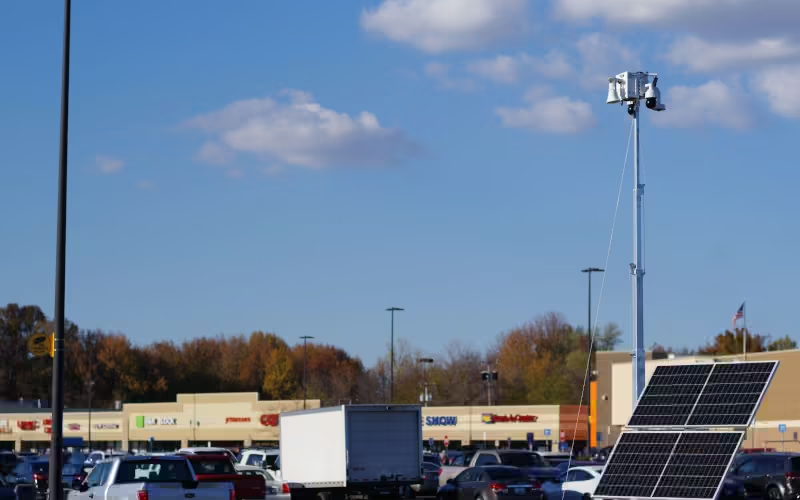
What good is it to have a parking lot security camera if the footage is low quality, blurry, or unusable?
Overcome Security Challenges with High-Resolution Cameras for Parking Lot Surveillance
Deploying business security surveillance cameras will help company leaders identify and solve problems, as well as protect customers and employees in the parking lot. However, there are some challenges to overcome when considering high-resolution cameras for clear parking lot surveillance. From hard-to-see spaces between vehicles to older architectural designs that allow people to lurk in the shadows behind columns, ramps, and walls, it’s imperative security plans assess and solve these issues.
One challenge that leaders must address is updating lines of sight in older parking structures. This pressing issue underscored what happened at Philadelphia International Airport, where a gunman fatally shot a police officer and wounded his partner in 2023. Since there are very few security cameras in place to monitor the activities in the various parking garages, it’s a sad, yet clear fact that vulnerabilities exist—that had devastating consequences.
“It’s a little bit shocking in a big city like Philadelphia that there’s no surveillance camera footage available,” Adjunct Criminology Professor at John Jay College of Criminal Justice Michael Alcazar told CBS News Philadelphia.
The retired New York Police Department detective said cameras are indispensable to protect parking lots.
“Surveillance cameras are number one,” Alcazar told the television station. “They’re there to help. It’s a good deterrent—and again with everything going on in the world right now, it's surprising they don’t have surveillance cameras.”
Unmonitored airport parking lots are not an issue isolated to passengers at PHL. People who park at Palm Beach International Airport in Palm Beach, Florida, or at Bradley International Airport in Windsor Locks, Connecticut, likely think parking lot security cameras keep an eye on their vehicles, yet investigative reporters discovered that both airfields lack security cameras in both the short- and long-term parking lots.
Why Parking Garages Are Harder to Cover Than Open Lots
An open lot is a sightline problem you can solve with height. A parking garage is a structural one. Columns, ramps, split levels, and low ceilings break every long sightline in the building, which means a garage needs many more camera positions than an equivalent square footage of open lot to reach the same coverage. Stairwells and elevator lobbies are the highest-risk spaces and the most frequently under-covered. Older structures built before surveillance was a design consideration are the hardest cases, and often the ones where retrofitting fixed cameras costs the most.
People Expect Effective Parking Lot Security
With the increase of security cameras in the United States (there were an estimated 85 million security cameras across the United States in 2021) people have come to expect there will be video footage if a crime occurs. The recordings help investigators track down criminals and serve as vital evidence for law enforcement.
“One of the first questions officers are asked by crime victims is about the existence of video cameras,” Chief and Director of Public Safety Laura Wilson told Stanford News. “In addition to the potential crime deterrence impact a parking lot surveillance camera can have, the Department of Public Safety anticipates being able to use footage from video cameras to investigate and solve crimes committed against those who live, work, and visit Stanford.”
While the majority of surveillance cameras provide retail-theft security and business analytics, technology and software improvements enhance proactive policing strategies. Access to 24-hour cameras, as well as facial recognition, specialized vehicle tracking, license plate recognition and drone programs, are proving to be vital tools for accountability. Investing in surveillance cameras with live video monitoring can deter crimes like car burglaries, break-ins, and porch thefts, and provides law enforcement with “more eyes on the ground.”
Many municipal and law enforcement leaders credit parking lot video surveillance footage from high-resolution cameras for reducing crime because it’s one of the best investigative tools for business-related criminal activity. And when business leaders work to integrate their security systems throughout a region, they can establish a broader community policing approach to security by pooling resources to:
- Share intelligence with each other and local law enforcement
- Create a network operations center backed by portable surveillance cameras
What Parking Lot Cameras Actually Need to Capture
From identifying potential threats and uncovering trends to collecting evidence and sharing information more broadly, investing in high-resolution parking lot cameras is a central component of effective security systems.
Video surveillance systems are central to two things: understanding specific incidents, and spotting the security trends across a business over time. After an organized retail theft or an attack on an employee happens, high-resolution parking lot cameras can provide asset protection leaders and local law enforcement concrete details, including:
- Visual Proof: Cameras capture incidents as they occur with remote video monitoring.
- Establish Timelines: Cameras can determine how events unfolded and the sequences of a person’s actions.
- Identify Details: Cameras can document people’s faces, clothing, and other useful information that describes suspects or victims.
- Reveal Vehicle Information: Parking lot cameras also capture vehicle makes and models, as well as license plates.
- Validates Eyewitness Accounts: Video recordings can substantiate or refute what a witness saw.
- Recreate Crime Scenes: If necessary, law enforcement can recreate the crime scene using video recordings.
- Track a Suspect’s Movements: Video surveillance can confirm alibis or track movements.
On an ongoing basis, video surveillance can help businesses develop a larger understanding of potential threats to their properties. Business leaders can also use this evidence to train future employees, influence asset protection policies, or even redirect their security efforts to better protect their employees and customers.
LVT Units and their proprietary platform provide state-of-the-art detection and AI-powered analytics capabilities. By fully integrating with a customer’s existing surveillance system, users can level up defenses that bolster overall security, deter bad actors, support investigations, and ultimately apprehend criminals.
Why Business Leaders Need to Prioritize Parking Lot Security
Most commercial parking lots and garages have cameras, but coverage is uneven and quality varies widely. A camera that records a parking lot at low resolution can tell you that something happened. Only a high-resolution camera, positioned correctly, can tell you who did it, what they drove, and which direction they left in, which is the difference between an incident report and an arrest.
Seinfeld built an entire 1991 episode, 'The Parking Garage', out of how badly a parking structure can go wrong: lost cars, no help, and a security guard involved by the end of it. The comedy holds up because the underlying frustration is real, and so is what happens in parking facilities when nobody is watching.
The foursome endured a modern-day Odyssey—the quest to find Kramer’s car in a multilevel mall parking garage. When nature eventually called, Jerry and George found themselves in the sights of a security guard, on the wrong side of the law, and facing public indecency charges.
The comedy of errors recounted in “The Parking Lot” delivered comedy gold in 1991. If producers wanted to tap asset protection professionals for a reboot, there are more dark comedic moments—and true crime stories—to mine for an entire season of parking lot episodes.
Helping shoppers find their parking spaces may not top the list of benefits of installing high-resolution parking lot security cameras for clear parking lot surveillance, but deterring and preventing criminal activity is. Petty crimes and misdemeanors, like public urination, may be annoying to shoppers, but business owners understand the “broken windows theory,” and how these seemingly insignificant issues can lead to much more serious and violent crimes.
LVT’s Parking Lot Cameras Prevent Theft
When the Community Action Services and Food Bank leaders needed to protect their community gardeners’ plots and harvests from thieves and late-night trespassers, they knew LVT’s high-resolution security cameras provided the solution. After deploying the 24/7 solution, the LVT Mobile Surveillance Trailer Units eliminated all instances of theft and trespassing in the gardens.
Another unintended benefit?
“It has also been fun to see how much has changed and grown,” Volunteer Coordinator and Community Garden Manager Hillary Whittaker said.

LVT’s Parking Lot Cameras Stop Crimes in Progress
Identifying criminals, or even their vehicles, makes stopping the crime much easier. For example, when thieves attempted to steal a moving truck, retailers used LVT’s video monitoring to send audio alerts while contacting law enforcement. Not only was the retailer able to detect the crime in progress, but they also provided officers with descriptions of the thieves, the truck, and the location.
Police officers stopped the vehicle and recovered more than $4,000 of merchandise.
LVT’s Parking Lot Cameras Safeguard All Industries
From apartment complexes to critical infrastructure, LVT’s high-resolution security cameras deter and defend businesses in every industry, and deliver a 62% reduction in high-risk crimes.
Enel Group invests in renewable energy sources, including hydroelectricity, solar, wind, and nuclear power. These sites, located mainly in remote areas, can be targets for theft, vandalism, trespassing, and equipment breaches.
The LVT Unit, with its high-resolution security camera, provides an efficient solution that reduces break-ins and trespassing incidents, and also reduces the company’s live security guard payroll.
“We needed the ability to deploy security in a timely manner and the stability of working with a valued partner,” said Phil Brophy, Enel’s Head of Security Services USA and Canada. “It’s not just a security solution. It’s an operations solution.”
Frequently Asked Questions About Parking Lot and Garage Cameras
Do parking lots have cameras?
Most commercial parking lots have some camera coverage, but far from complete coverage. Retail centers, hospitals, and campuses typically monitor entrances, exits, and the areas closest to the building, while the outer rows and the far corners are often uncovered. Coverage is a business decision, not a legal requirement, so it varies enormously between properties.
Are there cameras in parking garages?
Parking garages are usually monitored at the entry and exit lanes, the pay stations, the stairwells, and the elevator lobbies. The parking decks themselves are frequently the weakest coverage in the structure. Older garages are the hardest cases, because columns, ramps, and low ceilings create sightline blocks that fixed cameras cannot see past.
How far can parking lot cameras see?
Useful range depends on resolution and lens, not on how far the camera can technically see. As a working rule, a camera can detect that a person is present much further out than it can identify who that person is, and identification is what an investigation needs. A high-resolution camera on a raised mast covers far more usable ground than several low-resolution cameras mounted at building height.
How long do parking lots keep camera footage?
Retention varies by operator and by system. Many commercial properties keep 30 days, some keep as little as 7, and organizations with compliance obligations may keep considerably longer. If you need footage of an incident, request it as early as possible: in practice, footage is far more often lost to a retention window closing than to a camera failing.
What are the police cameras in parking lots?
The tall units with cameras, floodlights, and often a flashing blue light are mobile surveillance units. Some are operated by police departments, but many are deployed by the property owner and monitored privately, with footage shared with law enforcement when an incident occurs. They are designed to be seen: the visible deterrent is the point, and the recording is the backup.
Can businesses legally monitor their parking lots with cameras?
In the United States, businesses can generally record video in a parking lot they own or control, because there is no reasonable expectation of privacy in an open lot. Audio recording is governed separately and much more strictly, and rules vary by state. Signage requirements also vary.
LVT’s Parking Lot Cameras Protect Communities
When Utah County Emergency Management needed more eyes, in more places, for more time across the 2,144-square-mile area of Utah County, they chose LVT’s high-resolution security cameras to monitor parking lots for pop-up vaccine clinics, voting sites, and known criminal hotspots.
By providing around-the-clock surveillance, instant monitoring, and the ability to deploy LVT Units across the county quickly, “LVT fills the monitoring gap that we had for significantly less than 24/7 human surveillance,” Utah County Emergency Manager Lieutenant Peter Quittner said.
Our customers trust LVT's high-resolution cameras and mobile surveillance units to deter would-be criminals, defend their sites against bad actors, and help law enforcement investigate and prosecute crimes. The best parking lot security does not produce good footage of a crime. It prevents the crime from being attempted in the lot at all.
“Crooks seek the path of least resistance which is why an ounce of prevention is truly worth a pound of the cure,” said retired asset protection leader Mike Lamb about LVT. “The bad guys see it, get it, and ultimately fear it.”
Ready to learn more? Contact our team today for a demo.

%20(1).avif)
%20(1).avif)
