Remote Guarding Explained: People + Technology = Smarter Security
Remote guarding combines AI-powered security with trained human operators to monitor properties, identify suspicious activity, and respond to true incidents. When technology handles continuous detection and people execute judgment and escalation, companies extend their security coverage without breaking the bank. Mobile security units provide active deterrence and remote monitoring, helping organizations detect threats and intervene before an incident becomes an expensive problem.
When you picture security guards, you probably imagine someone physically standing on a property. Maybe they’re walking the perimeter, sitting inside a guard shack, checking gates, or making a dramatic flashlight sweep across a dark parking lot.
But what if your guard didn't have to be on-site to keep an eye on things?
With remote guarding, AI-powered cameras and trained off-site professionals work together to monitor activity and respond when something doesn't look right. It combines something technology does exceptionally well—watching lots of places at once—with something humans do exceptionally well: examining a situation and deciding the best course of action.
Protection Without the Physical Presence
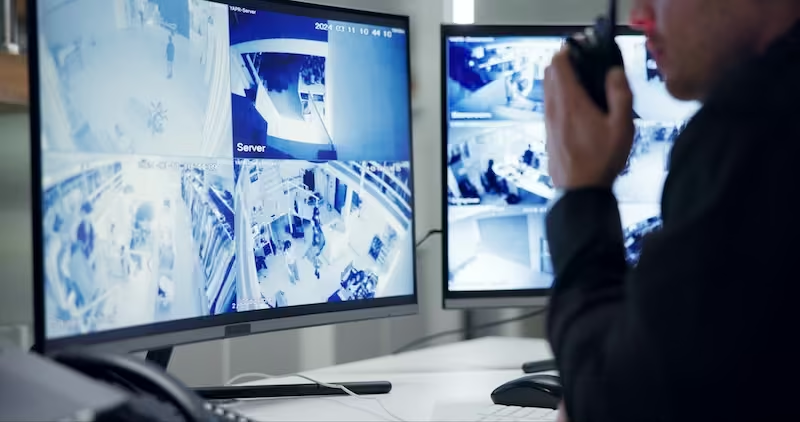
At its simplest, remote guarding uses security cameras and off-site monitoring professionals to protect a property without requiring a guard to physically stand at every location being watched. But that doesn't necessarily mean someone is staring at your camera feeds 24 hours a day. (After all, asking a person to stare at mostly uneventful footage for hours isn't a recipe for razor-sharp attention.)
Modern systems use analytics and AI-powered detection to identify activity that meets certain criteria. AI doesn't mind boring. It continuously analyzes camera feeds, looking for specific activity based on the rules established for the property.
Instead of expecting a human operator to notice the one important event hidden inside hours of absolutely nothing, AI surfaces the moments worth investigating, sending an alert and corresponding video to a trained operator for review.
The Human Element
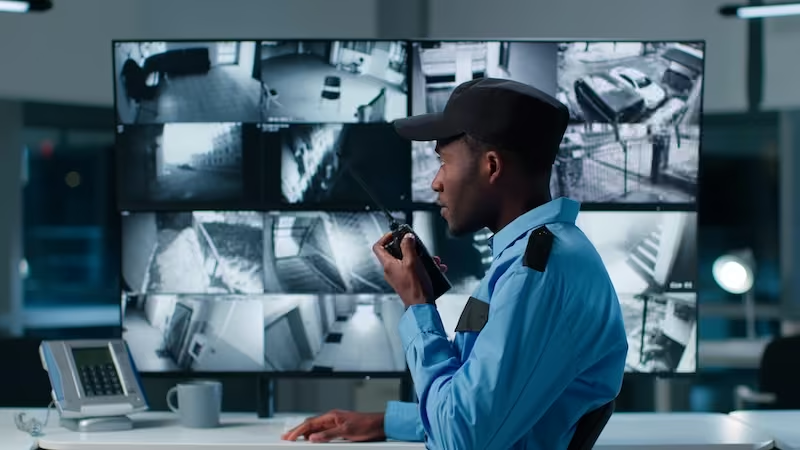
Once an alert reaches an operator, the operator reviews the live video and determines whether the activity appears legitimate or suspicious. Depending on the provider, property, and established response protocol, remote guarding services may then take additional action like notifying a designated employee, contacting law enforcement, or using on-site audio equipment to address the person directly.
Imagine someone sneaks onto a construction site after midnight. He thinks he’s alone when a voice suddenly booms from a speaker: “You in the blue jacket. This property is under surveillance. Leave immediately.”
That's a pretty good way to ruin dubious evening plans. More importantly, intervention can happen before the person has time to steal equipment or damage property.
Is Remote Guarding the Same as a Virtual Security Guard?
A virtual security guard and a remote human guard aren't necessarily the same thing. For instance, LVT (LiveView Technologies) offers systems that detect, analyze, and respond to suspicious activity using cameras, AI-powered analytics, alerts, lighting, speakers, and automated deterrence. A mobile security unit provides these capabilities in locations where permanent security infrastructure may be difficult or expensive to install.
In other words, the technology can perform many of the repetitive tasks traditionally associated with guarding a property. It watches, detects, alerts, and activates deterrents.
But there are situations where adding a human operator to that technology makes sense. The technology does the heavy lifting, while a remote operator steps in when human judgment or escalation is needed.
A “Tag-Team” Approach
The AI-driven, virtual security guard stays on watch continuously. It doesn't need lunch, get bored, or start scrolling through its phone halfway through a quiet shift. When it detects something worth investigating, it “tags in” a human operator.
Operators don't have to spend eight hours watching nothing happen. Instead of drowning in alert fatigue, the system helps focus their attention on the handful of events that deserve it. The entire approach becomes more time- and cost-efficient as technology handles scale and people handle nuance.
But don’t misunderstand. This doesn’t mean onsite security guards suddenly have no place in modern security strategy. There are plenty of jobs technology can't physically perform. For example, a camera can't physically walk someone to their vehicle. It can't double-check a door to make sure it's actually locked or help a confused visitor find the correct entrance.
Mobile Security Makes Remote Guarding Even More Flexible
Of course, cameras can't monitor a location if there aren't any cameras there. That's easy enough inside a permanent building. It gets trickier when you're protecting a construction site, vacant lot, temporary storage area, remote facility, or sprawling parking lot. Running power and internet to those areas can be expensive, slow, or downright impossible.
Mobile security units are solar-powered and use cellular connectivity, allowing businesses to establish video coverage without waiting for permanent power or wired infrastructure. They can also be easily relocated as security needs change.
After all, seeing a threat is useful; getting the person to leave before anything happens is much better.
Traditional surveillance cameras have historically been great witnesses. They record what happened, preserve evidence, and help investigators piece together an incident afterward. But watching someone steal your stuff in glorious HD isn't exactly the outcome anyone is hoping for.
Mobile surveillance technology supports visual and audible deterrence. Monitoring partners access camera feeds and, depending on the setup, use lights or prerecorded audio to deter bad actors. Security moves from passively documenting an incident to actively preventing it.
Take Your Security Team to the Next Level
Ultimately, remote guarding is about extending what your security team can see and do. A person can only look in one direction at a time. A physical guard can only stand in one place. And nobody can stay perfectly attentive to dozens of uneventful camera feeds for hours on end.
Technology doesn't have those limitations. But technology doesn't eliminate the value of human judgment either.
That's why LVT's virtual security guard capabilities and professional remote monitoring complement one another so well. AI-powered detection and deterrence provide an always-on first layer, while trained operators can step in when an event needs human attention.
The result is more context, better coverage, and faster response times.
Contact LVT for a free demo to see how the dynamic duo of intelligent mobile security and professional monitoring can work together to protect your property.