LVT vs. Flock Safety: Which Mobile Security Unit Fits Your Site in 2026?
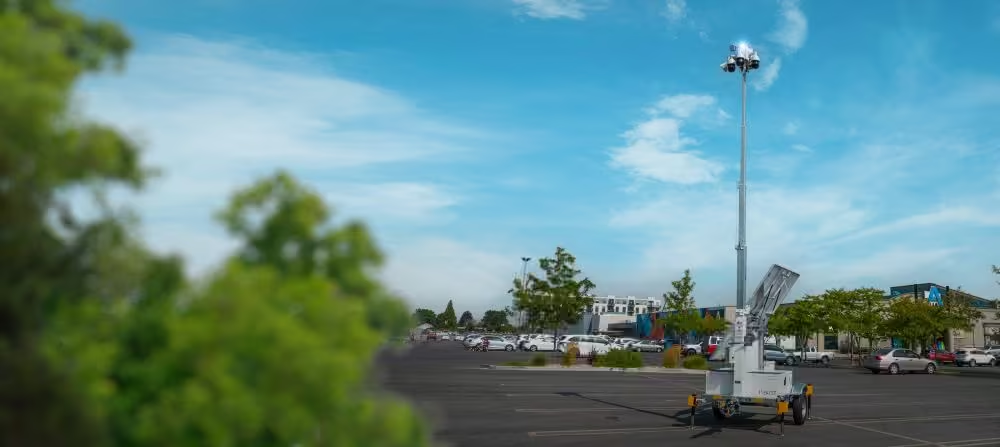
A comprehensive side-by-side comparison of LVT and Flock Safety mobile security units, highlighting how each provider serves different strategic needs.
Comparison based on data publicly available as of January 2026.
Short answer:
- For maximum uptime: LVT is the clear leader, engineered with cellular auto-failover, guaranteed satellite backup, integrated fuel cell power, and cold-weather charging for reliable use in remote or harsh environments.
- For max optical zoom: Flock Safety has a slight edge with 41× PTZ zoom versus LVT's 32×.
- For remote access: Both offer cloud VMS, remote video access, IR PTZ, forensic AI search, and 30‑day onboard storage.
- For data privacy: LVT operates a proprietary, private cellular network while Flock Safety uses standard commercial networks.
Who each is for:
- LVT is best for: Resilience and proactive security at remote, cold, or unstable-network sites that require layered, AI-driven deterrence.
- Flock Safety is best for: Long-range optical surveillance where maximum PTZ zoom is the decisive factor and standard IR/cloud VMS coverage is sufficient.
Third-Party Analysis on Mobile Surveillance
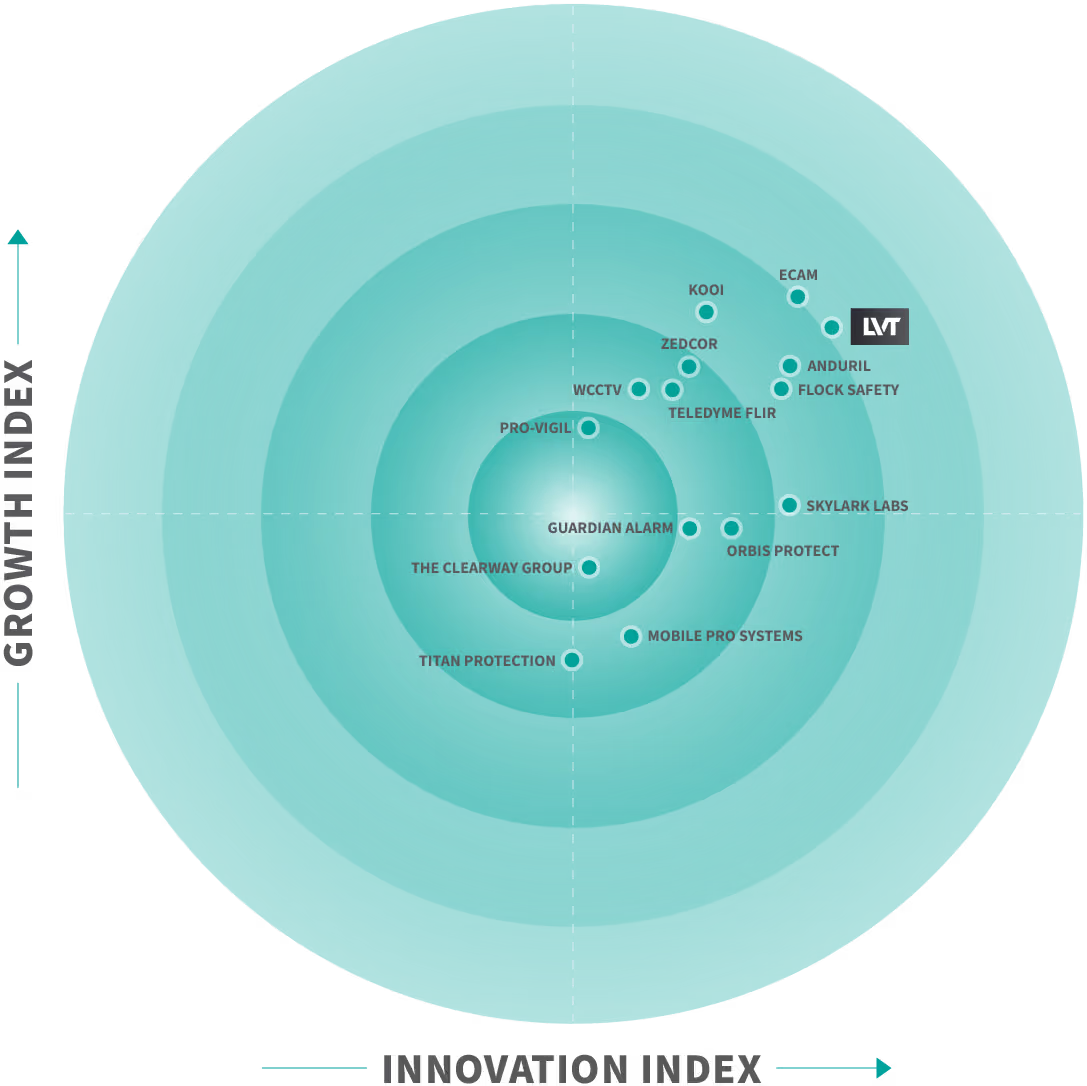
Frost & Sullivan, an independent company that specializes in market research and analysis, named LVT as a leader in innovation in the mobile surveillance industry. Frost & Sullivan’s work is focused exclusively on identifying the growth opportunities of the future and evaluating companies that are best positioned to take advantage of them. Read the full report to find out why LVT is the best-positioned provider to scale operations and meet your evolving security needs.
At‑a‑Glance: Key Differences
- Connectivity: LVT adds cellular auto‑failover, satellite connectivity, and guaranteed backhaul bandwidth; Flock lists “No” for these three.
- Optics: Flock PTZ max zoom 41x vs 32x for LVT. Both have IR PTZ; only LVT has thermal PTZ and fixed thermal cameras.
- Deterrence: Both support talk down; only LVT lists AI auto‑deterrent talk down, remote multi‑color strobes, floodlight, and pan‑tilt spotlight.
- Operations: Both are cloud VMS and remote video accessible from any device; neither requires a dedicated PC/VM for firmware.
- Mobility and Power: LVT is movable by customer; backup generator (fuel cell) on LVT; solar 880 W (LVT) versus up to 880 W (Flock); batteries 900 AH @12 V (LVT) versus up to 600 AH (Flock).
- Environment: Low‑temp (−40 °F) charging supported by LVT; LVT temp range −22 to +149 °F (Flock not specified).
- Logistics: Time to delivery: LVT 5–7 days vs Flock 14+ days. Damage protection: Included with LVT, no on Flock.
- Data Privacy: LVT utilizes a private cellular network, which means that your data never touches a public network. Customers control which features and data are shared. Flock does not provide a private network.
Full Spec Comparison
Connectivity and Uptime
LVT is the safer bet for unstable networks and remote sites.
While both units offer a standard cellular plan, LVT ensures a more resilient connection with cellular auto-failover, satellite connectivity, and guaranteed backhaul bandwidth. Flock Safety does not currently list any of these features.
- Cellular plan: Flock Yes | LVT Yes
- Cellular auto‑failover: Flock No | LVT Yes
- Satellite connectivity: Flock No | LVT Yes
- Guaranteed backhaul bandwidth: Flock No | LVT Yes
- Private network protection: Flock No | LVT Yes
Why it matters: Reduces blind spots during carrier outages, disasters, or congested events; satellite and guaranteed backhaul are decisive in remote construction, utilities, and critical infrastructure.
Deterrence and On‑Scene Response
Both units offer live talk down capability, but LVT layers multiple proactive deterrents to escalate response before human intervention is required. This includes: AI auto-deterrent talk down, remote-controlled multi-color strobes, a powerful floodlight, and a pan-tilt spotlight.
- Talk‑down: Both Yes
- AI auto‑deterrent talk down:Flock No | LVT Yes
- Strobes: Basic blue (Both Yes); Remote multi‑color (Flock No | LVT Yes)
- Lighting: Floodlight (Flock No | LVT Yes); Pan‑tilt spotlight (Flock No | LVT Yes)
Why it matters: Automated, dynamic deterrence shortens response time and is key to preventing loss before a human dispatcher even needs to intervene.
Deployment, Mobility, and Power
LVT is designed for true self-sufficiency and rapid redeployment. LVT Units can be moved by the customer, reducing downtime and service costs for site changes. Crucially for extreme weather or remote sites, only LVT supports low-temp (−40 °F) charging and includes a fuel cell backup generator.
- Movable by customer: Flock No | LVT Yes
- Battery capacity: Flock 400 Ah @24 V | LVT 425 Ah @24 V
- Solar generation: Flock 800 W | LVT 880 W
- Backup generator: Flock None | LVT fuel cell
- Low‑temp (−40 °F) charging: Flock No | LVT Yes
- Operating temp range: Flock Not specified | LVT −22 to +149 °F
- Weight: Flock Not specified | LVT 1900 lb
Why it matters: More solar/generator redundancy means fewer truck rolls; customer‑movable units reduce downtime and service costs.
VMS, Storage, and Software
When it comes to the core functionality—viewing, managing, and storing video—both LVT and Flock Safety offer excellent, modern solutions.
- Cloud‑based VMS: Both yes
- Accessible from any device: Both yes
- Remote video access: Both yes
- Onboard storage: 30 days per trailer (Both)
- Dedicated PC/VM needed for ops/firmware: Both no
- Forensic AI search: Both yes
- Latest software update: 2025 (Both)
Why it matters: Both systems provide cloud-based VMS that is accessible from any device. Both also include 30 days of onboard storage and offer powerful forensic AI-search capabilities to quickly filter video and accelerate investigations.
Delivery, Protection, and Fees
LVT leads on deployment speed and peace of mind coverage. LVT Units can be secured on your site in 5–7 days, significantly faster than Flock Safety’s typical 14+ day delivery window. LVT includes damage protection in the contract, a feature not offered by Flock.
- Time to delivery: Flock 14+ days | LVT 5–7 days
- Damage protection: Flock No | LVT Included
Why it matters: Faster time‑to‑secure reduces risk windows; coverage for damage can simplify procurement.
Data Privacy
While both companies assert that the customer owns their video data and neither uses facial recognition, their underlying network and sharing architectures differ significantly. LVT uses a proprietary, private cellular network. This means video data and network traffic never route over the public internet, offering an additional layer of security and integrity. Flock uses standard commercial cellular networks.
- Data Ownership Stays with Customer: LVT Yes | Flock Yes
- Uses Proprietary Private Cellular Network: LVT Yes | Flock No
- Data Leaves Private Ecosystem (via public network): LVT No (Private Network) | Flock Yes (Standard LTE/internet)
- Uses Facial Recognition Technology: LVT No | Flock No
Buyer’s Guide: Choosing Between LVT and Flock
- Pick LVT if: Your site demands resilience (weak network, extreme cold) or requires proactive security (thermal vision, AI deterrence, multi-color strobes) and rapid, flexible deployment.
- Pick Flock Safety if: Your top priority is maximum optical identification distance (41× zoom) and your site is in a stable environment with consistent network access.
Decision matrix:
- Unreliable networks/remote sites: LVT (satellite, auto-failover, and backhaul)
- Extreme long-range zoom: Flock (41x PTZ for maximum standoff distance)
- Extreme weather resilience: LVT (-40°F charging, integrated backup fuel cell)
- Active, layered deterrence: LVT (AI talk down, multi-color strobes, pan-tilt spotlight)
- Fastest time to secure: LVT (5–7 days delivery)
Real‑World Use Cases
- Construction and laydown yards: Where power gaps and after-hours theft are common → LVT (power redundancy, AI deterrence, thermal vision).
- Utilities and critical infrastructure: Where guaranteed uptime and compliance are non-negotiable → LVT (guaranteed backhaul, satellite redundancy).
- Retail parking or car lots: Where long-range vehicle tracking is key → Flock (zoom advantage); use LVT if proactive deterrence or thermal is needed.
- Events and pop‑up sites: Requiring rapid deployment and frequent site adjustments → LVT (5–7 day delivery, customer-movable unit).
FAQs
- Do mobile security units work without internet? Yes—LVT supports satellite and cellular auto‑failover.
- Which unit has better optical zoom? Flock at 41x PTZ versus LVT’s 32x.
- Which supports thermal cameras? LVT lists both thermal PTZ and fixed thermal; Flock lists no thermal.
- Can I move the trailer without a vendor visit? LVT Yes; Flock No.
- What about extreme cold? LVT supports −40 °F charging and includes a backup fuel cell generator; these are not listed for Flock.
- Is cloud VMS supported? Yes on both; both are accessible from any device and don’t require a dedicated PC/VM.
- How fast can I get one delivered? LVT 5–7 days versus Flock 14+ days.
- Is damage protection included? LVT Included; Flock No.

.avif)