Is This Thing On?: Why The Most Reliable Security Cameras “Uptime” All The Time
%20(1)%20(7)%20(1).avif)
Security system uptime is one of the most important measures of reliability because even a brief outage can create a window of vulnerability. Reliable security cameras combine dependable power, connectivity, system-health monitoring, and responsive support to help businesses maintain coverage around the clock. By making uptime a priority when choosing a security provider, organizations can reduce blind spots and have confidence their cameras will be working when they need them most.
Imagine spending thousands of dollars on a sophisticated security system. You’ve got cameras covering every important area, real-time alerts, AI-powered analytics, remote monitoring, the whole shebang. Then someone breaks into your property. No problem. You have the cameras!
Except when you pull up the footage, you discover the camera covering that particular area went offline two hours earlier. Oops.
We spend a lot of time talking about camera resolution, artificial intelligence, analytics, night vision, and other flashy features. But none of those things matter if the camera isn’t actually online.
Security system uptime measures how consistently your technology remains operational and connected. And when you’re choosing reliable security cameras, it may be one of the most important numbers you’re not asking about.
Why High Availability Matters in Physical Security
Thieves don’t check your maintenance schedule. Vandals don’t come back after the network reconnects. Someone trespassing on your property isn’t going to politely wait while your camera reboots. A camera going offline for a few minutes might sound insignificant. But if an incident happens during those few minutes, that small outage suddenly becomes a very big (and sad and expensive) deal.
When evaluating security systems, continuous availability is the key benchmark. Over the course of a full year, even brief periods of scheduled maintenance or minor network drops accumulate. The closer a system gets to true 24/7 uptime, the smaller those potential windows of vulnerability become.
The closer a security system gets to continuous availability, the smaller those windows of vulnerability become. Smart business owners ask vendors about uptime rather than assume a system will simply work whenever they need it, because (unlike death and taxes) 24/7 coverage is not always a given.
Downtime Creates More Than a Blind Spot
The obvious problem with an offline camera is lost visibility. Suppose one of your outdoor security cameras loses connectivity overnight and someone steals equipment. Without footage, identifying the person or vehicle becomes harder. Your security team has less information to work with, and law enforcement may have less evidence for an investigation.
There isn't one single cause of security system downtime. Power failures, dropped internet connections, damaged equipment, hardware malfunctions, buggy software updates, unstable cellular connectivity, severe weather, and even good old-fashioned human error can knock the best system flat.
The question isn't whether technology will ever encounter a problem (it will!) The real question is what happens next?
- Does anyone know if the camera is offline?
- How quickly is the problem identified?
- Can it be diagnosed remotely?
- How long does it take to restore service?
Questions like these often reveal the reliability of a security solution more than a long list of fancy features.
Don't Just Monitor the Property. Monitor the Cameras.
A good security system watches your property; a great one also watches itself. Modern security platforms can continuously monitor the health of connected equipment, helping teams identify issues with cameras, batteries, network connections, or other components…which is a lifesaver because manual equipment checks aren't always realistic, especially at scale.
Imagine a business operating hundreds of cameras across dozens of properties. Nobody wants an employee driving from location to location asking, “Is this one still working?”
Automated system-health monitoring not only saves paid work hours, but also identifies problems much faster. When something goes wrong, support teams receive an alert, investigate the issue, and begin working toward a solution, shifting maintenance from reactive to proactive.
Reliability becomes especially important when security is deployed in places without traditional infrastructure. Construction sites, remote equipment yards, overflow lots, vacant properties, and temporary storage facilities may not have convenient access to electricity, let alone internet.
If you're deploying mobile security cameras miles away from the nearest office, you don't want someone constantly driving out to check whether it's still connected.
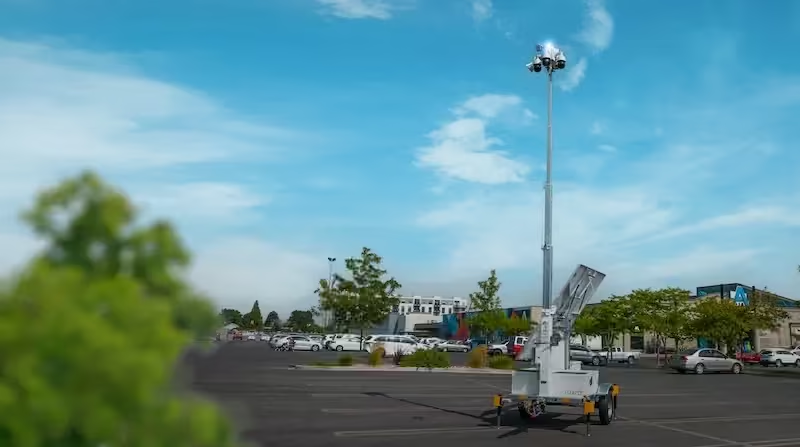
Well-designed mobile surveillance units combine solar power, battery storage, cellular connectivity, and remote system monitoring to provide security without relying on permanent onsite infrastructure.
That independence gives businesses tremendous flexibility, but only if the equipment is designed to remain operational in real-world conditions.
Solar Power Needs a Backup Plan Too
Solar-powered security is incredibly useful because it allows businesses to deploy surveillance without trenching power lines or waiting for electrical infrastructure. But, alas, the sun eventually goes down. Clouds happen too.
A strong solar-powered system therefore needs more than a solar panel. It needs sufficient battery capacity and intelligent power management to keep equipment operating when sunlight isn't available, especially during winter, extended storms, or periods of heavy cloud cover.
When evaluating mobile surveillance trailers, businesses should ask how the system handles those conditions. How long can it operate without direct sunlight? How is battery health monitored? What happens when power levels fall unexpectedly?
“Solar powered” and “reliable” aren't automatically the same thing. Look beyond hardware specifications and ask what happens after installation.
Reliable Security Is Boring—and That's Good!
You want your cameras to turn on, stay connected, record what they're supposed to record, and be available when someone needs them. Every day, every night, during storms, during holidays, when the building is empty, and when nobody is thinking about security at all.
Reliable security cameras should quietly do their jobs in the background without forcing your team to constantly wonder if they’re still on. Feature comparisons are tempting (Camera A has this resolution. Camera B has this type of analytics. Camera C has a cool dashboard..) But reliability determines whether you can actually use any of them.
The smartest AI analytics in the world can't analyze footage that isn't being captured. The clearest camera can't record a thief while it's offline. Remote monitoring can't protect a site it can't see. Before choosing a security provider, ask some less exciting—but much more important—questions like:
- What is your actual uptime?
- How do you monitor equipment health?
- How quickly do you know when something fails?
- What redundancies are built into the system?
- How do you handle power and connectivity interruptions?
- What happens when something breaks?
The answers will tell you whether you're buying security technology or simply buying cameras. Remember, boring is beautiful!
The Best Camera Stays On
Security is fundamentally about being ready for something you hope never happens. That makes reliability especially important.
You don't know when someone will climb the fence. You don't know when a truck will enter a restricted area. And you certainly don't know when someone will decide tonight is the night to steal thousands of dollars in equipment.
Whether you're protecting a retail parking lot with outdoor security cameras, securing a remote construction project with mobile surveillance trailers, or deploying mobile surveillance units across dozens of properties, uptime should be part of the conversation from the start.
Learn how businesses like yours maintain dependable security coverage 24/7 by contacting LVT for a free demo today!
%20(1).avif)
%20(1).avif)