Which Industries Benefit Most from Mobile Surveillance Units?
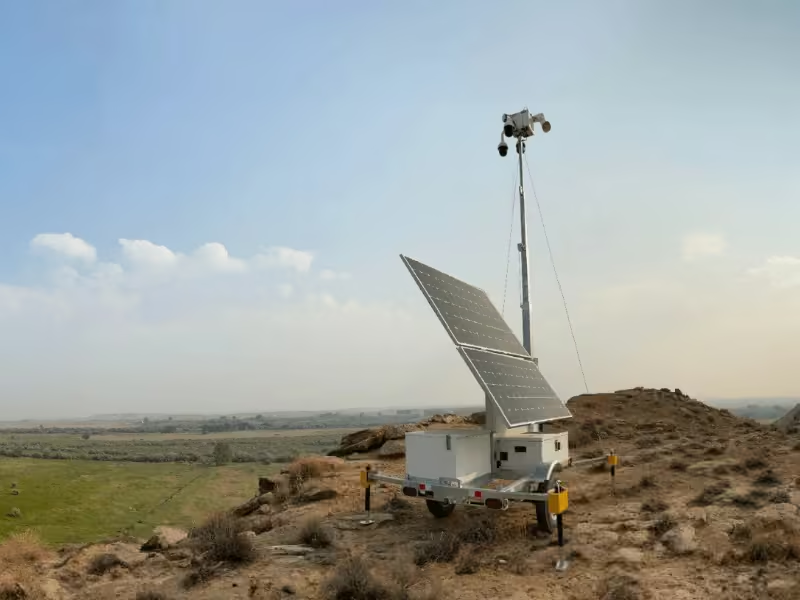
From construction to campuses, mobile surveillance units deliver flexible security coverage where changing needs make fixed systems less practical.
“It would have been so much easier if I had just bought the right tool.”
I’ve heard this phrase more times than I can count over the last decade.
My husband is able to take on just about any home repair project with great results, but he often attempts to use whatever tools he has on hand instead of spending on a tool specifically built for the job. Like clockwork, he goes into the project assuring me that his regular drill bits (or smaller saw, etc.) will be fine, only to report back hours later that the project took so much longer than it needed to, he’d burned through way too many bits, and he’s unhappy with an uneven line. Which brings him to the oft-repeated line: “It would have been so much easier if I had just bought the right tool.”
While operating on a much larger scale with more significant consequences, the security industry isn’t so different from a home improvement project: Using the right tool for the job can make all the difference.
Take mobile surveillance units, for example. Each LVT® Unit (the mobile surveillance units from LiveView Technologies) is on wheels, takes up less space than a parking space, and can be equipped with:
- Up to three cameras
- Solar panels and backup power sources
- Cellular connection
- Local and cloud storage
- AI-enhanced deterrence features, from custom talk down messages to targeted spotlights
These units provide flexibility, require no pre-existing infrastructure, and scale easily—but these advantages mean more to some industries than others. Mobility matters most when security needs aren’t static.
The industries that benefit most from mobile surveillance units tend to share certain characteristics:
- They have large outdoor areas to monitor.
- Their security needs change frequently.
- They operate in remote locations or with little infrastructure.
- They need fast deployment with little disruption to day-to-day operations.
Five industries in particular stand out as especially strong fits for mobile surveillance units. Each faces a different combination of these challenges, but all can benefit from the flexibility, scalability, and rapid deployment that mobile surveillance provides.
Construction
Security challenges:
- Limited infrastructure
- Constantly changing
- Valuable equipment and materials
Most construction projects begin with a blank slate or require a complete overhaul of the existing structure. Without readily accessible infrastructure, many traditional security measures become impractical at best. Add to that the fact that construction sites are, by their very nature, constantly changing: Site layouts, access points, and high-value target areas all shift as projects take shape.
Materials and equipment used at these sites are easy to resell, making for tempting targets. Machinery on the jobsite can be difficult to secure, and smaller materials can be difficult to track once they’re taken. But the cost of theft or vandalism goes far beyond the materials themselves, as every item taken or damaged results in delayed timelines and unhappy customers.
Mobile surveillance units meet this set of challenges head-on.
No infrastructure available? None is required. LVT Units are powered by solar panels and connected via cellular connection instead of relying on Wi-Fi.
Changing landscape and sightlines? These construction site security cameras can be repositioned easily as the jobsite changes.
Events and Entertainment
Security challenges:
- Security needs are temporary
- Rapid deployment matters
- Large outdoor footprints to cover
Concerts, festivals, fairs, sporting events—while these may seem different at first glance, all of these events involve large crowds and temporary security needs.
While events may last anywhere from a day to a week, large crowds and constantly changing activity can make comprehensive security particularly challenging. These short timelines also call for security measures that can come and go as easily as the crowds themselves.
Mobile surveillance units offer rapid deployment and leave no trace behind once they’re relocated. These units are also easy to scale, making coverage for larger events that much easier to navigate.
Security needs can also change throughout an event. Before attendees arrive, units can monitor entrances, parking areas, and staging areas. During the event, they can provide visibility around crowds and perimeters. Afterward, they can help monitor equipment and facilities as crowds disperse.
In addition to rapid deployment and easy relocation, mobile units offer another layer to event security: enhanced situational awareness for crowd management and emergency responses. Pole-mounted security cameras can give a big-picture perspective, providing context for those on the scene. After an incident occurs, AI-enhanced forensic search features can also help security teams quickly locate relevant footage using keywords, giving them another tool for understanding what happened.
Critical Infrastructure and Utilities
Security challenges:
- Remote locations without infrastructure
- Assets spread across large areas
- High consequences of unauthorized access
While we don’t usually give much thought to it, critical infrastructure is the backbone of modern society. Power plants, pipelines, water treatment facilities—these often operate outside of city limits but affect entire communities immediately if they fail.
Their remote locations serve a purpose but can also make security solutions significantly more challenging. More challenging, that is, unless you have a security solution that requires no infrastructure to get up and running.
Mobile surveillance units provide visible deterrence and real-time alerts without requiring extensive new infrastructure. For critical infrastructure, physical security isn’t solely about protecting equipment. Unauthorized access, vandalism, or other disruptions can have consequences far beyond the individual site.
Coverage can also adjust as critical infrastructure construction and maintenance projects arise. A unit can be deployed around a work area, then relocated when the work moves elsewhere.
Logistics, Warehousing, and Distribution
Security challenges:
- High-value inventory and cargo
- Constant traffic and activity
- Large outdoor areas with shifting needs
This category covers a wide range of facilities, from warehouses and distribution centers to large storage and loading areas.
Loading yards, truck lots, employee parking, storage areas, and facility perimeters can extend beyond fixed camera coverage provided by commercial video surveillance systems. Storage yards can be particularly difficult to monitor because vehicle and inventory locations change constantly, creating new blind spots as operations shift.
Mobile surveillance units can adjust as quickly as the layouts themselves and address temporary blind spots. They also provide a visible signal that this facility prioritizes security, deterring wrongdoers.
The same challenges extend to retail properties, where parking lots, loading areas, and other outdoor spaces can fall outside the coverage of fixed security cameras. Mobile surveillance units can provide flexible retail security coverage where and when it’s needed, whether that’s responding to a temporary security concern, monitoring a large parking area, or supplementing an existing system.
While most of these logistics and distribution locations require several layers of security, strong perimeter security, like industrial video surveillance, serves as the first line of defense. Mobile units can extend visibility as needed, layering onto existing systems seamlessly.
Educational Institutions and Campuses
Security challenges:
- Geographically large areas with varying needs
- Semester and event changes
- Temporary high-risk areas
Educational campuses can have remarkably varied security needs across a single property.
While often covering large geographic areas, campus security has to extend to events, construction zones, parking areas, and fluctuating student populations. Maintaining comprehensive coverage across all these areas can be challenging, particularly when security needs change throughout the year.
Mobile surveillance units can add to and expand campus safety and security efforts. These units can help cover parking areas, walkways, construction zones, and more. Campus security needs can change almost as quickly as the academic calendar: A parking area may need additional coverage during an event, a construction zone may require monitoring during a renovation, or an athletic facility may need expanded surveillance on game day.
Rather than installing permanent cameras for every temporary need, LVT Units can be redeployed as priorities change, helping campuses maximize their security coverage without adding permanent infrastructure for short-term needs.
Where Mobility Makes the Difference
The best candidates for mobile surveillance aren’t necessarily the industries with the most valuable assets—they’re the ones where security needs are difficult to predict, difficult to reach, or likely to change. From construction sites that change with each phase of the build to campuses that shift with the academic calendar, mobile surveillance units give organizations the ability to put security where it’s needed when it’s needed.
With rapid deployment, flexible positioning, and the ability to operate without traditional wired infrastructure, LVT Units give organizations a scalable way to respond to changing security demands.
To see this flexible solution in action for yourself, contact LVT for a demonstration today.

.avif)

