Mobile Surveillance Trailers Compared: LVT vs. Mobile Pro Systems

This guide compares LiveView Technologies (LVT) and Mobile Pro Systems, highlighting how LVT offers an integrated hardware-and-software solution while Mobile Pro Systems acts as an open edge extension for existing security stacks.
Mobile surveillance trailers have become a standard tool for securing construction sites, parking lots, events, and remote infrastructure without permanent wiring. LiveView Technologies (LVT) and Mobile Pro Systems are two established providers in this space, each taking a different approach to power architecture, integration, and deployment. This guide compares the two based on publicly available product information from each company.
Specifications below are drawn from LVT's and Mobile Pro Systems' public websites as of publication. Both companies offer multiple configurations and update their lineups regularly, so we recommend confirming current specs directly with each vendor before making a purchasing decision.
Company Overview
Hardware Lineup
Mobile Pro Systems positions its trailers as an "edge" extension of a customer's existing security stack—cameras, analytics, and video management software the customer already uses—rather than a fully self-contained platform. LVT ships as an integrated hardware-plus-software solution with the option to integrate with certain VMS, LPR, and monitoring softwares.
Power and Deployment
Detection, Deterrence, and Monitoring
Where the Two Differ Most
- Product tiering: Mobile Pro Systems offers a clear full-size vs. compact split (Commander 3400 vs. Falcon 3100) aimed at different deployment durations and site sizes.
What to Ask Any Mobile Security Vendor
Regardless of which company you're evaluating, a few questions are worth asking directly:
- What does detection accuracy look like in real-world conditions (weather, low light, occlusion)?
- What's the actual cost over a full contract term—unit price, monitoring fees, and any per-incident response charges?
- Who handles live monitoring and escalation: in-house staff, a third-party monitoring center, or software alone?
- What's the typical timeline from order to a fully deployed, operational unit?
- Does the trailer work with the cameras, VMS, and analytics you already use, or does it require replacing your existing stack?
Here’s How LVT Would Answer
- What does detection accuracy look like in real-world conditions (weather, low light, occlusion)?
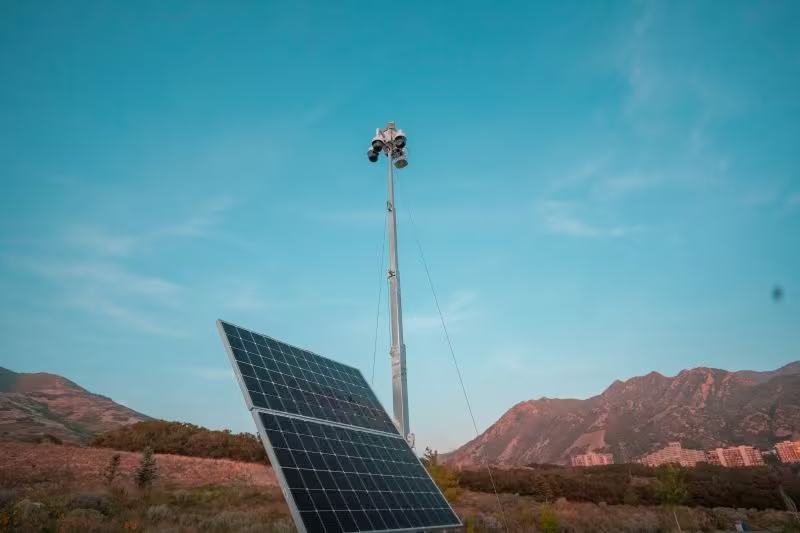
- LVT’s thermal imaging camera works in all weather conditions and detects heat signatures from a distance, which allows for accurate threat detection, even in total darkness.
- LVT Units hold up in high winds and extreme weather. See evidence from Hurricane Ida.
- Another example of the LVT Platform detecting in zero visibility weather.
- What's the actual cost over a full contract term—unit price, monitoring fees, and any per-incident response charges?
- The answer to this question depends on your specific site. LVT teams work with each individual site to create a custom plan to meet your security needs and secure any blind spots. Our goal is to work as partners to create a safer and more secure world starting with your location. Visit LVT’s pricing and packaging page for more details.
- Who handles live monitoring and escalation: in-house staff, a third-party monitoring center, or software alone?
- LVT leverages professional third-party monitoring to respond to LVT Unit alerts in real time. Users that you authorize can access your live video surveillance feeds at any time, from anywhere, but our trusted partners from central stations can do it for you. Our advanced surveillance software will alert our teams of security professionals when activity is detected on your property. From there, they will follow set procedures which could include:
- Deterring trespassers by talking through the on-unit speaker
- Contacting you and telling you exactly what is happening
- Calling law enforcement
Learn more about LVT’s monitoring packages and find the best solution for your business.
- What's the typical timeline from order to a fully deployed, operational unit?
- This answer depends on several factors: what type of unit, where it is going, what the availability is in the area, and more. We aim to have our units deployed and set up in days, not weeks or months.
- Does the trailer work with the cameras, VMS, and analytics you already use, or does it require replacing your existing stack?
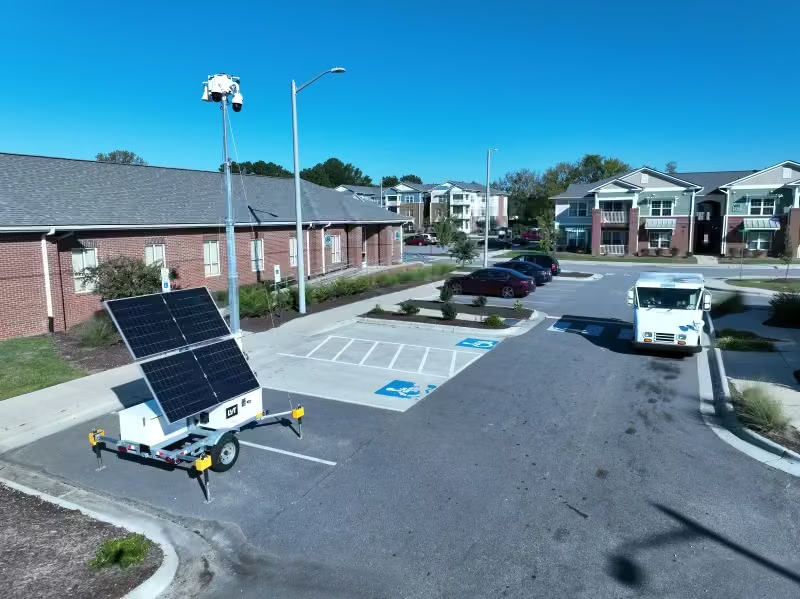
- LVT’s trailers ship with their own proprietary camera hardware built into the unit, so you cannot use existing cameras. LVT does have direct integrations for VMS/software layers. They’ve built integrations for various third-party VMS providers and offer an open API so customers can access their data using whatever software they prefer. LVT supports live remote monitoring through its own platform, and many customers integrate with third-party monitoring services or internal security teams rather than being locked into LVT's monitoring only.
If you'd like to learn more about LVT’s product offerings and get a quote for your specific property, reach out to our team.
%20(1)%20(5)%20(1).avif)
