Mobile Surveillance Trailers Compared: LVT vs. RAD Security
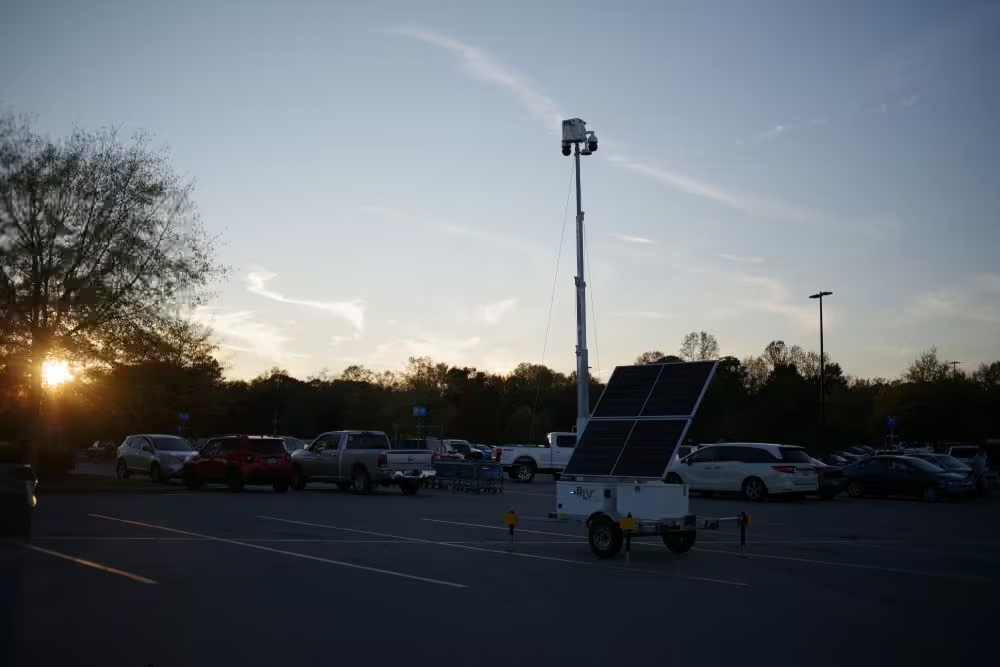
This guide compares LiveView Technologies (LVT) and RAD Security across hardware, AI detection, power, and deployment models. While both offer solar-powered mobile units with automated deterrence, LVT uses a direct/reseller model with custom setups, whereas RAD relies on dealer networks with structured product tiers.
Choosing a mobile security solution means comparing a growing list of options, each with its own approach to solar power, AI detection, remote deterrence, and more. Two companies operating in this space are LiveView Technologies (LVT) and RAD Security, the security-hardware brand of Robotic Assistance Devices (RAD), a subsidiary of Artificial Intelligence Technology Solutions (AITX). This guide lays out how the two compare on hardware, detection capability, and deployment model, based on each company's publicly available product information.
Specifications and features below are drawn from LVT's and RAD Security's public websites and press materials as of publication. Both companies update their lineups regularly, so we recommend confirming current specs and pricing directly with each vendor before making a purchasing decision.
Company Overview
Both LVT and RAD Security were founded over a decade ago and their experience shows through in their top quality products. They are strong competitors in the mobile security market and have comparable offerings with important key differences.
Hardware Lineup
Both companies build their offerings around a solar-powered mobile trailer as the core product, with additional fixed and access-control hardware around it.
Detection and Deterrence
Both companies offer AI-based detection paired with automated deterrence rather than relying solely on recorded footage.
Power and Deployment
Where the Two Differ Most
- Sales model: LVT sells and leases directly as well as through resellers. RAD Security leans more heavily on a dealer and systems-integrator network, which means pricing and support can vary more by region and installer.
- Product tiering: RAD Security publicly segments its RIO line into three price/performance tiers (Mini, 180, 360), giving buyers a documented low-cost entry point. LVT's public materials describe customizable unit configurations (pole mount, wall mount, mobile unit, GuardGate, SafeNow, Surround, etc) rather than a named tier structure.
What to Ask Any Mobile Security Vendor
Regardless of which company you're evaluating, a few questions are worth asking directly:
- What does detection accuracy look like in real-world conditions (weather, low light, occlusion)?
- What's the actual cost over a full contract term—unit price, monitoring fees, and any per-incident response charges?
- Who handles live monitoring and escalation: in-house staff, a third-party monitoring center, or software alone?
- What's the typical timeline from order to a fully deployed, operational unit?
Here’s How LVT Would Answer
- What does detection accuracy look like in real-world conditions (weather, low light, occlusion)?
- LVT’s thermal imaging camera works in all weather conditions and detects heat signatures from a distance, which allows for accurate threat detection, even in total darkness.
- LVT Units hold up in high winds and extreme weather. See evidence from Hurricane Ida.
- Another example of the LVT Platform detecting in zero visibility weather.
- What's the actual cost over a full contract term—unit price, monitoring fees, and any per-incident response charges?
- The answer to this question depends on your specific site. LVT teams work with each individual site to create a custom plan to meet your security needs and secure any blind spots. Our goal is to work as partners to create a safer and more secure world starting with your location. Visit LVT’s pricing and packaging page for more details.
- Who handles live monitoring and escalation: in-house staff, a third-party monitoring center, or software alone?
- LVT leverages professional third-party monitoring to respond to LVT Unit alerts in real time. Users that you authorize can access your live video surveillance feeds at any time, from anywhere, but our trusted partners from central stations can do it for you. Our advanced surveillance software will alert our teams of security professionals when activity is detected on your property. From there, they will follow set procedures which could include:
- Deterring trespassers by talking through the on-unit speaker
- Contacting you and telling you exactly what is happening
- Calling law enforcement
Learn more about LVT’s monitoring packages and find the best solution for your business.
- What's the typical timeline from order to a fully deployed, operational unit?
- This answer depends on many factors: what type of unit, where it is going, what the availability is in the area, and more. We aim to have our units deployed and set up in days, not weeks or months.
If you'd like to learn more about LVT’s product offerings and get a quote for your property, reach out to our team.
%20(1)%20(5)%20(1).avif)