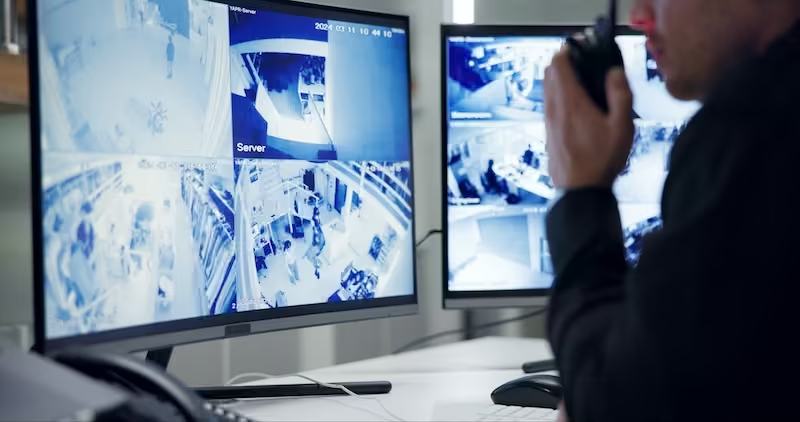
Security Cameras for Schools: Types, Placement and Features

Advanced security systems help ensure safety on your campus for teachers, students, and visitors.
Schools run on trust: students learn better when they feel safe, and staff work better when they are not the only set of eyes on a campus. Security cameras are now near-universal in U.S. schools, but coverage tends to stop at the building walls, leaving parking lots, fields and bus loops unwatched.
These powerful institutions are, unfortunately, often the target of diverse threats, and must be kept as secure as possible. LiveView Technologies is prepared to help secure your campus against danger of every kind.
What Security Cameras Do Schools Use?
Most schools run a mix, chosen by location rather than by brand. Bullet and pan-tilt-zoom cameras cover outdoor perimeters, parking lots and athletic fields, where weather rating and long-range zoom matter most. High-resolution cameras at entrances capture identifiable detail of everyone who walks in. Dome and wide-angle cameras cover hallways and common areas without blind spots at corners. Classrooms are generally excluded except in specific special education settings, and restrooms and locker rooms are never covered.
Camera use in schools is close to universal. According to the National Center for Education Statistics, 93 percent of U.S. public schools used security cameras to monitor the school in the 2021 to 2022 school year, up from 61 percent in 2009 to 2010. The open question for most districts is no longer whether to install cameras, but how to cover the outdoor areas that permanent wiring never reached.
Why Is School Security Important?
A school can function better when students, faculty, and staff feel safe and secure. Campuses with comprehensive security are, for this reason, far more conducive to learning. Those who work at and attend the school, as well as their families, will trust your institution on a deeper level, which can help improve and preserve its reputation. Students will be empowered to achieve their full potential when they feel safe and secure.
Effective security measures prevent unauthorized entry and deter unlawful activity, and are designed to mitigate any type of threat your campus will face, from vandalism to violent protests.
Threats
Recent years have seen an alarming increase in campus violence, at all grade levels and types of institutions. While some types and locations of schools may be more vulnerable to attacks than others, it’s essential that every campus has a comprehensive security plan. Terror threats, shootings, and other violent events necessitate a security regimen that can both deter and monitor suspicious activity on campus.
Protests
An increasingly common security situation, mostly unique to college and university campuses, is political and non-political protests. While many protests are peaceful, some can become unpredictable and have dangerous and volatile effects on a campus, its facilities, and its occupants. Additionally, large-scale campus events, such as graduations, can be made increasingly complicated by protests, creating a logistical nightmare for campus security teams.
Traditional camera systems are not an optimal solution for protest scenarios; the events/dynamic nature requires a dynamic camera system to match. Mobile cameras with continuous monitoring, such as the ones offered by LVT, are much better at picking up complex problems. Cameras can also help boost the power of a security team’s limited resources, allowing them to be in multiple places at once. That matters on a large, open campus.
Campus Security Cameras
A campus security camera system does three jobs: it deters people who would otherwise act, it shortens the time between an incident starting and someone responding, and it produces footage clear enough to be useful afterward. A system that only does the third is a recording device, not a security system.
When weighing the pros and cons of security cameras in schools, remember that grainy, unreliable CCTV is a thing of the past. Today’s technology, including cloud storage and artificial intelligence, allows for far more advanced security. Furthermore, security cameras in schools can have a powerful effect on the safety of your campus, as long as they’re equipped with current and intuitive features.
Key Features for School Security Cameras
School security systems are paramount for a functioning, thriving campus. Modern technology has made it easier than ever to monitor and secure even large campuses, empowering students, teachers, and staff to teach, learn, and achieve their fullest potential. Among this novel technology are the impressive strides that have been taken to improve and innovate surveillance cameras. Below are some modern features that you should look for in your campus’s security cameras.
Continuous Up-Time
When securing a school, it’s vital that you never miss a second. Cameras with continuous monitoring make sure that no threat goes unseen.
High-Resolution Footage
Some conditions, such as low light and dark times of the day, make it difficult to identify offenders and investigate problems. High-definition cameras are essential for campuses, providing detailed footage for a clear vision of incidents after the fact.
Cloud Storage
Security footage is no good to anyone if it can’t be easily accessed. Intuitive storage software, such as cloud storage, allows evidence to be retrieved, studied, and used for investigative purposes.
Video Analytics and Artificial Intelligence
Don’t want to employ a costly team to sit and monitor campus footage for threats day in and day out? Video analytics, especially when powered by artificial intelligence, such as the AI-powered software offered by LiveView Technologies, can identify and differentiate threats and alert both management and the authorities, allowing for an impressive response time to emergencies.
System Integration
An effective, unified approach to campus security must involve several compatible systems, including access control and alarms. Choose a system of surveillance cameras that can be easily integrated with these additional security systems so that there are no gaps in your campus’s protection.
Mobility
Traditionally, security cameras have been installed and wired in a fixed location. The dynamic nature of most campus issues and threats, however, necessitate a more flexible solution. Moving threats, protest hotspots, high-capacity events, and more are better secured with mobile cameras. This is also a more cost-effective solution, as they’ll allow you to save on installation and de-installation costs. In addition, mobile cameras can begin protecting your campus right away, without having to wait on extensive installation processes.
Live Alerts
Cameras with continuous up-time often carry another key advantage: live alerts that keep you apprised of every potential threat. Real-time alerts help keep response times quick and prompt.
Independent Power
The corners of your campus that need the most monitoring may not be equipped with a readily available power source. Mobile units with their own attached power source are easier to place wherever, eliminating the need to reroute electrical wiring to accomplish your security goals.
Floodlights
Good lighting can boost security efforts in a variety of ways; cameras equipped with floodlights not only combat the blurry footage that accompanies low-light conditions, but can also act as a powerful deterrent against crime and protection for students, faculty, and staff.
Loudspeakers
Security cameras with audio capabilities can make a big difference in your security efforts. Loudspeakers on surveillance cameras can serve a variety of functions, including emergency instruction, crowd control, and broadcast warnings.
Where School Security Cameras Belong on Campus
- Parking lots and bus loops. The highest-incident outdoor area on most campuses and the hardest to wire. Look for long-range zoom, night visibility and floodlighting.
- Perimeter and fence lines. Intrusion detection matters more than image detail here. The goal is to know someone crossed the line, not to read a license plate at 300 feet.
- Main entrances. High-resolution coverage so footage is usable for identification, not just for confirming that something happened.
- Athletic fields, stadiums and event spaces. Coverage is needed seasonally and for specific events. This is where fixed installations are hardest to justify, and mobile units earn their place.
- Hallways and common areas. Wide-angle coverage that eliminates corner blind spots.
- Classrooms, restrooms, and locker rooms. Restrooms and locker rooms are never monitored. Classroom cameras are restricted to specific settings and governed by district policy, parental consent, and state law, which varies widely.
Master Campus Security With LVT
LVT® Units combine the features above in a single deployable package: high-resolution cameras, intrusion detection, floodlights, loudspeakers and independent power, placed wherever coverage is needed and moved when it changes. See how districts and campuses put them to work on our school security systems page.
Your school’s security is of the utmost importance to students, families, faculty, staff, and the team at LVT. With an industry leading up-time, AI-powered video analysis, floodlights, and so many other essential and customizable features, LiveView Technologies is perfectly poised to transform your campus’s security.
School Security System FAQs
Is it legal for schools to have security cameras?
Yes, in common areas. Schools may monitor hallways, entrances, parking lots and grounds, where there is no reasonable expectation of privacy. Restrooms and locker rooms are off limits. Classroom monitoring is more restricted and depends on district policy, parental notification or consent, and state law. Check your state's rules and your district's policy before adding cameras to any instructional space.
Do schools check cameras every day?
Most do not watch footage live all day. Staffing rarely allows it. In practice footage is reviewed after an incident, which is why analytics and real-time alerting matter: they turn a passive recording into a notification that reaches someone while the situation is still developing.
What type of security is most needed for schools?
Controlled building access and video surveillance are the two measures nearly every school already has, at 97 percent and 93 percent of U.S. public schools respectively. The measure most schools are still missing is coverage of the outdoor areas between those buildings: parking lots, fields, bus loops and construction zones.
What is the best setup for a district managing multiple campuses?
One platform across every site, so a district office can view all campuses without separate logins. Prioritize cloud access, consistent alerting rules and the ability to move coverage between campuses as needs change.