How AI Security Cameras Fill the Security Gap
AI security cameras help businesses fill both staffing and skills gaps by catching what people might miss. Using agentic AI and AI-powered agents, they analyze activity in real time and reduce false alerts. The result is faster responses, better use of human time, and a far more cost-effective way to prevent property crime.
If you’ve tried to hire for a security role lately, you already know the drill: Open position. Few applicants. Even fewer qualified ones. The ones you do hire? Hard to retain, harder to scale, and nearly impossible to place everywhere you actually need coverage.
Security guards in the U.S. earn an average of $19 per hour. Low pay, odd hours, and risk to personal safety keep churn high. Keeping positions filled can feel like a perpetual uphill battle.
Meanwhile, the risk doesn’t wait just because you’re short-handed. Businesses are left in a bind: managing risk exposure with fewer hands.
The Hiring Problem Nobody Can Ignore
Security has always depended on people: Guards on patrol, operators watching feeds, teams reviewing footage after something happens, etc. But now turnover is rampant. While average workforce turnover hovers around 40%, the security industry often hovers between 100% and 300%.
Even when positions are filled, there’s still a limit to how much any one person can realistically monitor. You can’t have someone watching every camera at all times. You can’t expect perfect attention across long shifts. And you definitely can’t scale human coverage across dozens of locations without costs climbing astronomically.
At the same time, property crime keeps cropping up in the same places: poorly lit areas, after-hours environments, and sites that feel like no one’s paying attention. Many business owners turn to security cameras to help keep watch, but traditional cameras are inherently passive and only provide information after something has happened. The damage is already done.
Cameras Used to Record—Now They Think
AI security cameras are different. They capture video, yes, but they can also flag unusual behavior and separate real issues from background noise. They don’t need breaks. They don’t call in sick. They don’t lose focus or doze off halfway through a shift.
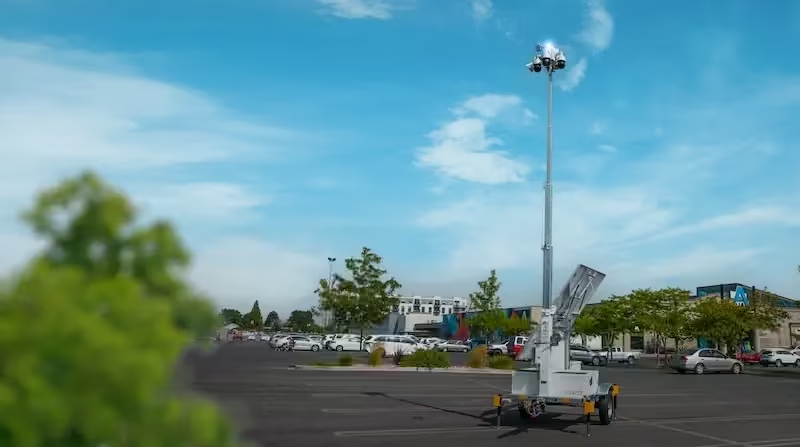
And when these AI security cameras are a part of mobile systems, they can be deployed in places where people can’t realistically be stationed (think remote lots, temporary job sites, large open areas, etc.), extending coverage without requiring more staff.
Some owners worry that these cameras will take human jobs, but they aren’t replacing people; they’re covering the gaps people couldn’t fill. Even the best security teams have limits. The reality is that humans get tired, our attention drifts after a few minutes, and details get missed.
Agentic systems don’t replace human judgment, but they can handle the repetitive, time-consuming parts of monitoring so people can focus on what actually requires attention.
AI-powered agents can scan multiple feeds at once, tracking movement across different areas and comparing behavior against patterns they’ve learned over time. They don’t blink. They don’t get distracted. And they don’t second-guess what they’re seeing.
This doesn’t make them better decision-makers than humans, but it does make them better at catching things early. And when it comes to property crime, early detection is everything.
From Passive to Proactive
One of the biggest shifts with AI cameras is timing. Traditional systems answer the question: What happened? AI systems answer: What’s happening right now?
When a system can identify unusual behavior in real time—someone lingering where they shouldn’t be, movement after hours, activity near high-value assets—it can trigger an immediate response. Lights come on, alerts go out, and audio warnings can be issued. Suddenly, bad actors who thought they were going unnoticed realize they’re actively being watched.
With agentic AI, these systems go beyond merely flagging and can make decisions about what to do next. Over time, these decisions become easier and easier as the system starts to recognize patterns more accurately through learning and feedback. Agentic AI understands what “normal” looks like for a specific site and immediately picks up on deviations from that baseline, something traditional systems (or even most human teams) struggle to do consistently at scale.
A Better Use of Human Time
As mentioned earlier, people hear “AI” and assume it means replacing jobs. But that’s not what’s happening here. Security still needs people. One of the biggest frustrations for security personnel is alert overload. Many teams are drowning in notifications and false alarms. When everything looks like a problem, nothing stands out as urgent.
AI-equipped cameras filter out irrelevant activity—wind, shadows, passing animals—significantly reducing the number of alerts. Human teams not only respond more quickly and effectively, but are also far less likely to burn out. When people aren’t constantly chasing false alarms, they’re sharper when real issues come up.
AI only changes how human teams’ time gets used. Instead of watching screens all day, guards can focus on investigating real incidents. Instead of reviewing hours of footage, they can work with curated, relevant clips. Instead of reacting to everything, they can respond to what is actually critical—a much better use of skill, not to mention a more sustainable way to operate, especially when hiring is already a challenge.
Better Security Without Blowing the Budget
Hiring more people to cover more locations is expensive and, ultimately, ineffective. Training, scheduling, turnover…they all add up fast.
AI security cameras give owners more bang for their buck by monitoring multiple areas simultaneously, no overtime required. For businesses dealing with property crime across multiple locations, this scalability is huge.
AI-enabled cameras move security from reactive and manual to proactive and autonomous. They don’t solve every problem, of course, but they close some of the biggest gaps by extending coverage, improving detection, and reducing noise.
AI security cameras don’t replace human teams; they support them. And they help businesses respond faster when something actually happens. In a world where attention is limited and risk is constant, AI-enabled security is the difference between stopping property crime and just passively recording it.
Learn how AI cameras can put a stop to your property crime by contacting LVT for a free demo today.
%20(1).avif)
%20(1).avif)