Is Loss Prevention Dead?: A Discussion with TalkLP

Retail is changing, and so is the role of the modern LP/AP professional. In this great discussion, Steve Lindsey (LVT) and Frank Patercity sit down with TalkLPnews to debunk the myth that Loss Prevention is a diminishing discipline. Instead, they reveal a profession in the midst of a massive transformation. Using the primary findings from the 2026 LVT & TalkLPnews Industry Survey, the panel discusses why 75% of leaders believe their role is expanding beyond traditional safety and shrink to become a driver of cross-departmental value.
The session dives into the "value-added" era of LP, where executives now expect asset protection teams to contribute to operational efficiencies, marketing compliance, and people analytics. However, with the rapid influx of AI and new surveillance tech, many professionals feel overwhelmed by the noise. Steve and Frank provide a blueprint for navigating these technology trends, ensuring you aren't just buying "shiny objects," but implementing tools that offer a clear ROI to the entire business.
Featured Speakers

Amber Bradley
Amber Bradley, founder of Calibration Group, LLC, is a communication expert with extensive experience across multiple business disciplines, including marketing and public relations. Amber’s proven success in creating multi-tiered, strategic marketing and communication campaigns continues to yield unmatched results for solutions providers, as well as retail loss prevention and operations professionals. Amber holds a Master of Arts in Communication and a Bachelor of Arts in Marketing/Communication. Amber is the Editor-in-Chief and host of the TalkLPnews that provides valuable content to loss prevention and asset protection professionals through unscripted interviews about all different types of topics.

Steve Lindsey
Steve Lindsey came to LiveView Technologies (LVT) in 2011. He has extensive experience with electronic engineering and specializes in computer programming. He began his career by selling computers and installing CAT 5 and fiber optic cables, and later worked for Novell on their NetWare, GroupWise, and eDirectory technologies, as the CTO at i3 Technologies, as well as starting his own company called AudioShare which was a first-of-its-kind digital audio distribution network. Because of this varied work history, Lindsey has a deep understanding of programming, engineering, networking, digital signal processing, RF engineering, and even physical wiring, all of which has had a powerful influence on LVT’s product offering.

Frank Patercity
Frank is Kroger’s Corporate Security Director, leading a team of investigators to combat Organized Retail Crime (ORC) and overseeing threat assessment, major crimes, active assailant response, and executive protection. With over 20 years of security experience, Frank previously held roles at Trane Technologies and Wells Fargo. A former Marine and Raleigh Police Department officer, he earned degrees in journalism and political science from Indiana University of Pennsylvania. Frank lives in the Cincinnati area with his family and enjoys reading and live music.
Navigating Retail’s Evolution with Data-Driven Strategies
The retail landscape is shifting at a breakneck pace, driven by sophisticated crime trends and a digital-first evolution in consumer behavior. For Loss Prevention and Asset Protection professionals, staying up to date isn't just an advantage, it’s a necessity for survival. This webinar dives into the critical need for investing in the right tools.
Full Transcript
Amber Bradley: What's up everybody? That's right. It's Talk LP News, webinar time. Amber Bradley, what's up? I am stoked to welcome our guests. I know I posted on LinkedIn about this, two of probably the smartest people I know, and that is high praise because I know a lot of smart people, but you guys, I'm stoked about this conversation. Okay. Before we get into the topic, let's introduce the presenters. If you don't know them, you've been living under a rock. But Steve Lindsay from LVT, co-founder, chief strategist, Gran Puba of all knowledge, because we've gotten into it with Steve before, former Apex presenter, which I really think is probably the highlight of your career. It's fine. It
Steve Lindsey: Was. It was.
Amber Bradley: And Frank Pattersity, also former Apex presenter, but also retail veteran, military veteran, phenomenal resource and workplace violence, all things risk for sure. So first I'll let you guys, if I left anything out, Frank, anything ... I know you were obviously a leader at Kroger and building that program and all of those workplace violence policies and all that good stuff. What'd I leave out?
Frank Patercity: There's a couple of things there in between. And I'm really flattered she came to me first, Steve, because when she said some people, I knew she was talking about you. I'm just happy to be in the room.
Steve Lindsey: Yeah, right.
Frank Patercity: But yeah, so most recently, yeah, four years plus leading corporate security at Kroger. So all things corporate security, organized retail crime, workplace violence, active assailant response and prevention, executive protection, and some other things mixed in there. That's part of, I guess, my 25 years plus now. That sounds like a long time when I say it out loud in the security field one way or the other. Got my start in the Marine Corps and spent 13 years in law enforcement doing a variety of things before almost an even amount of time now, about 10 plus years in a corporate security setting doing all things violence prevention. And I'm excited to be partnered here with Steve today and have this conversation.
Amber Bradley: Yeah. Super stoked. So Frank's our retail perspective, Steve are my resident technologists. I can tell the audience that you have taught me a lot. I mean, I feel like I can use the words, and I did this on a podcast recently that I know the difference between agentic AI and machine computer learning. I'm probably saying it all wrong, but I know it now, thanks to you. So appreciate that. You want to tell us a little bit more about what you got going on at LVT?
Steve Lindsey: Yeah. I mean, most people know that I have been with LVT since the beginning and really serving as the chief technology officer there. I've recently relinquished that, handed it off to a ... I like to consider a more capable person so I can focus more on the strategy for the business, how technology and the business can be strategizing and solving problems for our customers.
Amber Bradley: I think one of the things I love most about both of you is that you have a very sensitive BS meter, which I appreciate. And you won't let anything pass by. It's very straightforward with you two, which is why we brought you on for the is LP dying survey results. And of course, if you're in marketing, you know, hey, we know it's not dying. We were going to use evolving. Okay, guys, but evolving is so boring. Everybody's talking about that. So we got your attention because you're here. So that's what we're doing today. We're talking about these stats that came in on this survey, and thanks so much. We had a tremendous response. So what you're hearing today is truly like pulse of the industry. So super stoked to have these guys talk about it. Okay. I've got a little name for each one of these sections, but the first part, the first part is the is LP dying piece, which You only know you're somebody until you've pissed off someone on LinkedIn and you start that whole trail of dying. Are you out of your mind? Which I love. Good to get sassy, folks. I appreciate that. Okay. 75, I'm reading the stats so I don't get them wrong. It's not fake news. 75% of respondents say LP is evolving to a greater value and influence across the business. Okay, that's interesting because then you look at the opposite, right? One in five don't see a major change. And so we're like, this is interesting. So I wanted to get ... Okay, Frank, we're going to start with you as obviously a leader in the LP industry. What do you feel like is driving this result? The divide between someone who's saying, "Oh yes, it is definitely evolving into a greater value for the organization." And then you've got some folks that are like, "Nah, we're
Frank Patercity: Good." Yeah. Well, look, I'll go back to your comments just a second ago and I'll leave the making people angry on LinkedIn. That's me.
Amber Bradley: I got
Frank Patercity: This. Yeah, that's yours. And I would say absolutely loss prevention is evolving. I mean, you don't have to really look too far to see out in the world the changes that we see every day since COVID, right? Violence impacting our stores, people just generally more upset than they have been. I feel like we're operating in the age of incivility sometimes. People are quicker to anger and they're quicker to act than I think they were before and the data show that. But I think the evolution, at least for me, is it's moving towards violence prevention versus strictly that shrink mindset. Of course, we have to pay attention to those things, organized retail crime, theft, loss, all of those things are things that keep the lights on and keep the business running. But leaders that are at the forefront, they recognize that violence is prevalent and that's something that we have to pay attention to. To me, nothing else matters, but preventing violence.
Amber Bradley: Yeah. And have you seen that ... You mentioned since COVID, and it seems like before COVID, everyone seemed a little less nuts, right? And the LP executive definitely had shrink on the plate, but have you seen ... It's not like shrink's gone away, and I'm probably mirroring just what you said, but you've obviously seen more departments within the organization relying on that LP executive to go, wait a minute, it's not just shrink, it's not just shoplifting, it's not just ORC. Safety is huge. And that's part of what the 75% is saying that's evolving into?
Frank Patercity: Yeah, absolutely. Absolutely it is. I think that the other partners, the other stakeholders in the business are looking to loss prevention asset protection leaders for how they can leverage their resources. And I know we're going to talk more about how we can do that as we get into the conversation, but you're absolutely right. The theft and the shrink is not going away. It's just, I guess, sharing the screen with some of these other things that are out there that we're seeing more prevalent. Like you say people have gone nuts since COVID and times have definitely changed. They've definitely changed. And we do see that quite a bit more than we used to. I could speak personally, I felt the change just in my time when I joined retail, right as COVID was kind of getting into full swing and seeing that evolution as we went through the years, and it hasn't really returned back to the center, in my opinion. I think we're still kind of operating in that age of incivility, as I mentioned.
Amber Bradley: Yeah. Okay. See, so I love, you're sitting obviously at a technology company that works with lots of different customers. So I'm curious from a technology perspective, are you seeing the 75% of folks that are like, "Yes, we're evolving." Are you seeing the technology kind of come alongside of them and evolving too? Is that partly why all these other organizational leaders in other departments are like, "Hey, we need to come to LP because they've got the goods on whether it's the tower in the parking lot or the cameras on the side of the building." From a technology perspective, what are you seeing?
Steve Lindsey: Yeah. When you think about the advancements in technology, it all starts with the camera, right? So let's look at the camera usage outside of physical security loss prevention. These are valuable data insights and I need the camera as that first input to be able to start getting those insights. So you're starting to see other functions within companies wanting to leverage those cameras. And the question is, well, what unlocked all this? And it really goes back to a couple years ago when we started getting these large language models actually able to reason, make decisions, take action. And so if we can just get the visual data into a form that those large language models can use, then we can extract all kinds of valuable insights and also be able to take a lot of automated action with that. And so all the other entities within your business are trying to get access to the cameras to unlock that. So the question now is, was how does an organization essentially share cameras? LP needs it for one use, the other businesses need it for the other. And this is where we got to rethink, and I think we'll talk about this later in the discussion, but we've got to rethink the value of this asset that we have that is really under LP's budget item and how that can be used by the rest of the organization that is, again, just unlocked in the recent couple of years with these large language models. So not to go into too much detail here, but people keep asking, "Well, what is the unlock, large language models? How does that all that work?" Think about it this way. We've never had the ability with analytics before to transform what the camera sees into what we call unstructured data. It's never happened before until now. And so we can now literally have a camera just watch what it sees and these capabilities now can transform that into data that can now be run through these large language models. And as soon as that happens, now you've got HR interested, you've got operations and supply chain interested, you've got marketing interested. Everyone's interested now in the cameras that loss prevention owns.
Amber Bradley: So let me ask you really quick though. One of the things that I get, I hear a lot is, "Oh, it's AI." And then they described me this example that was like, "Well, that was video analytics three years ago." So I'm curious, when you say, because what you described could be, "Oh, okay. It can tell me when the cashier's not standing at the crash rap." And you're like, "Okay, well, that's video." So what changed between that simplistic little piece to what you're describing now?
Steve Lindsey: Yeah. So let's think about computer vision, traditional computer vision and analytics, like simple if then statements. If this happens, then do this. They are built to look for specific patterns, specific things, and anything that doesn't fit that model, it ignores. So if you think about how do I map the physical space? How do I represent the physical space and data? Because there's so many unknowns that happen, you'd have to create a video analytic for every possible thing that ever could be detected. So you're
Amber Bradley: Telling it, you're telling it.
Steve Lindsey: Yeah. You're saying, look, look for this, look for this. And you're telling it specifically, look for this. That doesn't work at scale. So the unlock is the fact that there's these new models that are a subset of what's called vision language models or VLMs. And all they simply do is they'll describe what they see and put that into text. Okay. So if you think about that, it's like, what do I see? Well, I see a parking lot and it has 70 cars and it has 54 people and they look like this and they're doing this and your carts are doing this and this. All it is is just describing it like every second of everything that it sees. When you feed that now into a large language model, now it can start reasoning through that just like a human would. It's starting to say, "Oh, well, I'm starting to see this person get out of their car and coming in and that person came in. Oh, that person seems to be casing cars. Okay. These shopping carts, everyone seems to get out and just put their cart right in front instead of putting it in the cart return." Or, "All of your delivery guys for your supply chain seem to come in this way." Or your snowplow drivers, they don't ever come every day. They come like once a week and all these things it just describes to you. Now you can come back and say, "Well, I'm paying every single day for a snowplower driver to clear my snow, but they only show up once, but they bill me four times."That's something that the system can now do. Your shopping carts, nobody tends to put them away because you've only got two of them here and they're all parked out there. And so again, the insights that you get are telling you, "Oh, I can do these things." And I'm just giving you examples of operational use cases of these, but if we look at loss prevention and such, Frank mentioned violence, what are the trends that we keep seeing that are causing people to then have these violent altercations? And the systems can now do this. It's not an if then statement anymore. It's not when I see this, send me alert. It's describe what I'm seeing, reason through that, and now start giving me actionable insights out of that. And again, this is new. This is something that only happened in the last two years, two or three years. And so like I said, I don't think a lot of people are familiar with what's possible, but because of that, I don't think they even understand how to make these things possible. And I think we can talk a little bit about that today, but that's the unlock for me when it comes to opportunities for loss prevention to use the assets that they have and be, again, those champions inside of their companies to say, "Hey, there's so much more information that we have as an organization that go outside of my domain of LP." I think that's the excitement here.
Amber Bradley: Well, it's a perfect segue into the next stat, which is the proactive versus reactive thing. And I think that the call out here was 48% say their LP team proactively leads cross-departmental initiatives with only 10% describing them as reactive, which I think the interesting point to this question is the cross-departmental initiatives. I think most, had you not put that in there, I think most LP executives are like, "Yeah, I lead my LP team." But when it comes to, okay, how do you lead a cross-departmental initiative, which kind of goes back to your point, Steve, about the technology part that it's like, okay, well, that is being proactive, learning that whole thing you just said, and then figuring out how to implement it and all these different departments. So Frank, we'll come to you on this one just and then get Steve's reaction from a technology perspective. Looking at proactive teams and how, in your experience as a retailer, why that's so important given budget cuts and all of the things that happen out of a retailer's control, what does that look like for you and why it was so important? And a little, I don't know, is it concerning 48% only? It's like barely even half. I don't know.
Frank Patercity: Yeah. Well, I think first things first, we clearly, if there was any question about who the smart person in the room was, it was answered with Steve's response to the last question.
Amber Bradley: Good for you, Steve. You beat me out on that one, but that's
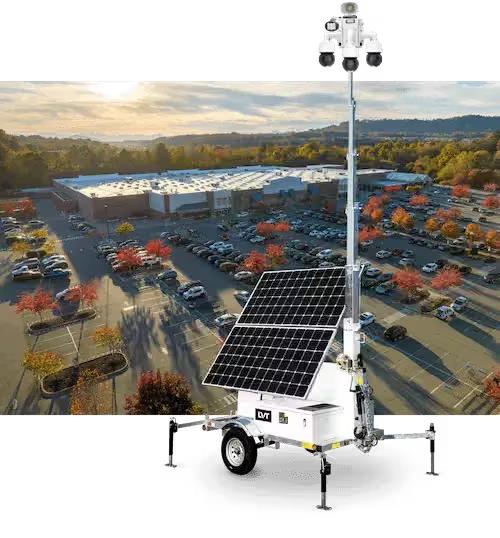
Frank Patercity: Okay.That was great. And it was a great segue into this question, and he gave some great examples of how you can operationalize some of this technology and get that partnership with the other stakeholders. I think 48% I think might be a little bit low. I think a lot of AP, LP leaders are the ones that are driving those initiatives. And I think about some of the other groups, maybe HR, business operations, supply chain, even legal in some regard when we talk about violence prevention, right? Technology isn't necessarily something they're thinking about in terms of prevention or even response or detection. And a lot of times the AP or LP leaders are putting those technologies in place, like Steve talked about, keeping it simple, right? The camera tower in the parking lot that's keeping the risk the furthest away from the store out of the perimeter or the camera pack that's on the wall that's going to detect and record. The smart LP leader is one that is able to articulate to the other stakeholders within the business, "Hey, there's benefit here for you too." This isn't solely a loss prevention tool. We're not here to catch just shoplifters or boosters in organized retail crime. We're also here to do all the things that Steve talked about. We're here to make the most of this technology and all of its capabilities to help keep people safer and keep our business running smoother. So that's the trick.
Amber Bradley: Yeah. So if you're in that 10% saying you're reactive, that might be a great tip then from Frank to be like, "Oh, okay, look, you got to learn the language of the other departments to know how your technology can help them and fit in. " And then you're the one coming to them going, "Hey, I got something you may be interested in. " And then they're a little bit more on board with it.
Frank Patercity: Yes. And if you start with one win, you start small. You pick one project, one initiative of maybe a project that you were already going to run and you bring them in on the front end and you show them the value. And we talked about, I think Amber, you mentioned it, right? Budgets, everything's tight for people. You can then maybe share some of the burden with them if you're able to prove that out, prove the ROI and show them that this could benefit all of us, not just those of us in asset protection loss prevention.
Amber Bradley: Stable company, obviously you gave some great operational examples before. Anything to add on this point?
Steve Lindsey: Yeah. I think when we think about proactive and reactive, I think there's inherent things in the technologies that we use to kind of cause that, but I also think that there's organizational structure that kind of causes that as well. And I think we have to look at both situations. Frank alluded to, I think the business and operational side, and that is how much of a relationship do you have with the other leaders within your organization and working together? We see a mix of some organizations actually have a really healthy relationship between all of those executive leaders across the space. And there tends to be emotions of trying to utilize, let's say, technology that can benefit the entire company, not just one department. But then we also see the extreme where everyone seems to just operate in silos and the left hand doesn't know what the right hand's doing. So I think there's some of those organizational structures that need to be looked at in order to really understand this. But on the technology side, I think you're also seeing the difference between technology vendors who are specifically solving problems for, I'll say LP, but then you've got IT, traditional IT vendors who are looking at more business systems. And those two worlds are kind of treated separately right now. So when we think about cameras, it's dominated by the LP world and security. And so everything is thought about with a security lens on. And now you're starting to see these IT business systems say, "Hey, there's all this rich information I can get. I just need a camera." And so you'll start seeing deployments where they'll just deploy the camera themselves for that, that's right next to the LP camera that's then doing this, right?
Amber Bradley: Oh, you're kidding.
Steve Lindsey: You seeing
Amber Bradley: That like it's
Steve Lindsey: Out there. Yeah. We see that, but then we see like the CFO step and say, "Why am I buying a camera for the same location for two different departments? I'm going to force you guys to work together." So it's a really interesting dynamic right now. And this is where I think the LP groups probably could look outside of the traditional physical security technologies space and look at what's happening in business intelligence space to help them understand what are these capabilities that can be extended to the other groups within my company so that they become the champion of that. As Frank said, you don't have to boil the ocean here. There's some easy wins that you can really look at and get that value, work with that business partner, and then start expanding from there.
Amber Bradley: So really interesting, moving on to the next segment here, and it says, so compliance surprise, right? So 63% say safety audits are LPs top non-traditional value. And I'm like, non-traditional, that's interesting, especially because now it's been what, six years almost since COVID, which when you really think about it, that's when the LP function, it seems. There was no space around it. There was no light between the safety person and the LP person if they weren't one and the same. So that's interesting. I'm wondering, and I want to get your take on it, Frank, what is the surprise in that? I don't think it's the safety part. I think it's more the audit part, right? Like, okay, we're not only just going to say, okay, make sure that you run, hide, fight, or whatever. We're making sure that we're not just saying the words, we're actually checking, we're actually, what is it? Inspecting what we expect? Man, that's old. That's super old, but still a tweetable. Okay? So is that it? Is that what's happening with this result?
Frank Patercity: Yeah, I don't know. I don't look at this as much of a surprise at all, to be honest with you when I looked at the data that came in on this. I feel like safety teams are just lean in general and they don't have to get- Lean or
Amber Bradley: Mean or both? Lean.
Frank Patercity: Well, I mean, I think I'm leaving the mean stuff to you, remember? I think they're lean. I think they, at least in my experience, they're doing a lot of things. Oftentimes you've got a loss prevention or asset protection professional who's having to absorb safety duties in a store or a supply chain location. So they're going to take advantage and make use of this technology to help them in their audits to make sure that things are getting done the right way. So I do think that's the low hanging fruit. I think there's opportunity using compliance data to drive those operational insights, not just the simple stuff like we talked about, like is the emergency exit blocked critically important that we make sure that that's not blocked, but is that the best use of this technology?
Amber Bradley: Yeah. And to me, it kind of sweeps to the broader theme of this really, which is using one technology thing for one purpose, those days are so gone. And they might have come with Mike Lamb's very first, I forgot what he called it, where he had all of the solution providers out to Kroger and then the whole ecosystem word was born, which makes ... I'm like, you hear it so much you want to stab a pin in your ear, but it's true. So kudos to that. But so it's almost like the evolution of ecosystem is that you're not going to get away from using technology for multiple things. You're not going to sell a one trick pony anymore. So is that from a technology perspective, Steve, not to step into your sandbox, but is that what you're seeing too? I mean, obviously you've given some great operational pieces. There are obviously technology that can say, yes, there is something blocking the exit door, but then you're talking about moving beyond that to go, yeah, great, that's a good first step, but there's so much more we could do.
Steve Lindsey: Yeah. Yeah. This shows a lot of potential in the industry. I mean, we haven't come close to making this ... I mean, 10% is a response to me seems high. I think this is a massive growth opportunity for us. And I think Frank alluded to really the heart of it. And that is these budgets and LP are lean. You are considered, like if you go to the CFO, you are considered a cost center. You are a necessary evil in the everyday doing business. How do you change that from a cost center to a valuable asset that even if you swing the pendulum becomes a revenue generator? These are the things that you got to be thinking about, especially if you put your CFO hat on. So when we think about AI, everyone's first reaction to AI, especially in the last couple of years, when they saw the power of what these LLMs could do, right? They can start reasoning. They can think like a human. It's like, it's going to take my job. Well, maybe some sectors in the professional world would fear that, but the last sector that should fear that is LP, because we've been so lean. We need force multipliers in this space. We need technology that helps do the mundane, redundant work, which compliance could probably be one of those things. I think Frank also illustrated some others. These things can be automated. The valuable human resources we have in think in the LP space really should be knowledge workers, right? These are the people who are solving problems, making decisions, doing things with the critical information, and all this other mundane work should be automated. And that's where the power of agentic AI comes in. It really is. When we think about agentic AI, again, think about it, it's got a goal and mission. It's got the ability to make reasoning and decision, and it can take action. It's a new capability that's never been done before, and it can do it in a non-deterministic way. It doesn't have to have hard rules on what its inputs are to be able to reason through that for these actionable outcomes. Again, with this capability, we've got to start thinking about how do we do the automated work using these tools? And that's why I mean it's untapped. Nobody's even attempted to do this yet. So again, that's where the excitement should come in. We shouldn't be fearing AI. We should be embracing it for that force multiplier and then turning it into that tool to actually make LP that champion for more efficiency and even possibly revenue generation within the business with the tools that they have.
Amber Bradley: So that brings me to another perfect segue, hype versus reality, right? So AI is like all the buzz, and we were talking about how maybe last year the conversation was kind of like, oh, do I need this AI thing that's coming out? And then now, obviously zoom ahead to where, no, no, we definitely need it. If we don't have it, we're going to get passed up. Passed up how, not real sure. But this survey was interesting because it said seven out of 10 LP leaders say AI and automation is critical or very important to their future. I'm like, seven out of 10. Okay, that's interesting. I wonder what the other folks are thinking, but they need to hop on chat and start messing around with it to figure this out. But I'm curious, and we'll go back to Steve for real quick before we hit you, Frank, on this thing. But I'm curious because a lot of people are like, okay, that's true, but I don't want to be the first one to come to my CFO, get the money for the pilot. And it actually turns out it's just a load of crap and there's no way that we could actually deploy this because who's done it? So comment about that hype versus reality, where are we really? And then you hear a lot of this pilot purgatory too. People get in there, they get promised all these things from these AI vendors. Meanwhile, they can't really deploy them and they're not really scalable. So where are we for real?
Steve Lindsey: Yeah, I think the problem starts with we don't know the problem we're trying to solve. We're given a tool and we're told this tool will change the productivity in our business, but we don't even know what problem we're trying to solve with the tool. And I think that's the problem with it. The easy ways to use these tools aren't the things that are needed to solve the problem. Let me give you an example. I'm sure all of us have been on ChatGPT or Gemini or something and we've made funny videos using GenAI or we've had it summarize an email that we've read. These are not LP problems, right? The LP problems have to be looked at and then you have to understand what the technology can do, understand the problem that you have. It It might be automation. It might be a force multiplier. It might be ... Another one that I think is unlocked with this tech is this idea of red actors in a sea of green actors. I mean, you think about technologies of detecting people and trying to deter them away. They work great in sterile environments, but they don't necessarily work great in the daytime when people are there. How do I pick that bad actor out of the sea of green actors? Again, this technology can now do these things. So it starts with the problem. If we understand the problem, we understand what the technology can do, now we've got to start being that knowledge worker and saying, "Okay, this is how I need to start solving this. " I think LP professionals can help by identifying those problems. Vendors can help by helping move the goalpost of what's possible with the customer or the LP professional. And again, working together then to start actually finding these low hanging fruit opportunities that can start using the technology. There's another problem with this though, and that's the how. When we think about Reactive from a technology perspective, the technologies aren't built today to do what we're describing that tomorrow can do or even what today can do. So we have to think about that as well. And I don't know if we cover that a little bit later today, but that's the other problem is the how. But I think it starts with that problem.
Amber Bradley: Yeah. We may have to get to the how in a series of this with you. I'm telling you, because it's so complicated. Because Frank, talk to us a little about the AI applications for the retail pain points and that no executive in retail wants to bring something into a pilot and have all these promises and it turns out to be vaporware. I mean, that's a lesson that is old as time. So talk a little bit about your take on this whole hype first reality.
Frank Patercity: Yeah. Well, look, I think it goes back to the genesis of this conversation and that's evolution. Things are evolving. We're at a period in time where AI is all around us. So to hear that seven out of 10 AP, LP leaders see this as critical or very important is a good thing. We got to get the other 30% on board because it's not just coming, it's here and it's all around us. And to Steve's point, it's going to continue to grow and evolve. And we have to figure out what problem we're trying to solve. And that's where I would go back to something Steve said. It's about relationships. And I've often said the time to establish a relationship with somebody is outside of a time of crisis. So if I want to put forth maybe an AI project of some sort, choose one project, choose one thing, not this transformational AI strategy where I'm trying to put forth 10 different things involving AI. And I've got a solid relationship already built with my company's chief technology officer. And I can go to them and say, "Hey, listen, I want to try this. Here's the pilot plan. Here's what it's going to cost. Here's what I think it's going to bring in. Let's start small, validate it, test it, validate it, see if it works, and then you can start to scale it and see if it works." And then going back to the things we talked about, bring in your other stakeholders and see what benefit there is to their line of the business. And it could be well outside of loss prevention, asset protection. And you go back and get out of that cost center kind of mindset that we can sometimes get bogged down and as Steve mentioned.
Amber Bradley: Yeah, no, really great points. And it leads into the budget question, which I'm calling show me the money. So what's really interesting, and I got a lot to say on this, this might be our last ... So we're not summarizing every point, listeners. So I will have a link obviously to the whole survey results that you can read, but we're just hitting the highlights here. But 43% say their budget is going toward AI, but the other 35% are still focused on upgrading basic CCTV systems. And so I want your take, Steve, on what's real, what you're seeing because I think a lot of people, and I don't know what the vendors are proposing, because you've got to be real discerning, to be honest. There's a lot of people out there that just put up their shingle and are touting all this AI stuff, but then they say, "Oh, well, you have to have the latest whatever." So are we going to spend, are we as in the industry going to spend the next year in pilot purgatory? Because when it comes down to it, we don't have the infrastructures, it's so old. I mean, retailers are retailers. They're not technology companies. Why would they have the most cutting edge camera every single year? So what is the reality of this when you hear that stat? Every AI company goes, "Great, 43%. That's money in the bank." And it's like, well, is it?
Steve Lindsey: Yeah. Yeah. Let me highlight what you said, which is the most important word. Every vendor is going to try to lead you down a path that is most beneficial to them and not you. Okay? So you've got to be very discerning. So let me just make sure that you understand some basic math here in how you can discern what a vendor is saying. At the end of the day, a camera is a camera. There's nothing special about a camera as long as it has the ability to see something with enough quality and then be able to get that back to, we'll call it your central nervous compute center, whatever that is. So the analogy I like to give here is when we were kids, we all have eyeballs. And if somebody, if you were four years old and somebody put in front of you a profit and loss statement, you would just see scribbles and dots and whatever else. You wouldn't be able to understand what it means. But at 20 years old, same eyeballs, it's just your intelligence got a little smarter. You can now understand, oh, this means income, money coming in and out and everything that a P&L has. Well, technology's the same way. Think about the camera is your eyeball. The eyeball doesn't need to be upgraded to be able to do capable things. It's the brain that needs to be updated. So think about your architectures. You don't have to rip and replace cameras. I would probably suggest that if you're still using analog cameras, they're probably not good enough for some of this stuff. But if you've got some IP cameras and they're of proper resolution, there's no reason why you'd ever have to rip those things out. What you need to look at is where is that data going and then what is the brain that's processing it? That brain can be in the cloud. The brain could be on premise there. What are your cost of ownership of maintaining the brain? What's the future proofing ability of that brain?That's how you kind of want to think about your investments, your capital investments in these things. I think the other thing that's going to be an interesting question is the more data and the more information that we get out of these cameras, it's also going to start asking, we probably need more cameras looking at different things too. I think right now we have a very minimalist approach in how we place cameras. The more value we get out of those cameras with that brain that I'm talking about, then you actually have justification for more budget to put cameras actually where you need them to be. Now, we're very camera heavy, by the way, in this discussion. There's other sensors that have a lot of valuable information, not just for LP, but for others. So again, don't just limit it to cameras. But yeah, I think when you start discerning what's there, that analogy of the eyeball and the brain is probably one of the easiest ways to think about this. And then just think about the fact that you don't have to have multiple cameras for multiple systems, right? A camera, especially if it's IP, can feed different brains if it had to. So anyway, there's a lot of ways that you can think about this thing, but it doesn't have to be a rip and replace.
Amber Bradley: Yeah. Well, that's good. That's good to know because I mean, I think that would just make everybody even more frustrated because they're already trying to figure this whole use case situation out for AI, much less the whole, "Oh, great. So now my whole infrastructure's got to go. " So from a retail perspective, Frank, when you think about these budget numbers, do they ring true from your retail background? It's where it's like, okay, wait a minute, there is an allocation that always has to go to make sure that the health monitoring and all the health of our technology is true. But is that a normal thing that people, "Oh yeah, 43% of AI, we're heading toward it.
Frank Patercity: " Well, I think so. And going back to something that Steve said, you have to think about the rip and replace model. And with budgets the way they are, if you're a retailer or a business of any kind of any size, doing a one-for-one replacement enterprise-wide is going to get you shown the door from the boardroom very quickly. If you're in there trying to tell them how many hundreds of millions of dollars you're going to need to make this replacement, oh, and by the way, to Steve's point, no sooner than I put this technology in place, the next latest, greatest thing is going to come out and you're going to be right back where you started from. So I go back to what I said earlier about starting small and devising a plan for that replacement because like Steve said, if you do have an analog camera, and those are still out there, by the way, they still do exist in the wild, it is time to replace them, to get something that is more current, more standard IP camera and then piped back into the central nervous system, that nucleus, that hub that Steve talked about that can take the information that's coming in and then use it in an intelligent way to help the APLP organization inside of the company because I looked at that stat, I think, what was it, 6%, Amber, that said that they were focusing solely on ORC or investing solely in ORC countermeasures. Was that right?
Amber Bradley: Yeah. Yeah. Something like that. It was single digit, which I mean, it's interesting.
Frank Patercity: Yeah. Well, look, I think to something Steve said, there's lots of sensors out there other than just cameras. I think that that 6% is probably much larger and they're doing it by proxy. If they're investing in AI, they're investing in upgrading their out- of-date camera system, that will go towards the mission of combating ORC. It's not just dedicated towards it. I think you get a lot more bang for your buck by doing it that way.
Steve Lindsey: Yeah. Let me add too, to what Frank was saying there, I think we don't think about the sequence or workflow that typically happens within an LP function and how data moves through that workflow. When we think about ORC functions, I keep putting that kind of more to the right of ... If we're going to use Reid Hayes' LPRC, left of Bing, right of Bing, even though you can say there's ORC activities that happen on the left of Bang, they primarily happen on the right of Bang. But the question is, what were all the data signals that were left of Bang that feed into that, that are now valuable to the ORC function? And again, this is another way to think about how you utilize technology in a multidimensional way, because there are preventative things that can be done, there's data gathering that can be done that really isn't necessarily saying, "Oh, this is specific for ORC." It benefits other organizations, but that data as it gets enriched moving through the workflow now becomes very valuable to ORC, as an example. So I think we just got to be thinking about how the data pipelines work and how that aligns with the flow of how these LP functions and activities and jobs to be done actually work.
Amber Bradley: Well, and where you want to impact it as well, right? Okay. So final thoughts. We've got a couple minutes left. Obviously, everyone, LP isn't dying. It's evolving and becoming amazing as always, as we knew it would spoiler alert. But okay, final thoughts, Steve, and then we'll come to you, Frank, on wrapping this up in a nice bow for our audience.
Steve Lindsey: Yeah. I think about technology can evolve just like the function of LP can evolve. Don't think about rip and replace. Think about your budgets from a point of view of this camera is valuable to not just LP, but the rest of the organization. Think about architecturally, where does my data go? Where does my brain live? Especially across an enterprise that has many locations, where does that brain really live? Think about how your jobs to be done happen within your corporation and how that data gets enriched as it moves through each one of those functions, right? So that, again, not every function is trying to look at technology as a silo, but it's this continuous path of information that it gets enriched and valuable to others. And then think about automation. Again, lean organizations, you should be able to use automation, do the mundane tasks so that your valuable human resources can focus on the knowledge work, the strategies, the problem solving that needs to be done that in AI, even though it's smart, it's probably not best suited to do right now, but it can definitely do a lot of these automation things and actually do it way simpler than we've ever been able to do it before. So I'll just kind of limit it to that bow and let Frank wrap some things in a bow too. I like
Amber Bradley: It. And I like that force multiplier too. It's like that's very well said on how it can impact your team versus thinking, "Oh, great. Now I'm going to be down labor." It's like, "No, no, no, it can actually help." All right, Frank, it's your vote time.
Frank Patercity: Okay. No pressure. I go after the smart guy. I appreciate that. No, but look, I think it goes back to what we were talking about the whole time here and it's evolution and understanding that loss prevention is evolving and it's becoming part of a more holistic larger package of security and asset protection and not just this one singular thing. We have to widen the aperture and focus on all the things that we have in front of us that are often tied together. One thing begets the other. I think there's some ways that we can do that and speaking specifically about my time in front of the C-suite and trying to convince them that they want to invest in projects that I'm looking to push forward. I think a few things work. I can also tell you what doesn't work, but one thing that works is building those relationships ahead of time, having your executive sponsor that understands what you're trying to do, having them buy in and having them serve as your champion in the boardroom and doing that before you've reached the boardroom. Having that all in place is a critical piece here. In line with that, also making sure that you're cataloging your wins, keeping track of the things that you're doing that are working. You did that one piece, that one project with the chief technology officer using AI. Do you have that information handy that when you go to present to the board to maybe take on a bigger piece, you've got that to validate the work that you've already done. And then lastly, speak in their language. Get on the gas, get off the gas, make your point and then move on. I think that's critically important. The last thing I would leave you with is, and this is my personal experience and I'm very glad that it is, they're people just like we are and they want the same things. They don't want people to get hurt. Yes, they have to run a business, but at the end of the day, they're in that position and they're by and large good people that want to invest in projects that keep people safe and keep people coming through the door, frictionless, come in, shop, do what they need to do, and then leave in the same condition they came to your store in. So I always kept that in mind.
Steve Lindsey: Love
Amber Bradley: It. I love that. That's a
Steve Lindsey: Great bow.
Amber Bradley: Yeah. No, it's perfect. Actually, and I love your points about the communication piece because yeah, we have another webinar coming up on executive presence too. I think it's part of the whole presenting and you open a perfect can too, Frank, when you think about all of that matters. And I love the point about having your success stories when you go in there. That's great. We could do a whole nother hour on it. We're not going to attendees, but make sure you download any LVT information on the handouts tab. It's over there. It's a plethora of incredible information about LVT. Thank you so much for the LVT partnership on this survey and Frank stepping in for our retail perspective. I really appreciate it guys. Thanks everybody for attending.
Frank Patercity: Thanks, Amber. Thanks.

Test Out the Best Security Strategy
We offer a free consultation and a custom end-to-end security strategy for your unique situation. Connect with an LVT specialist to see if you qualify for a risk-free trial.
