Beyond the Hype: How Security Leaders Avoid Buyer's Remorse

The security market is flooded with vendors promising cutting-edge innovation at unbeatable prices. For integrators and their customers, navigating this constant noise is overwhelming—and chasing flashy features or steep discounts often leads straight to buyer's remorse and wasted budget.
In this session, Steve Lindsey, Co-founder and Chief Strategist at LVT, cuts through the marketing hype. You’ll learn where the security industry is headed, how to maximize the long-term ROI of your tech investments, and the exact questions to ask during vendor evaluations to ensure you get a solution that actually works.
Featured Speakers

Steve Lindsey
Steve Lindsey came to LiveView Technologies (LVT) in 2011. He has extensive experience with electronic engineering and specializes in computer programming. He began his career by selling computers and installing CAT 5 and fiber optic cables, and later worked for Novell on their NetWare, GroupWise, and eDirectory technologies, as the CTO at i3 Technologies, as well as starting his own company called AudioShare which was a first-of-its-kind digital audio distribution network. Because of this varied work history, Lindsey has a deep understanding of programming, engineering, networking, digital signal processing, RF engineering, and even physical wiring, all of which has had a powerful influence on LVT’s product offering.

Aaron Luna
Aaron Luna brings 14 years of journalism experience to his role as LVT’s webinar host and webinar marketing manager. As a former news anchor and PBS host, Aaron spent over a decade covering law enforcement, crime, and local government—gaining an inside look at the security challenges facing both public agencies and private organizations. An expert interviewer who has engaged with high-profile newsmakers, Aaron understands the art of asking the questions audiences want answered. Today, he channels that same curiosity and clarity into every LVT discussion.
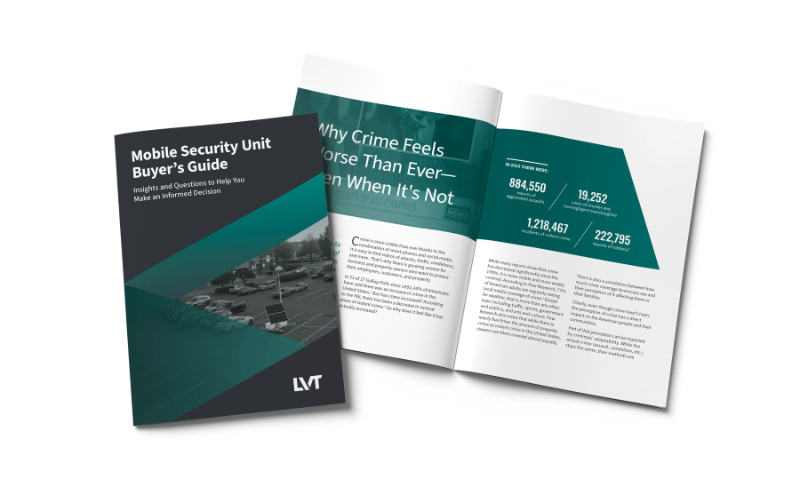
Discover the ultimate mobile security unit buyer's guide to choose the best solution for your property. Protect your business today with confidence.
- The must-have components of a reliable MSU
- How quickly units can detect and deter threats
- The integrations you need for a seamless security ecosystem
- Key questions to ask MSU vendors
Learn how to choose the right mobile surveillance unit for your business. This guide covers essential features and key questions to ask vendors as you search for the right MSU for your buisness.
Full Transcript
Beyond the Hype: How Security Leaders Avoid Buyer’s Remorse
Speakers: Aaron Luna, Host; Steve Lindsey, Co-Founder, LVT
Aaron Luna, Host: Hello, everyone, and thanks for joining us today. We're gonna get this started in just a minute here, so we'll get you just a moment to situate yourselves. And be ready for some great conversation and some dialogue. Love this topic. We'll get you going in just a moment. Alright, I think everyone's ready. Welcome, everyone. Thanks for joining us for Beyond the Hype, How Security Leaders Avoid Buyer's Remorse. I'm Aaron Luna. Today, we're talking about something nearly everyone in this industry has lived through, buying a security system that looks great on paper, then disappointed after it went live.
Most importantly, though, how to avoid that situation. Joining me is Steve Lindsey, co-founder of LVT. Steve, thanks so much for being here, we really appreciate your time and your knowledge that you bring to the table here. Steve, we talk about this probably more internally than you think. How many teams end up disappointed by tech, that it looks great on paper. It just doesn't perform. We want to bring that conversation to our audience today. Here's how today will go. We'll start with why this keeps happening, then we'll walk through the four areas worth pressure testing with any vendor. System downtime, device repair, ease of integration, and of course, cybersecurity.
We'll save time at the end for your questions. The chat's open, so we love when people have questions that we can answer live.
Steve Lindsey: Yes, we do. Send them in whenever they come to mind.
Aaron Luna: Let's set up the problem. Here's our Buyer's remorse cycle, real quick. So, number one, features and price drive the decision. Promises fall flat under real conditions. Integrators and consultants, they have to pick up the pieces. Teams try to fix the now insufficient stack, and then that just keeps going. So, Steve, let's start with this. We see vendor saturation play out constantly. ISC West, GSX, in our own sales conversations. What frustrates you the most about that?
Steve Lindsey, Co-Founder, LVT: Yeah, I think, especially in our industry now, when we talk about, you know, the area that we're in is mobile security units, right? But even in the areas of Agentic AI and some of these vision AI, physical AI-type worlds. There's just a lot of vendors starting to come into this space, and so we're all competing, and we're all trying to gather the attention of potential buyers, and we basically are just overwhelming the buyers with a lot of noise. And the noise, is so overwhelming that it's really hard for the buyers to be able to really know how to navigate all of that. But at the end of the day, as you've pointed out here, if they don't make the right choice, they're going to have this buyer's remorse.
And so, it really comes down to how are you really vetting Each of the buyers, because… or, sorry, the vendors, because each vendor is highly incentivized to tell you what you want to hear, so that you will buy their product. Unfortunately, they're not ashamed at all to tell you false truths or half-truths, or whatever else, just to gain the attention, right? So, it really is up to the buyer to have the discernment, to know how to ask the right questions, and here's, I think, the key point we want to make today. How to dive deep enough that you're able to separate fact from fiction, right? And really be able to determine… Am I being oversold something that really can't deliver when put into practice?
Aaron Luna: Well, because a lot of times, when you're looking for a security system, or, you know, a whole platform, you don't even know which questions to ask, because that's not your realm. You're trying to run a business. Your mind's focused on so many other things. You just want someone to come in and tell you what you need, so it's easy to fall into that trap. Let me bring in some outside data. Genetec's 2026 State of Physical Security found that 60% of teams are replacing legacy technology and integrating with newer systems, and just kind of how the cycle goes. That matches what we hear directly from customers, but what's the risk teams take on by connecting more systems together that they might not be thinking about, or might not be weighing in that equation.
Steve Lindsey: Yeah, so the number one thing that I hear, even today, is, you know, we're still using analog cameras. And we need to upgrade it to IP cameras. And it's not necessarily they need to upgrade it to IP cameras. What they're really saying is, we want to start taking advantage of the latest in computer vision. There is a pixel density requirement that's there, right? So I need to upgrade my cameras more from a resolution perspective, right? And there could be some network connectivity in there. But it's really trying to utilize these newer technologies. And so, when we think about the purchasing of cameras specifically for AI, there is a… there is a broader ecosystem question that's at play here, because for the longest time, we have always considered cameras to be a security tool that records an incident when it happens, and then I go back and look at footage.
In this new world of… Computer vision… We are literally turning cameras into operational sources of truth, right, for the physical space, and they are integrating into a different set of systems. So the integration requirements are different, and we have to think differently about this. You can't think about it as, camera connects to a video management system, and I'm done, right? It's… maybe a video management system is one of the consumers of the information, but other systems are there. So, you now have an integration question that goes beyond what you've traditionally asked before. Right? And so we need to ask better questions about integration that go beyond video management systems.
Aaron Luna: That's like your old cameras. You'd take a picture, then you'd look at it. Now it's online, it's digital, you're sharing it with people, people expect to be uploaded to the cloud, tagged in it, kind of goes through the security system.
Steve Lindsey: Well, the real question here is, does camera systems become an operational, part of the data set that's already there, right? When we think about business technology systems for any corporation. You're gonna start with an HRIS system, you're gonna then have an ERP-MRP system, right? Then you're gonna have a… CRM, CPQ type of a system, right, for customer relations and sales, and then you're going to have a service ticketing system. Those are kind of your basic four pillars within a standard business technology stack. What we're gonna see is that physical AI is gonna come into this as a fifth pillar.
Of that, which means that the data integration and the way that that data is consumed, operationalized, and even actioned upon is now going to follow the same patterns that we see with IT, these business technology systems. So, your integration and ecosystem questions are beyond anything you as a security professional even understand. Okay? And this is also something that probably your CIO, COO also are trying to figure out, too, right? So, these… these questions have to be looked at way broader than we've ever looked at them before, if you really want to consider your technology to be applicable to that space.
Which kind of leads to what we have on the slide here, right? 25%. Of these end users know that their cameras are going to be used for other purposes than security, right? Again, taken from the same, survey that Genetec ran. We internally, we call this intelligent site management, right?
Steve Lindsey: But you can… you can generalize that concept. I guess intelligent site management could be that term, but we use it internally LVT that way. But, vision AI, physical AI, those are other terms that the industry would use. Where cameras would get consumed for this particular use case. And so you have to have the pillar, the foundation of that. ISM is having the actual eyes on everything, and the interconnectivity of it. Yeah, and again, the interconnectivity isn't just data consumption. Okay, because when, again, when we talk about business technology stacks, there is a two-way communication happening, and there is action being taken along with data consumption.
So, I don't want to spend all of our webinar today talking about this. But there is a much broader problem set that has to be dealt with when we think about that.
Aaron Luna: Yeah, so that's a good place to dig in. Let's… we have four areas, we're going to go through them one at a time. Here they are. We're going to start with system downtime.
Aaron Luna: Steve, power and connectivity in the field get complicated real quick, whether that's solar, cellular, or remote sites. What is it about a simple connection between a camera Solar panels, and then a cellular connection that creates such complex problems.
Steve Lindsey: Yeah, so most people think that it's not hard to connect these things together, right? And you're seeing a bunch of vendors enter the space. But in reality, it is a very, very difficult problem. And the reason why it's difficult is because you're dealing with 3 things that you typically don't have to deal with in a typical IT camera-connected infrastructure that's hardwired, right, with cable… structured cabling. So, the first one is power. Mother Nature doesn't want to cooperate with you all the time. There's no such thing as an infinite storage of power, so you always have a budget that you have to operate under, and the more processing power you're trying to do from an AI perspective, the more it consumes from those reservoirs, right, within your storage systems of power.
So, it is a very difficult problem to solve for, and it has to be intentionally solved at the engineering level to ensure that your systems are as optimized as possible, for power consumption, for power storage, right? And ensuring that that power is always there when needed. So, that problem alone is difficult. Now, add to that connectivity. So, mobility in the form of cellular and satellite are what we call non-persistent connections, which means they are not intended to be always on. Just by design, they are supposed to be connecting and not connecting, right? This is just kind of how they work.
Well, that's different from a Cat5 cable that you plug into your network at work. It's hardwired in. Right, it's hardwired in. So, the fact that the system can go online and offline, and it does that often. Makes it hard from a telemetry perspective to know really what's happening. And it also makes it difficult from, okay, the health perspective with that telemetry, like, is it really online or is it offline, and how do I really know? And then let's say that it does go offline. Well, what are my options to bring it back online, right? Because… This could be a problem with the hardware itself, it could be a problem with the carrier, maybe they're having an outage that you have to account for.
Anyway, the list goes on and on. So again, a very complex problem, right, when it comes to connectivity. And then the last one that I think a lot of people overlook, device health. So what, okay, device health, what does that mean? So, these are dumb Internet of Things devices. They are manufactured both from a hardware and a software perspective as cheaply as they possibly can. So, they're not space-grade, military-grade, anything. There is not a lot of redundancy in them, there's not a lot of hardening in them, and so they are going to have issues. And when you start then stacking multiples of these devices in a system.
Now you've increased the number of… the potential probability. Do I have any kind of automation that's in play? Right? There's all kinds of things that can be done, and things that will go wrong. And so when you add up device health, connectivity, and power. It is an extremely complex problem to solve for, and a new entrant into the space has very little experience with any of this. They're learning on the job. Right? They're trying to ask the right questions. Without knowing what questions to ask. And they're essentially encountering the problem and trying to learn from it, and deal with it. As they're trying to sell their product, right? It is… essentially, you're… you are the laboratory for them, right? You're paying for the service.
Aaron Luna: We don't want to be a test subject for them, either. So all that power connectivity device health, that translates into what you call uptime, how efficiently the system is running. Why is that such a huge issue?
Steve Lindsey: Well, because, obviously, downtime means that you don't have eyes watching. Now, when we look at this both from a safety and security perspective, and then the aspirational goal to get into intelligent site management. The uptime becomes more and more important, right, as we look at this. So… The way to think about this, again, is percentage of uptime is a function of 365 days a year, right, multiplied by the percentage of downtime. So, let's say that you have a solution that has a 70% uptime. That doesn't sound too bad.
Aaron Luna: Oh, it sounds, you know, more than 50.
Steve Lindsey: Yeah, 70%, 60%, well, that actually equates to around 130 days to 146 days of downtime
Aaron Luna: Let me go back to that other slide.
Steve Lindsey: Right? So, yeah, at the bottom there, it says, AI can't optimize what it can't see. Well, if you have 60-70% uptime, it's 146 days down, Right? That is a long time to be down. So…
Aaron Luna: You're missing something at that point.
Steve Lindsey: Yeah, well, you're gonna… yeah, from a security perspective, you're missing alerts, right? And from an operational, if you really have the aspiration to use your cameras now for these new future-facing things. This is impacting revenue. This is business disruption, right, that's happening here. You can't afford that amount of downtime. Right? So, uptime is absolutely important, and when we think about the questions to ask around uptime. You know, one of the easiest things to ask is to say, well, what do you mean by uptime? Okay? It's running. A lot of… a lot of vendors, because they know how difficult this problem is, what they will do is they'll say, as long as one device is online, we're counting it up.
So you have four units, one of them's running, that's still… Well, by units, we mean, like, cameras, right? Maybe you have a camera or a speaker, but whatever those critical systems are on the system, if one of those things are up, we are up. We're calling it… We're calling it good. Even though 3 cameras may be down, one is up, so we're good, right? But at the end of the day, really, well, what are those 3 cameras watching that are down? Is it really up, right? So, so the way I would look at it is I would say. What does your uptime look like with all systems running, right? Nothing can be down.
Tell me what your uptime is with all systems running, right? Because that's the metric that matters to you. If anything's down, you're missing something.
Aaron Luna: So there's a difference between systems down and, like, let's say you're processing in the cloud, so you have to… Or do they measure cloud uptime as one thing, and then, like, a system response as another?
Steve Lindsey: Yeah, I've seen this a lot, too. If you see a vendor say, we have 99.9% uptime. I would highly scrutinize that. Because that is… that is… I wouldn't say right now, that's impossible from an edge device perspective. Because, again, power, connectivity, and device health. Any one of those things can happen at any moment, and we'll give you some data later. What… if somebody gives you 99.9, they're probably telling you their cloud uptime, right? So, most of these systems connect to a cloud service that then they provide, you know, access for you. That cloud uptime is measured in what we call three nines, 4-nines, or 5 nines of uptime.
Those are standard cloud service uptimes. 99.9 would be the three nines, right? Because you're measuring three nines. Four nines would be 99.99, right? And five nines is, like, that's aspirational. The big boys in the cloud services, like, they're achieving five nines of uptime, but we're talking to hit those numbers in a 365 year, you're only down minutes. Okay, so that's how… that's what five nines of uptime mean. So yeah, if you're hearing 99.9, they're probably telling your cloud services. So then you need to clarify, and you need to say, well. Okay, are you talking cloud or edge? And if they're saying, no, that's our edge.
If they're really at 99.9, I would say, show me the receipts. I don't trust you. Yeah, give me some proof. I want to see your actual uptime of your fleet. Show me the data, because I don't believe you.
Aaron Luna: What does a receipt look like? Is it a spreadsheet? Are we looking at a one-pager?
Steve Lindsey: Well, I mean, each one of these companies should have that telemetry I was talking about. This should show what's up and what's down at any given point in time. And they should be able to show you what their uptime is in a chart, right? And I would see a historical chart. I wouldn't say… I wouldn't show… don't have them show you June 20th of the summer, right? That's actually the easiest time to keep a camera up, is June 20th. Show me on December 20th, or actually, what we notice is it gets really hard in January and February. Those are the months…
Aaron Luna: The colder months?
Steve Lindsey: Yeah, the colder months, less sun, right? That is when systems have the hardest time staying up, is January, February. But again, I would ask for it over, you know, a 365 day, and it's for as long back as you can see.
Aaron Luna: That's a good point. So, you're saying if someone gives you a 99.9, red flag?
Steve Lindsey: Yes. Or at least it needs some clarity. You need some clarity on that. Yeah, and then if they say, you know, no, this is a real uptime well, that's a red flag, show me the receipts.
Aaron Luna: Would you say there's a baseline? Like, if it drops below… 75? 80%?
Steve Lindsey: Yeah, in the industry, what we're seeing is most vendors are in the 60-70% uptime. That’s what you would expect. If you're seeing anything higher than that, that they're claiming. Ask for the receipt.
Aaron Luna: Ask for the receipts, yeah. Get some clarification.
Aaron Luna: I guess that, you know, we're talking about January and February, let's talk about, you know, physical device repair. Something happens. So, what does that look like? Who's responsible for it? How does a company source that?
Steve Lindsey: In many cases. Yeah, so… Every device is gonna require some manual, you know, person to go do work. And, you know, what we state here on here is you should anticipate within 6 months of deployment that there's going to be a work order that a human is going to have to go deal with, right? And, you know, and depending on the sophistication of the vendor, they might have some automation in place. You know, LVT has some automation that actually deals with a lot of this stuff. But whether they use automation to solve the problem or human labor, within 6 months, every unit is going to have to have somebody go visit it.
Aaron Luna: Now, is that something that's actually tracked, or is that just a planning metric?
Steve Lindsey: I think it's an awareness metric right now. Like, people just need to understand how difficult it is to keep these systems up and running. Because it is tough. In fact, our fleet, we're over 15,000 units nationwide into Canada of our fleet. And we average 3 work orders… per unit per year, right? So it actually turns more into, like, every, what is that, 4 months? something actually needs attention on it, right? And that's… that's per unit. Right? So then, the bigger the fleet gets, the more of these support tickets are required. So, again, depending on how sophisticated, some of that might be automated that can deal with that, and some of it's gonna require the human to go out there and do it.
So the question you have to ask is, well, who does that work? Right? So ask them. Do you do it internally? Do you have staffing that actually covers the entire area that I need you to cover, right, for me as a customer, and… or do you use a service partner? And if you use a service partner, well then, what's the SLAs around that service partner? Because, again, the service partner isn't just servicing the vendor, they're servicing everyone else, and there's competing… time, right, to do that. And so there's certain windows that they will guarantee you know, they'll visit the site and do the repair.
Aaron Luna: Yeah, it's like an appliance repair. We'll be there between the hours of…
Steve Lindsey: Yeah, but the way that these will do it is they'll do it between this day and this day, right? There could be, like, a 5-day window in there, right? In some cases. And I would say that's best case. A lot of… a lot of these field service repair partners, you know, it could be weeks before they can actually get out there and do stuff. So, what is the SLA with the vendor? And again, this is an opportunity to show receipts. Like, show me how long It takes. We call that in the industry, Mean Time to Repair, M-T-T-R, or Mean Time to Resolution. Same acronym, right? What are your… what are your stats on that, right?
And if they can show you the stats, well then, now you've got some evidence of that. But you need to understand all of those things, and know how to ask the right questions.
Aaron Luna: But what sort of, like, failure rate should people expect to see, or how do you ask that question? Like… Hey, how often do your units fail, or how often do they break down?
Steve Lindsey: Yeah, you can ask that. I mean, we're giving you numbers right now. We're seeing in our fleet, which we think is very well engineered, you know. Three times a year, something needs some love and attention. And we'll call it serious love and attention. Right?
Aaron Luna: Is the fail… so, I wouldn't say if, as we're talking now, failure being they have to replace the whole unit, or just a repair, how often does a whole unit need to be swapped out, do you think?
Steve Lindsey: It shouldn't have to be swapped out.
Aaron Luna: Ever?
Steve Lindsey: Well, yeah, I mean… Are there bad lemons? Right? But, yeah, it shouldn't have to be swapped out. What we're talking about is maybe you have a camera that literally fails. And you gotta replace the camera or the speaker itself. We also see a lot in the form of, like, software firmware type issues, or configuration issues that happen. This, again, this is where the sophistication of the vendor can automate some of that or not. But any of those things can happen where… where… well, actually, here's another one. Maybe the unit just… maybe the camera just went offline, right? A lot of unsophisticated vendors will have to send out a field tech repair to go and literally just flip the off button and the on button.
To get the thing that performs cycle. Reboot it. Yeah, to just reboot the thing. So, it can range anywhere from that to, literally, the device failed and we have to replace it.
Aaron Luna: I mean, repair matters most when a system has to talk to everything else, right? Which brings us to integration. Third area, ease of integration. Vendor locks, one of those terms that gets thrown around a lot. What does it actually look like when we've seen, you know, a client experience it? Is it the hardware that bricks up, or is it something a little bit more subtle that you may not be aware of right away?
Steve Lindsey: Yeah, I think underneath the hood of every company, every vendor is a strategic and intentional business decision of how they keep customers. And that can be done one of a couple of ways. It can be… vendor lock, as you're saying, we're going to make the cost of switching so hard that nobody's going to want to do it, and so we're intentionally creating vendor lock, where you have to use our hardware, our software, our solution, and we're kind of like the hub of how everything works, right? And that's one extreme. And I think a lot of our listeners understand vendor lock, and they understand, kind of, what those risks are.
But the other thing, then, that incentivizes is, you know, are we the most innovative company? Are we something that's constantly solving problems, and we're always on the cutting edge, and working with our customers? And as long as we continue to do those things, they will stay with us, right? Those are the two extreme strategies that, under the hood, a company is going to use to retain customers. And so, if they emphasize the latter, you know, the first one. Well, it manifests itself in… you have to use their proprietary hardware. Everything from a software integration perspective has to run through them, right?
I mean, those are the flags that you kind of see. That kind of should… I mean, if you don't care about vendor lock, then by all means, do that. But if you do care about it, those are the signals that make you… you should be going, okay, maybe I don't want to do this, right? Especially at the enterprise level. You've already made capital investments in hardware, why can't I use the existing hardware I already have? Right? From an integration perspective, why can't I use the vendors I want to use as part of this integration strategy?
Aaron Luna: Right, which it kind of goes along with, screen fatigue. You know, systems aren't talking to each other, you gotta open a window for this, open a window for that.
Steve Lindsey: Yeah, and yeah, I mean, the term we use is, like, a single pane of glass, although that's an overloaded term, so I want to be really careful when I say single pane of glass, because there's times when single pane of glass is really good, and then I think there's terms, times when single pane of glass is completely irrelevant. Okay, so when we talk about Agentic AI, I would say a single pane of glass is irrelevant. Nobody cares. Because the machine is doing the work. It doesn't care if it has a single pane of glass, right? That's all for humans. Now, I would say in some cases, a single pane of glass is good, like real-time crime centers, right?
Alert response services, like, those things need a single pane of glass. So depending on the problem you're solving. Who the end user is, right? Those things really matter. But at the end of the day, I think when we talk about integrations on an open platform or a closed. Again, look at vendor lock, and then also look at two-way data transmission.
Aaron Luna: Okay, what do you mean by two-way data?
Steve Lindsey: Yeah, so… This is kind of the trap on a vendor lock, is they will be the central hub of your solution, but all data flows in. Right? If there's a one-way data flow into their system, but they don't do any integrations out. Then you should be concerned. And why is this important? Well, because every vendor… there's no one vendor that solves 100% of your problems, right? And so, you're gonna have other solutions in there, and you're gonna need that data to move back and forth between those systems. That, to me, is an open system, something that's two-way data movement. But if it's one way in, and that's it, well then, again, a yellow flag or a red flag should be thrown.
Aaron Luna: Yeah, good to know.
Aaron Luna: Let's talk about cybersecurity posture. When we're in these conversations with integrators, what's the cybersecurity question that just tends to catch people off guard? Either, you know, because they hadn't thought to ask it, which… you know, they might have their brain pulled in 100 different directions, or is it because answers kind of surprise them? They're just not aware of?
Steve Lindsey: I'm gonna add a third.
Aaron Luna: Yes, do it. I like it.
Steve Lindsey: I don't think… I think people assume too much. They assumed that the vendor has the… the number one priority is to ensure cybersecurity of their solution.
Aaron Luna: Because why wouldn't it be? Why… yeah, like, that's what I would do, so why wouldn't they…
Steve Lindsey: Well, no, that is… that couldn't be further from the truth, right? Every vendor is cutting corners to try to stay ahead of competition. And or they don't have the acumen to be able to do it, right? I mean, there's a couple of reasons of why they wouldn't do it, but at the end of the day. You would be shocked at how vulnerable systems are out there. And… And therefore, you have to ask some of these questions. Now, I think a lot of our audience, because they are not sophisticated information security folks, or IT folks… they'll just hand that off to their IT departments and infosec departments.
But I would even argue then that I'm not sure the scrutiny of those questions are really being addressed, because when you're dealing with cellular-connected systems, it looks like it's not my network, so it's not my problem, to a lot of InfoSec and IT departments. When in reality, it should still be, right? So, we call this bring your own infrastructure, when you are a provider that has a cell-connected thing, because, again, the IT department is just asking the question, are you trying to connect the camera to my network or not? Oh, you're not? You're not. You connect it into them? Sometimes we see them wipe their hands and say, okay, good, fine. Cindy, it's your department. You do what you have.
Aaron Luna: Which is shocking to me.
Steve Lindsey: Or they'll say. They'll ask some further follow-on questions, but they don't even fully understand some of those vulnerabilities sometimes. So, when it comes to cybersecurity, yeah, you've got to assume that the vendor really hasn't done a great job with cybersecurity, because more times than not, they haven't. And you've got to start understanding what are the… Risks? that I am now taking on, and I've got to start asking questions about those risks, right? And hopefully your InfoSec department can help you, but like I said, sometimes they just say, oh, my network, not my problem, right? And they'll kind of wipe their hands and then leave it on.
But in reality, you are still vulnerable for… there's really two types of attacks that are gonna come at you. One of them is a… is a device compromise attack. And the other one is a data… like, data acquisition attack, like, where they're trying to steal data, right? And there's two different methodologies that are used, and therefore there's two different threat vectors that are coming at you. The device compromise is where they're trying to gain access to a trusted device that allows them to laterally move within the network to then get to the prize they really want. It's a doorway. It's a doorway, right?
And cameras or IoT devices are the most vulnerable devices on networks, they're the easiest to compromise, and so therefore, they want to attack those to then get the door… get in the door, right? Or, sometimes the door is the way that they want… they access the data that they're trying to get, right? So don't think that maybe the device… like. Maybe I don't care that they're gonna compromise my camera, like, what are they gonna see? This? That's not what they're after. What they're after is, I need to get to the door so that I can actually get to the thing that I want, and that's what you need to be concerned about, right?
So it's either accessing data, or data repository somewhere. Or it's being able to move laterally to get to something else that eventually gets to what they want. So, the cybersecurity questions that you're after are trying to understand what are those risks. And what do those risks mean to my brand? What are they risks to the data acquisition? To the… again. They have customers too, and if their customers realize that they're getting compromised, well, then that's a reflection on them as well. So, there's a whole bunch of complexity to this, that just needs to be accounted for, and they just have to assume that the vendor has not done it. Because they probably haven't.
Aaron Luna: Which is scary. Come at it from a standpoint of, it's not there until you see it's there.
Aaron Luna: Let's… let's review real quick. We've talked a lot… we've talked about a lot of things, but let's boil it back down to kind of the four main points. Downtime, uptime, device repair, integration, cybersecurity. Those are kind of our four main talking points. So we've given the buyers the roadmap to asking these questions, and Steve, now it's, test time. Let's take this test, let's take these questions and apply it to what LVT has to offer. How does LVT answer these questions? How does LVT answer these questions? Pop quiz! Are you ready? Pop quiz. Let's hear it, Steve.
Steve Lindsey: Hey, by the way, before we show these slides, I want you to say that sometimes you want to show data, and sometimes you don't. Right? Because this is in the public domain, and everyone's gonna see this, but… you know, we've had to walk a fine line on some of this stuff, especially in the public domain, so we're gonna be showing some information here that, you know, I guess we are proud of, but at the same time, it's kind of opened the curtains a little bit. But again, we're not… we're not shy from any of this. So let's talk about uptime.
Aaron Luna: We're talking about edge uptimes. How does LVT measure uptime?
Steve Lindsey: Every device on the unit has to be up for it to be considered up. Cloud, device, yes. All that stuff. All devices. If a camera, if a single camera or a single anything is not online, we consider the whole thing down. Okay? So, when you see what you're seeing on the chart here, this is over a 365… day history of our entire fleet, 15,000 units, some up in northern Canada and Alaska, and some down on the southern border, right? So we get all kinds of weather on these things, all kinds of connectivity issues, and again, the device health issues. And so. We average, over the time of the year, we average around 97% uptime.
It's something we're extremely proud of. Here's the receipts. You can see, during January, December, January, February, that that uptime starts to dip, right? This becomes… we call this LVD season. This is low voltage disconnect season. This is when the it's all hands on deck. Like, we are at the ready for everything that could possibly be going wrong, because this is when it's hardest to keep things up. And you'll notice that we will dip down to the 95-94%, at least that's what happened last year. In fact, I would argue that last year was harder than normal because of certain weather phenomenon that was happening on the East Coast.
As well as some of the battery issues that were happening at the time in there. So, you know, that's probably an extreme case that we were encountering, but you know, as we come into the summer months, you can see it's easier to keep units up in the summertime, right? So, that's just us, and that's just a swing of, what, 4%, right, over a 365-day time frame.
LVT on repair time
Aaron Luna: Repair time.
Steve Lindsey: That's that MTTR you're talking about. Yeah, so mean time recovery. So, we measure this in two ways. There's when we need a work order, and when we don't need a work order. So. We are sophisticated enough that we have a lot of automation that we've developed in the system itself, and the ability to self-heal, the ability for us to escalate when we need a technician remotely to go in and look at something. And then, of course, the last escalation stage is an actual work order generated, and then a person going out and dealing with it. The blue line that you see there is what we call the non-work order incidents, so we've detected something, and we've gone through the steps of automating that to repair, right?
And our mean time to recovery is .7 days right now across the entire 15,000 unit fleet. And you can see that over time, we've actually been improving drastically, right? From the same time last year to now, we've actually gotten even better at what we do. And you'll notice that the work order is higher, and the reason why it's higher is because, again, a lot of the relationships we have with our field technicians are… there's certain windows of opportunity. Sometimes we have to mail, next overnight air, a new device, you know, for them to have. Sometimes they actually have an inventory of devices.
So, there's different reasons why certain things would cause a longer time there, but you can see that that comes in in about 13 days, on average, if we have to send a work order out, right? But what's interesting about this data here is it might take 13 days to repair a unit, but we're still maintaining about an average of 97% uptime, right? So the number of units that require this are still relatively small, and it doesn't negatively impact the overall uptime, right? So, But yeah, we pride ourselves in, again, the improvement of these numbers and these numbers that you're seeing heal. And a lot of the technology that we've built to be able to self-heal, which really addresses a lot of these issues.
Aaron Luna: The self-healing technology, is that more software development, or explain that a little bit better.
Steve Lindsey: Yeah, so…
Aaron Luna: At least to me.
Steve Lindsey: Yeah, so…
Aaron Luna: I'm not as techy as you are Steve. Believe it or not.
Steve Lindsey: Well, here's the thing, like, we've been around for 21 years, and we were solving what we call infrastructure-independent problems for 12 years before we even came up with the mobile security unit, okay? So, we had developed technology to self-heal, and what we mean by that is it is software, it's running on the edge. And it's interrogating all of the devices that it's… that's under its, jurisdiction, I don't know, its domain. And it can do all kinds of things. Like, it knows when it needs to power cycle things, it knows when it needs to put configuration settings back in, it knows when to do a lot of different things that are needed to repair itself.
And it does it on the edge, right? It's not a cloud service that's trying to reach out, and the reason why is because what if I lose connectivity? Well, I can't do anything anymore, right? So it has to be local to the device, and that's why we intentionally developed it that way. And it does heavy, heavy lifting, right? the number that I said 3 times a year a unit fails, that's with the self-healing in place, right? When you throw self-healing in there, it actually ends up being, like, 20 to 30 incidents a year. That's how much the self-healing actually helps. It's doing a good thing, it's doing the heavy lifting.
90-something percent of all the incidents, it's dealing with on its own. So… when we say the three incidents, the serious incidents, we're talking about this really does need a human, and we might be able to remotely deal with the problem, or we might have to send the field tech out, right? So, that just kind of puts it in perspective of how complex these problems really are.
Aaron Luna: Integration. It needs to talk to other systems.
Steve Lindsey: So, our system, we are open, and what we mean by open is we're not trying to lock you in, we want to play nice and meet you where you are within your ecosystem, and we are very interested in data moving both directions. We don't care if you're using us as your endpoint viewer, or you're using a partner of ours as the endpoint viewer. We know what we do really well, we know what our partners do very well within your ecosystems, and we want to make sure that we're meeting, again, where you're at. Everything from how things are connected, to how things are maintained, to different AI models that are being used, to different visualization tools that you're using, or like, you know, ARS, or real-time crime centers.
You know, over to even AI analytic tools that are there, right? We have a whole ecosystem of partners that we work with where all those partners are also open and willing to bidirectionally share information.
Aaron Luna: And number 4. Let's talk about the security, the cyber security. You have it kind of broken down into almost, I would say, 3 categories here.
Steve Lindsey: Yeah, I call them 3, well, 3 zones. Three zones. Right? So… the… so this is a very unique network architecture. You don't see a lot of vendors who can do this, and the reason why is because this is very complex network engineering, and, you know, luckily, the backgrounds that we have, that helped develop a lot of this, you know, we come from enterprise computing, everything from the old on-premise desktop computing, WANs, LANs, MAN-type networking, to the modern, cloud computing, and all of the infrastructure that's needed to pull that off. So, what we have are these, boundaries or zones, I like to use the word boundaries, actually, where on the left, you'll see that we have our edge units, and the connectivity of those edge units to our private global network, right?
And we call this our private communications network. And what's really unique about this is it is our own subnetting, it's our own routing, it's our own network monitoring tools, and it's at a global level. And so we control all traffic that's on that network, we can monitor all traffic, we can see if there is any bad actors happen to be on the network, and we can control what is going to the internet and what is coming from the internet, right? And this is not a firewall. Okay, I want people to understand, this is more sophisticated than a simple firewall, right? Now, that then connects into what we call our private cloud.
So this is where all of our cloud services live. In a multi-tenant or a single-tenant type of an operation. So, the reason why this is important is because we want to set up a boundary that separates the software services and the servers that are trying to connect to the edge devices. As different network boundaries themselves, right? You'll notice that the very right boundary is the public internet, okay? That is where all of the… current cell providers put, you know, have your phone, right? Now, they put firewalls, and they put different things to kind of protect those, but at the end of the day, you're still on this public network.
That if things are not configured right, it's easy to expose something on the network. And again, this is where you have firewalls, and you have device-type firewalls, and you're trying to protect devices in this… in this… big, huge, open internet. Well, we have that be another boundary, right? So we're separating this public internet boundary from our cloud services, and then our cloud services are a boundary that's separated from our network connectivity on the inside, so that we can keep everything Protected within that, and also governed and also monitored. And it is an incredibly robust architecture of how all of that works, and it is something that allows us with confidence to say, yes, we protect your devices and your data from hack… from those two vulnerabilities, right?
The device compromising, even the device wanting to call home to a bad actor, right? That's addressed with this, as well as the data privacy and security concerns.
Aaron Luna: Well, you've shown us the receipts. Which is nice, appreciate that. One thing we haven't talked about yet, pricing. Pricing, flexibility, a company's needs. Change over time, whether they're growing or maybe they're scaling back. How does LVT address that with what it offers?
Steve Lindsey: Yeah, so we always look at contract terms, we look at different pricing tiers. I think it's important to understand that… you know, sometimes you have a $1 problem, and you only want to pay a dollar to fix it, right? Sometimes you have a $10 problem, and you need to pay $10 to fix it. So, there's gotta be a solution that matches the pricing tier of the problem that you're trying to solve for. So, we offer those different levels. For example, we have our Essentials package, which is really just eyes on, recording, live streaming. Maybe I don't need advanced deterrence, maybe I don't need advanced detection.
And I'm not willing to pay that much for that, right? So there's this entry-level tier down here we call Essentials, and then we have what we call our core tier, which is where most of the basic alert response services functions live, right there in the middle, and then we have an advanced tier, which is trying to operationalize video, right? Trying to turn it not only from a security tool into an actual operational tool that drives revenue growth, and it drives business growth, and everything else. So. Again, more sophisticated problems, more sophisticated capability, and with… and thus, you're willing to pay more for those types of capabilities.
So, yeah, so different pricing tiers, contract terms, and I think the last thing, too, is just understanding, kind of, what these ceilings are, right? Like. If I am going to renew, like, what's the… what's the ceiling that I'm willing to renew at, right? What's it going to cost me over time? And if I add new services, like, is there some kind of a cap, right, put on there? And I think that's something good for everyone to kind of look at, right, as you're negotiating terms, so that you don't have a surprise at next renewal. You know, one of the tricks right now you see in the industry is, I'm going to… have a loss leader, where I'm going to basically give this thing away, just to entice you to use it, but the next time there's a contract renewal, you're going to be paying more for that device, right?
Get you in the door, and then hit you with something. Right, so you've got to kind of understand those games. And again, you know, companies have been doing that for decades. So you kind of need to see what that looks like.
Aaron Luna: We're gonna keep taking questions. I hope people have questions sent in, so we'll take that, ask that in just a few minutes here. We'll look at the chat, see what, is on deck.
Aaron Luna: I was gonna ask you, Steve, if someone was to walk away with just one question that they want to bring to their next vendor conversation. What should it be? But then I kind of figured I might… If I had to guess what you're gonna say, I would say, show me the receipts.
Steve Lindsey: Well, yeah, I mean, show me the receipts would be one, but I… no, I would probably change it to this, and I think maybe I mentioned this in the beginning. Like… know how to ask clarifying questions, and know how to go deeper in the questioning to really find out what that answer means, right? Because the very first answer you get is going to be the easiest answer the vendor's going to be able to give you.
Aaron Luna: And probably practice at giving it.
Steve Lindsey: And they practice at giving it. So what you need to do is learn how to ask the next… Let's say 2 or 3 questions that help clarify and help separate, again, the fact from the fiction, right? Because again, the vendor's trying to look as good as they can to you, and so you need to work through the first answer and actually get to the other answer. So you just gotta get better at asking questions so that you can actually, you know, determine truth from… fake promises.
Aaron Luna: Fake promises. Here's a real quick slide for everyone who wants to maybe, you know, have something tangible to take away from this as well. Get the facts before you invest, here's a QR code, you can download the LVT Buyer's Guide, and I have some of these main talking points as well. We'll also be putting this online, people can re-watch it, so they can reference the material that we talked about. I'm gonna go to questions now, so I'm gonna stop sharing this real quick and see what we have. Bring up the chat. Maybe we got overwhelmed… people overwhelmed just trying to digest all this. I don't have a question yet. We'll see some coming in here in a minute.
Aaron Luna: I think one… one thing that I always like to talk about, or just hit on, is when we're looking to next year, you know, what should we… people… what should… what questions should people be asking that apply to what's coming down the pipeline? I mean, we talked about getting the essentials, we talked about, you know, having that interconnectivity, building a foundation for you know, using your cameras as eyes, but also as interdepartmental tools, which is where we talk about ISM. So when you think about 2027, what comes to mind And what are you excited about?
Steve Lindsey: Well, I think I hinted at this at the beginning. The, it's… I think now, it's not a surprise that people understand that there's more value to cameras, right, than just safety and security. But I think people need to appreciate the fact that they own the largest untapped, unstructured data that their company has ever had. And now there's a way to actually start utilizing that. And the challenge is, is actually starting to make use of that information. And there's certain intentional decisions, intentional, ways that you deploy that to actually start leading to real outcomes of value. So in 2027, We need to be very intentional in how we are moving and transforming the businesses to be able to take advantage of that.
It's gonna require a different mindset. And it's gonna require, deeper relationships within our organizations. For the longest time, safety and security technologies have been a single… IP, everyone thought, well, hey, the CIO's gonna take over this, because it's an IP camera, and it's gonna be on the IT network. Well, I think that was a misunderstanding of what the CIO's role is, right? The CIO is not the… chief… information… IP network officer, you know, they're the chief information officer, right? And the information is the key word here. It's not that the camera's connected to the network that the IT department cares, or that the CIO cares, it's what's the information that comes from that.
And for the longest time, safety and security was being recorded to a DVR, and the content of that information, the CIO really didn't care. Right? But if I can transform what's happening in the physical world into actionable intelligence that the business can actually use, now the CIO cares. So, you need to develop relationships with your CIO, right? With the other parts of your business that really care. And here's the thing, you don't want to overthink this, right? You don't want to say, well, we've got to have all these AI tools and everything else. Sometimes, just giving access to live video streams to other entities within your company that can benefit from just having eyes on is a great start, right?
And if you can help facilitate that, you're already building the relationships, right? And you're already enabling the business to start changing the way it thinks about utilizing cameras as an actual operational efficiency tool. And then, you can start overlaying on that some of these more sophisticated AI Agentic tools that can actually transform video to data and becomes part of the broader business technology stack, as I mentioned before, right? We have the four, and I really believe physical AI will be the fifth. And so, again, the security operators who typically own the camera systems themselves are the ones who can be the gateway for that transformation to happen, and again, to do that, they have to have relationships, and they have to understand how to really move the business in that direction.
Aaron Luna: Steve, thank you so much for being here and sharing your knowledge with us. Greatly appreciated.

Test Out the Best Security Strategy
We offer a free consultation and a custom end-to-end security strategy for your unique situation. Connect with an LVT specialist to see if you qualify for a risk-free trial.
