
The Future of Physical Security
Moving Beyond the Era of the Scarecrow to Solve the Safety Crisis With Intelligent Site Management

When we take a look at the current landscape of safety and security, it is clear the traditional model is under immense pressure.
For a long time, the mandate in our industry was straightforward: secure the perimeter, record the incident, and manage the entry points. It was a discipline largely defined by gates, guards, and guns.
Now, we are seeing a shift driven by three compounding factors: an escalation in aggression and violence, a persistent labor shortage, and a technology landscape that is becoming harder to navigate.
The most visceral change isn't just that theft is up, it's that theft has become more violent. Here is the scary number: violence associated with theft rose 17% in a single year.
This changes the calculus. It’s no longer just about shrink or lost inventory; it is about the physical safety of your people. This is being felt across multiple industries. According to recent surveys, 60% of nurses and 52% of retail workers have considered quitting their jobs because they don’t feel safe. That means crime has moved from being a security team issue to an HR crisis.
Before we talk about the solutions, let’s look at the data behind that pressure.
The Story Behind the Crime Numbers
Criminals are like water: they are fluid, they always find the path of least resistance. For years, that path was on our city streets. Today, the current has changed, and the data suggests it is flowing directly toward businesses.
On the surface, the national outlook on safety is optimistic. According to recent data, we are currently living through one of the safest eras in modern American history when it comes to street crime:
- Homicides have dropped by 17%.
- Carjackings have plummeted by 43%.
- Street robberies are trending downward across almost every major metropolitan area.
These tell a hidden story for business owners. The threat hasn't vanished, it has flowed to a new location.
The shift is evident by these numbers:
- Thefts of copper and precious metals have risen for five consecutive years.
- Intentional injuries in the professional environment have hit a 10-year high.
- Assaults in grocery stores have surged by 63%.
- Over 50% of all active shooter incidents now happen in places of commerce.
So while the data celebrates safer streets, the frontline is now inside your front door.
Guard Spend Increasing, Output Remains the Same
The usual answer to these problems was to hire a guard. But with guard turnover rates at 100% to 300%, that means every single one of the 1.3 million guards in the U.S. has to be replaced every single year. It’s a revolving door that never stops spinning.
We’ve shown there is a supply and demand for a guard, but scarcity of labor has driven prices up. Let’s do the math on a single 24/7 post, or 168 hours of coverage a week. At a conservative rate of $30/hour, you are spending over $260,000 a year just to have one set of eyes watching your property. But because that single set of eyes consumes such a massive portion of the budget, many end up assigning one person to work multiple posts which naturally creates holes in your coverage. There is a good use of guarding services, but it's not in detecting threats.
The Scarecrow No Longer Works
For years, the industry relied on the scarecrow effect. The theory is that if you install a camera or put up a sign that says “Police Patrolled,” the mere presence of security is enough to scare away bad actors.
But the numbers prove the scarecrow is dying. A 40-year study of surveillance data proved that while passive cameras might deter a car thief, they have zero statistically significant effect on violent crime. The modern criminal knows that a standard camera is just a documentary tool—it records the crime, but it doesn't stop it.
That’s assuming the security camera is even recording the crime at all. A recent federal audit revealed that nearly 30% of the remote cameras on our own border were broken. Most companies don’t realize a camera is down until after a crime has occurred and someone goes to pull the footage. By then, the failure is complete. If your system can’t monitor its own health and alert you before the failure happens, then that camera on the pole is just a false sense of security.
Finally, criminals have done the math. In most major metro areas, police response times for property crimes are now measured in hours, not minutes. Without an immediate, on-site consequence, the risk of being caught is effectively zero.
The Era of Observation
For the first 50 years of its existence, the surveillance camera was fundamentally a passive tool—basically a way to add a few hundred feet of length to your optic nerve. But there was a fatal flaw in that equation: Biology.
A famous study by Sandia National Labs found that after just 22 minutes of looking at a monitor, a human guard misses 95% of the activity playing out on the screen. That means the entire model of security was just an illusion. The camera was just a window for a human to look through—and the human wasn't looking.
The Era of Digitialization
With the introduction of digital DVRs and IP cameras, we gained two new capabilities: time travel and teleportation. We no longer had to watch in real time, we could remotely access cameras from anywhere in the world, and access footage like never before.
And with that, we crashed head first into the productivity ceiling. While the volume of video grows exponentially every day, the human capacity to review it has stayed exactly the same. That means that our ability to easily record petabytes of security footage doesn’t change the fact that we could never hire enough guards to watch it.
The Era of Automation
While we are recording more footage than at any point in human history, we still felt blind. Which is why computer vision was developed. We tried to break through the productivity ceiling with analytics. We taught cameras to recognize simple shapes—a car, a person, an animal. We drew digital tripwires on the screen, added timers, and ushered in automation.
We went from the burden of having to watch everything, to the luxury of being alerted exactly when and where we needed to look. Instead of scanning a wall of 50 monitors hoping to catch a break-in, the operator could sit back and wait for the system to say: “Camera 4. South gate. Look now.”
This was a significant step forward, but there were limitations—these analytics were based on “if-then” statements, not artificial intelligence reasoning. So if a tree branch blows across the line, it’s an alert. If a shadow moves across the ground, it’s an intrusion. The camera could detect that pixels changed, but it couldn't understand the context.
Which means to solve the infinite number of situations you encounter in the real world, you would need to program an infinite number of “if-then” statements.
The era of automation undeniably increased productivity, but it brought with it a hard lesson: When a system cries “wolf” too many times, the human stops listening. If an operator gets 500 alerts a night, and 499 of them are false alarms, the one alert that actually matters will inevitably get lost in a sea of noise.
The Era of Intelligence
The last 18 months have changed the physics of our industry. AI is turning video into structured data.
And with the explosion of video language models, deep learning, and large language models, we aren't just detecting shapes or looking for pre-programmed objects—we have crossed the threshold from observing to understanding.
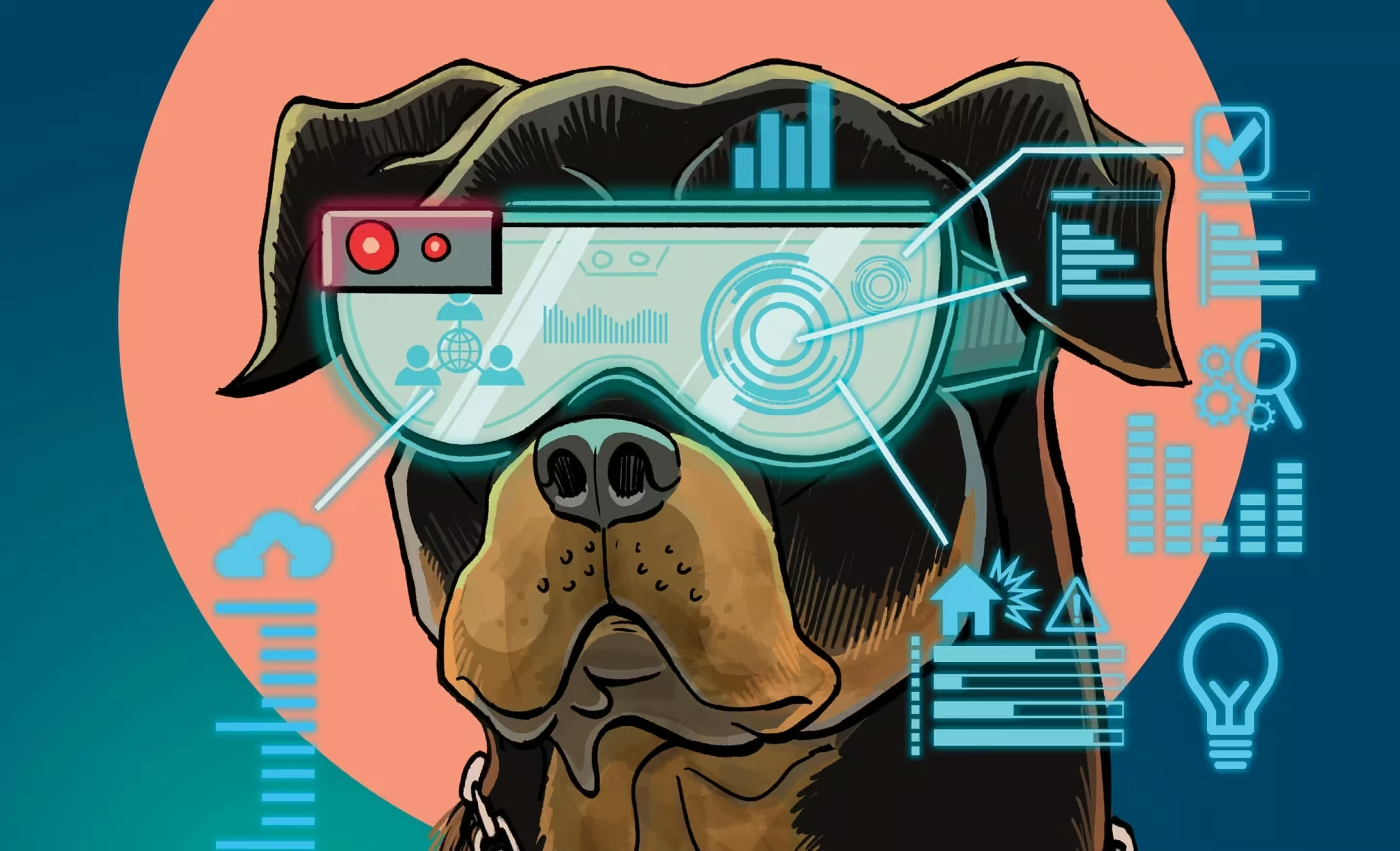
Computers aren't just detecting motion or objects anymore, they are able to identify behavior, decode context, and choose their own workflows on the fly.
For the first time in history, the camera isn't just a recording device. It’s a tool that turns the chaotic physical world into a structured, searchable database that can understand, reason, and take action. This is the breakthrough that finally has the power to shatter the productivity ceiling.
The New Workflow: From Observation to Action
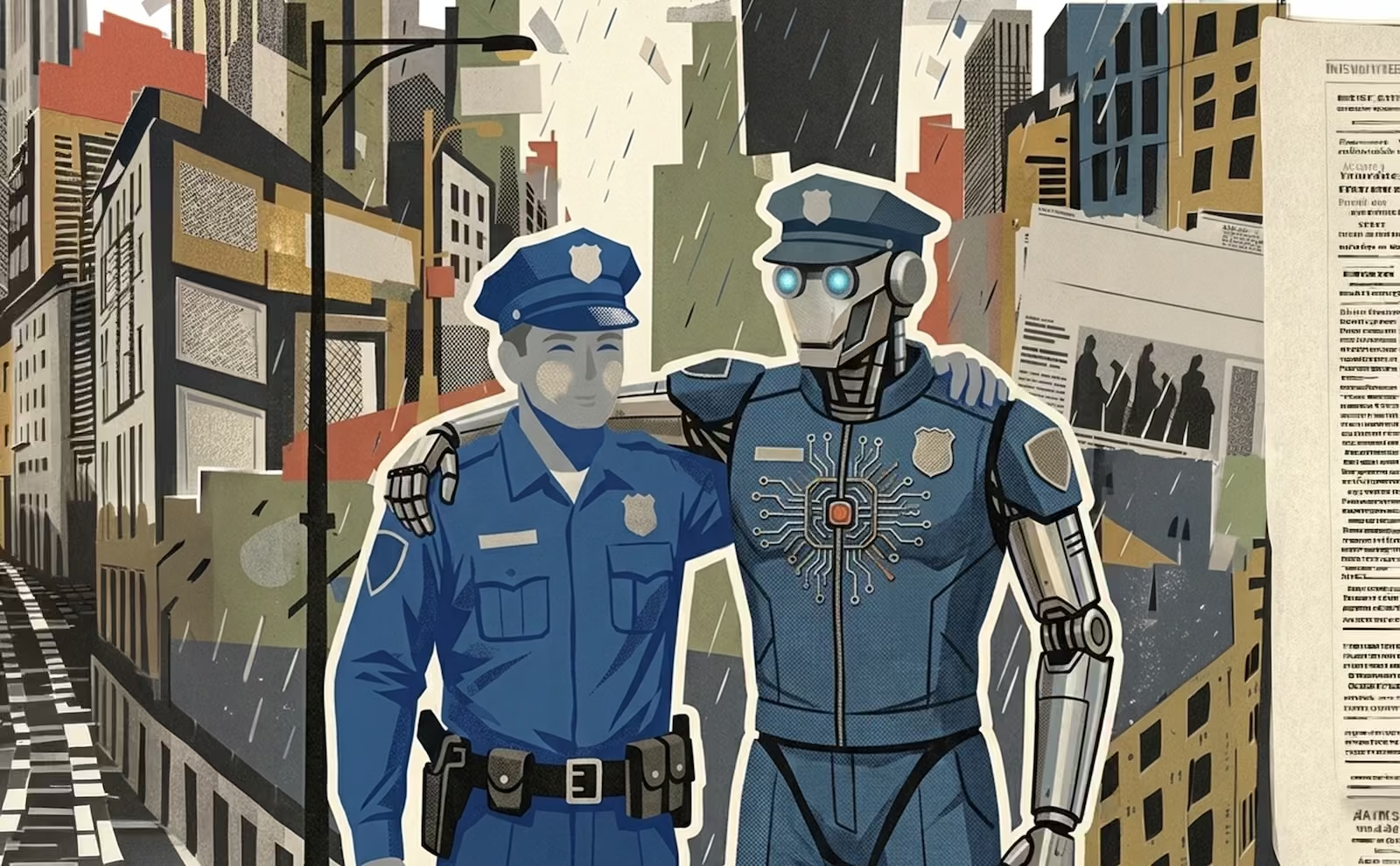
When we move from observing to understanding, the entire lifecycle of a security event changes. In the old model, a human had to be involved in every second of the process—watching, deciding, and reacting. Now the machine takes over the heavy lifting and allows the human to move from being a watcher to being a decision-maker.
First, we’ve solved the problem of noise. AI actually understands what it sees. It doesn't just distinguish between a vehicle and a shadow; it can determine that a specific truck belongs to your company’s fleet and is supposed to be there. By solving the validation problem, the noise disappears. The machine filters out 99% of the chaos so your team doesn't have to spend time on things that don’t matter.
Next, the system moves to deterrence without hesitation. Because the system validates threats in real-time, it can act faster than any human. It uses everything it has learned to determine the most effective way to dynamically deter a specific threat—deploying tracking lights and dynamic audio in milliseconds. It’s no longer just a motion light.
The system also transforms how we document and investigate. In the past, investigating a crime meant a human sitting in a dark room watching hours of grainy video. Now? It’s an intelligent search. You can type “red truck with dented hood rapidly leaving scene” and the AI will pull every instance of a red truck with a dented hood speeding away across all your sites in seconds.
The human is no longer slowing the process down. We have removed the watching and waiting from the loop so your team can focus on where they are most effective: responding to high-level threats and providing authorities with a chain-of-custody-sound evidence package. The machine does the time-consuming work. You get the result.
Teaching Old Hardware New Tricks
If the machine is now capable of doing the heavy lifting—validating threats, deploying deterrents, and organizing data—the obvious question for most leaders is: "Do I have to replace every camera I already own to get this?"
If you start with a future-proof architecture, the answer is no.
In the previous eras of security, intelligence was trapped inside the lens. If you wanted a smarter system, you had to buy a specialized camera that was hard-coded with basic rules. But AI doesn't live in the lens; it lives in the CPU. That means your existing hardware can understand what it’s seeing, regardless of whose name is on the camera.
Agentic AI
AI is a confusing term with many meanings and variations so it’s important to understand which AI we are talking about. Today, most people think of AI being tools like ChatGPT or Gemini which is Generative AI. Cool for creating videos, songs, and writing papers but Generative AI is like a consultant. If you ask a consultant for a shipping plan, they’ll hand you a beautiful document describing the best route. That’s about it.
The AI I’m talking about is agentic AI; AI that works. Agentic AI is like a logistics manager. If you tell a shipping coordinator to "Get this package to Chicago," they don't write you a report. They print the shipping label, schedule the truck, notify the driver, and report back to you when the delivery is signed for. One gives you words; the other gives you a result.
Agentic AI doesn't need a human to walk it through every tiny step; you simply give it a goal and it works out the problem until it's finished.
As the name implies, this system relies on agents. Think of them as specialists, highly capable of performing a single task.
All of those agents report to an agent manager that synthesizes those separate data points to create a holistic understanding and coordinated decision-making.
To be truly effective in the field, these agents must follow three core principles:
- Mission-Driven: If the mission is to clear a loiterer, the system doesn't just try once and quit, it works the problem with escalating deterrents until the goal is achieved.
- Situational Awareness: It understands that a box truck arriving at 2:00 PM is routine, while that same truck at 2:00 AM is an anomaly.
- Rules of Engagement: It knows its limits and follows your strict protocols. If it encounters a situation it doesn't understand, it doesn't guess—it asks a human for help.
The Last Mile: Solving the Engineering Nightmare
Although agentic AI is showing great promise in digital first jobs, it has been very hard to deploy in physical security. This is because agentic AI has been constrained to the silicon, data centers, and large language models of the cloud.
Bringing agentic AI out of the cloud and onto the muddy construction sites, busy retail parking lots, and remote rail lines, is an engineering nightmare with three massive barriers:
- The Dirt Tax: Trenching for power and fiber costs $25–$50 per linear foot. A 500-foot run can cost $25,000 just for the ditch. Getting power and communications where you need it is extremely expensive.
- Power: Modest processing for agentic AI requires about 2,700 watt-hours/day. Trying to use solar power as an alternative struggles to meet this demand, especially in winter.
- The Bandwidth Bottleneck: A single 1080p camera streaming 24/7 uses about 2GBs of data per 24 hours, limited by most cost effective commercial bandwidth pipes and hitting cellular data caps in a single day.
To bypass this, many try traditional infrastructure-heavy solutions like on-prem servers wirelessly connected to cameras but soon realize this is very expensive to design, deploy, maintain, and upgrade including time, money, and human capital & expertise.
21 years ago, LVT set out on a new approach to camera deployments; infrastructure-independence. Although it wasn’t easy, taking over a decade to perfect and resulting in over 18 patents in innovation, LVT brought to the world the first-of-it’s-kind infrastructure-independent camera system making it possible to live-stream video from anywhere on the planet to anywhere on the planet with no infrastructure needed. Not only that, but LVT delivers this capability with the highest levels of reliability, cyber security, scalability, and agility at a fraction of the cost once thought possible. And now, LVT is able to leverage its infrastructure-independent solution to deliver agentic AI to the places where physical security is needed.
The Moonshot: Intelligent Site Management (ISM)
With agentic AI, our "moonshot" isn't just security—it's intelligent site management. Instead of just seeing what is happening, we turn those events into structured data to provide actionable intelligence for the entire business.
- For safety and compliance: It identifies hazards like PPE violations or blocked exits and resolves them before they become incidents.
- For marketing: It calculates physical conversion, comparing foot traffic to store entries.
- For HR: It removes the guesswork of scheduling by predicting exactly how busy a location will be.
ISM in Action
Imagine an office building where the system automatically detects snowfall, tracks when the snowplow arrives, maps what was cleared, and verifies the invoice at the end of the month.
Imagine a railyard where the system runs visual seal checks on every car and prioritizes maintenance for graffiti that obscures critical reporting marks—ensuring compliance that keeps the trains moving.
Imagine a distribution center where the system cross-references a truck's DOT number with the manifest to prevent a driver from backing into the wrong bay. It checks the trailer temperature to ensure FDA compliance before the doors open. If a trailer separation event occurs, it triggers the emergency restraint instantly—saving lives and preventing hundreds of thousands of dollars in restitution.
Choosing the Future
We have spent over 21 years building the world's largest fleet of infrastructure-independent, agentic AI capable edge computers. Those are our rockets, and agentic AI is our fuel.
We choose to go to the moon. We choose to build a reality where you no longer have to watch and wait. We are turning chaotic physical events into structured, searchable data that not only prevents crime and saves lives but drives value for the entire business. The human is no longer the bottleneck. The era of the scarecrow is over. The era of intelligent site management is here.
Get the Latest Articles
Unlock exclusive insights from the world of intelligent site management and proactive security. Subscribe to ELEVATE to get our latest featured articles, expert interviews, and tactical insights delivered right to your inbox.