Year in Review: 2025 Security Trends

Security in 2025 was defined by rising sector-specific threats, surging AI innovation, and a shift toward proactive, integrated protection. Organizations prioritized data security, real-time deterrence, and complete site coverage—turning to unified platforms and mobile surveillance units to stay ahead of evolving risks.
It was a year of contrasts for the security industry. National crime rates hit their lowest levels in decades, but many sectors saw spikes in incidents that pushed security teams to their limits. Let's unpack the crime patterns that shaped the year and the trends pushing the industry forward, from AI adoption to the growing role of mobile surveillance units, real-time analytics, and more.
2025 Crime Trends: A Mixed Picture
In August, the national crime statistics released by the FBI painted an encouraging picture. Violent crime decreased 4.5% compared to 2023. Murder dropped nearly 15%, robbery fell 8.9%, and property crime declined 8.1%. Motor vehicle theft saw a dramatic 18.6% drop. These are the lowest rates the nation has seen in decades.
But beneath the national trends, specific sectors told a different story.
Retail Crime Trends
The Impact of Retail Theft & Violence 2025 found that shoplifting incidents increased 18%. And according to the 2025 State of Retail Safety report, over one-third of retail workers reported feeling unsafe at work.
Healthcare Crime Trends
The healthcare sector reported safety challenges like community violence, abuse, and threatening behavior. In June 2025, the American Hospital Association released a report that found violence costs hospitals $18.27 billion annually.
Transportation Crime Trends
CargoNet's second quarter report documented 884 supply chain theft incidents—a 13% increase compared to the same period in 2024. Cargo theft losses cost the U.S. trucking industry roughly $7 billion annually. If you do the math, that’s roughly $19 million per day.
Law Enforcement Crime Trends
The National Law Enforcement Officers Memorial Fund released its 2024 End-of-Year Report in January, showing that 147 officers died in the line of duty in 2024—a 25% increase from the previous year—and that firearms claimed 52 lives, up 13% from the previous year. On the bright side, the organization's mid-year 2025 report showed a dramatic reversal: officer fatalities dropped 53% between January and July.
Top 4 Security Technology Trends of 2025
1. AI Adoption Accelerated
AI has been a bit of a buzzword in recent years, but in the security industry, it’s making a real difference. According to the Security Industry Association's 2025 Security Megatrends report, 91% of security solutions developers characterized their research and development investments as fully, heavily, or somewhat focused on AI. And we’ve seen that focus materialize. Security systems use AI for automated monitoring, behavioral analysis, facial recognition, and predictive analytics. Surveillance cameras increasingly incorporate computer vision to detect people, vehicles, objects, or specific activities without requiring human review. Access control platforms are also beginning to apply machine-learning models to flag unusual entry patterns or credential misuse.
2. Data Security Took Center Stage
The average cost of a data breach in the United States reached $10.22 million in 2025, according to IBM—that’s a 9% increase and an all-time high. One of the drivers behind this spike was the rapid adoption of AI tools across enterprises. The same survey found that 13% of organizations experienced breaches involving their AI models or applications, and 97% of those organizations lacked proper AI access controls. Shadow AI (unsanctioned AI tools used by employees) factored into 20% of breaches and added an average of $670,000 to breach costs.
So, it’s no surprise that data security was a huge priority this year. With new risks introduced by AI and increasingly complex tech stacks, organizations are scrutinizing how and where their data moves, who can access it, and how securely it’s protected end-to-end.
→ Learn how LVT protects sensitive data.
3. Proactive Security Became the New Standard
Rising threats across industries pushed organizations to look for tools that could help them get ahead of issues. More and more, teams leaned on:
- Remote deterrence tools: Lights, strobes, and loudspeaker warnings that can be triggered manually or automatically give teams a way to intervene in real time.
- Automated system health checks: Platforms that send alerts about failing cameras, low power, or connectivity issues before they cause gaps in coverage help prevent blind spots.
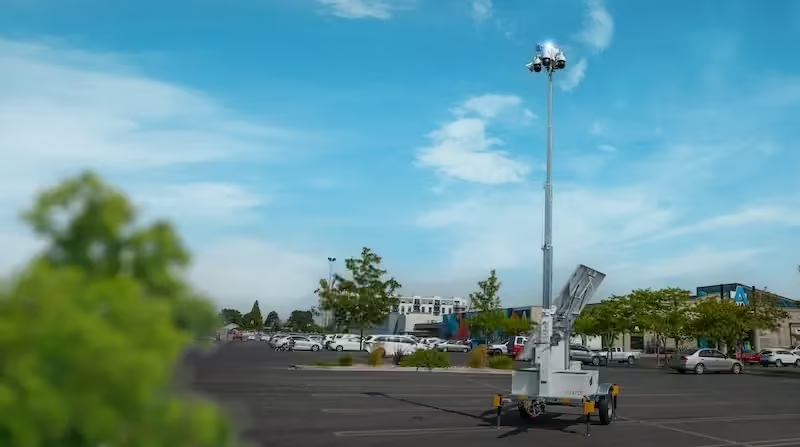
- Rapidly deployed, flexible solutions: Mobile surveillance units can be repositioned or added to fleets quickly based on shifting needs and temporary events, or to keep up as the business scales.
4. Integration Became a Non-Negotiable
Security teams have no shortage of solutions at their fingertips—video surveillance, access control, and analytics tools, to name a few. Overall, this is a good thing, but it also means teams are juggling more systems, data streams, and dashboards than ever before. Fragmented systems slow response times, bury teams in tedious work, and make it harder to spot patterns. Unified platforms, on the other hand, allow security teams to find evidence fast, automate workflows, and easily manage sites at scale.
Looking to 2026: The Shift Toward Intelligent Site Management
The trends that defined 2025 laid the groundwork for the next era of security: intelligent site management.
Intelligent site management builds on the momentum of AI and platform consolidation by unifying every endpoint—visual, environmental, operational—so teams can see patterns, spot problems, and act faster and more efficiently.
Key Components of Intelligent Site Management
Stay Two Steps Ahead with LVT
It’s never been more important to invest in complete site coverage, and now’s the perfect time to do it. New year, new security strategy.
LVT’s solutions provide site-wide camera coverage—from parking lots and loading docks to remote construction sites or retail locations. Powered by agentic AI, they automatically detect threats and trigger real-time deterrents. Whether you need perimeter coverage cameras for expansive outdoor spaces, building- or pole-mounted units for fixed locations, or rapidly deployable mobile surveillance units that go wherever you need them, we’ve got everything you need to protect your people, property, and assets.
Let’s fortify your 2026 security plan together. Contact our team for a demo.
%20(1).avif)