The Security Industry's Strategic Shift to Greater Coverage

Intelligent site management represents the next evolution of physical security, moving beyond perimeter protection to full-site visibility and proactive risk management. By combining AI-driven analytics, flexible sensors, mobile security, and centralized data, ISM helps organizations detect threats earlier, respond faster, and generate operational insights. The result is stronger security, improved efficiency, and greater return on investment across complex, dynamic environments.
The Strategic Shift to Greater Coverage
For decades, physical security was built with one focus: to protect points of entry. Cameras at doors, gates, and lobbies were designed to document who came in and out, with the main goal of investigating incidents after they occurred. While this approach made sense when sites were smaller and threats more predictable, it leaves significant gaps in today’s environments.
Organizations today operate across larger, more complex properties. Campuses, construction sites, storage facilities, critical infrastructure, and remote locations are often challenging to secure with traditional, fixed systems. At the same time, security teams face staff shortages, tighter budgets, and more sophisticated threats that move faster and exploit blind spots. Relying solely on perimeter coverage is no longer enough to keep people, assets, and operations safe. Today’s businesses need total site security.
The Next Evolution of Physical Security
In response, security is embracing intelligent site management (ISM)—a strategic shift that expands security to monitor entire properties holistically.
At its core, ISM is powered by modern technologies like AI-driven analytics, rapidly deployable sensors, mobile security, and centralized monitoring and data management platforms. These systems allow organizations to design security strategies that are proactive, intelligent, and responsive. Even in the most remote and rapidly changing areas, ISM unifies data from across an entire ecosystem into a single, informed view.
With this foundation in place, ISM delivers a dual set of outcomes. First, it enhances security features by enabling teams to detect, deter, and manage risks proactively. Security teams shift from reacting to alerts after the fact to actively managing risk as it unfolds. Second, ISM transforms physical security into a source of business intelligence. The same systems used to deter threats also generate insights into how people, assets, and spaces are used. These insights can improve safety, optimize operations, and inform smarter business decisions, extending the value of security far beyond protection alone.
Three-Step Intelligent Site Management Framework
Intelligent site management is a strategic approach built in deliberate stages. Each step builds on the last, expanding visibility, strengthening prevention, and increasing operational impact.
1. Achieve Total Site Security with Flexible Sensors and Infrastructure
The first step in an intelligent site management strategy is establishing visibility across the entire property—not just at doors, gates, or fixed checkpoints. Full site coverage means designing security around how a space is actually used, not just how it was originally built.
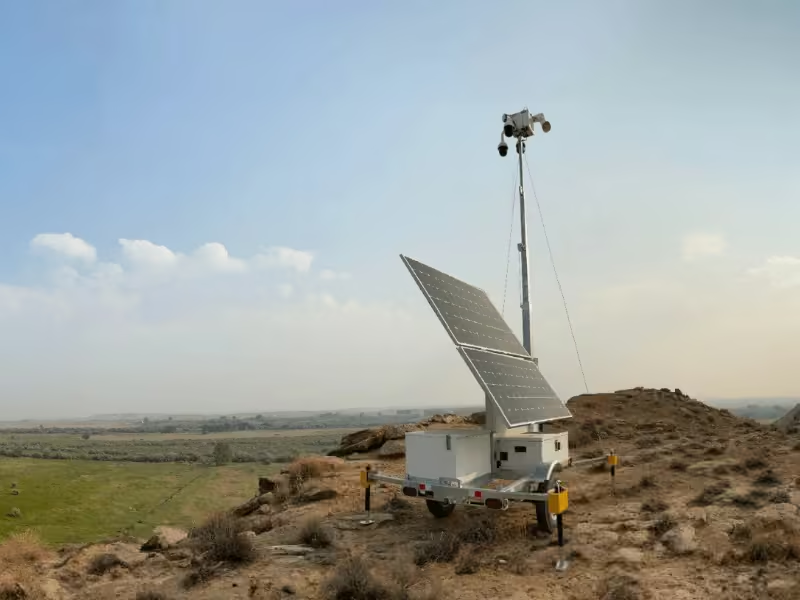
Fixed security cameras struggle to keep up with dynamic security needs. They are costly to expand, slow to redeploy, and often do not work in remote environments. Construction sites change weekly. Industrial campuses expand and contract. Critical infrastructure and storage facilities span vast areas with limited connectivity. In these settings, blind spots emerge not from a lack of awareness but from infrastructure that cannot adapt. Choosing systems that are rapidly deployable, mobile, and scalable closes gaps without the cost or time of more fixed setups.
Just as important is unification. Total site security isn’t about adding more sensors; it’s about connecting them into a cohesive system. When data is centralized, teams gain a single, consistent view of activity across the property. Surveillance shifts from passive observation to a foundation for intelligence.
With full site coverage in place, security personnel gain continuous awareness and better context, and are left with fewer blind spots. This sets the stage for proactive deterrence, intelligent insights, and faster, more effective responses.
2. Proactively Deter Threats and Generate Intelligent Insights
Once full site coverage is in place, security can shift from passive monitoring to risk prevention. Instead of reacting to isolated alerts after something has already happened, ISM enables teams to understand what is happening across a site and why.
Advanced analytics and AI play a critical role in this shift. Traditional systems focus on events: a door opens, motion is detected, and an alarm is triggered. ISM moves beyond individual moments to behavioral awareness. By learning what “normal” looks like for a site, intelligent systems can flag abnormalities that suggest risk, such as loitering, unusual movement patterns, or activity occurring at the wrong time or in the wrong place. This allows teams to identify potential issues earlier, before they escalate into incidents.
Centralized data is what makes this possible. By connecting video, sensors, alerts, and historical patterns into a single platform, security teams gain context. They can see how activity unfolds across an entire property, correlate events, and make faster, more informed decisions.
The insights generated through ISM extend beyond security. The same data used to detect threats can highlight operational inefficiencies, safety risks, and how spaces and assets are actually used.
For example, on a construction site, ISM may be deployed to deter theft and vandalism after hours. Mobile security allows coverage to move as the site evolves, closing gaps as work zones, materials, and access points change. Over time, the data can reveal recurring safety risks, such as workers entering restricted zones, equipment being staged in high-traffic areas, or material deliveries creating bottlenecks. With this visibility, teams can adjust site layouts, improve safety practices, and reduce delays by using the same system originally put in place for security.
With ISM, organizations gain visibility not only into what needs to be protected, but into how their sites function day to day.
3. Improve Response Times Across Security and Operations to Maximize ROI
Visibility and insights only matter if teams can act on them quickly. The final step in an intelligent site management strategy is turning intelligence into faster, more effective responses.
With real-time alerts and a centralized view of the site, teams no longer waste time piecing together information or confirming what already happened. When something comes up, they can see what’s happening, where it’s happening, and why it matters—all in one place. That clarity makes it easier to respond quickly and confidently.
The benefits extend beyond security. Facilities, operations, and security personnel can tap into the same visibility to respond to hazards, disruptions, or maintenance issues more efficiently. Security stops being a silo and starts supporting the broader needs of the organization.
Over time, this adds up to real return on investment. Fewer incidents, faster resolutions, less downtime, and better use of resources all reduce costs and improve resilience. Security becomes more than something that prevents loss—it becomes a tool that helps the entire organization move faster and work smarter.
Rethinking Site Security
Intelligent site management reflects a shift in how organizations approach physical security. Instead of focusing narrowly on the perimeter, security becomes something that actively supports how a site functions every day. ISM is about protecting an organization and operating with confidence, resilience, and control in environments that are constantly changing.
To dig deeper into ISM and how to provide total site security for your business, read our Full Site Coverage Buyer’s Guide, which walks through the key infrastructure considerations, sensor types, deployment strategies, and decision criteria that help organizations build a security footprint that matches how their sites operate.