School Security Measures: How to Assess Your Campus Grounds

Effective school security is essential for protecting students and staff, involving access control, surveillance, and collaboration with law enforcement to address various threats.
Nearly every U.S. school already has cameras and controlled building access. The question facing most administrators is not which measures to adopt, but where the existing ones stop working: the parking lots, fields and perimeter areas that were never wired, and the hours when nobody is on site to watch them. This guide walks through how to assess those gaps on your own grounds.
What security measures do schools use?
U.S. public schools rely on a layered set of measures, and the federal data shows which ones are near-universal and which are rare. In the 2021 to 2022 school year, according to the National Center for Education Statistics:
- Controlling access to buildings during school hours: 97 percent of schools
- Requiring visitors to sign in and wear a badge: 97 percent
- Using security cameras to monitor the school: 93 percent, up from 61 percent in 2009 to 2010
- Structured anonymous threat reporting: 62 percent, up from 36 percent in 2009 to 2010
- Random metal detector checks: 6 percent
- Daily metal detector checks: 2 percent
The pattern is worth reading carefully. The measures that spread fastest over the last decade were the ones that add visibility without turning a school into a checkpoint. The measures that stayed rare were the ones that do the opposite. That is the real constraint on a campus assessment: the goal is coverage that a student body barely notices.
Why Do Schools Need Great Security?
While some schools may be more vulnerable to danger and attacks than others, institutions at every education level, and in every location, need comprehensive security. During the 2021-2022 school year, public schools in the United States reported about 479,500 nonviolent incidents and 857,500 violent incidents. Events of particular concern include school shootings and other violent attacks that severely endanger and even, tragically, claim the lives of students, faculty, and staff.
Effective security measures protect students, faculty, other staff members, and visitors from threats, and mitigate the dangers of unauthorized entry, violence, and other dangerous situations that occur in schools.
When a school environment has been secured, it is far more conducive to learning. Students, teachers, and parents alike are better able to trust the school and its district, and can therefore focus on the educational activities at hand. The goal? We all want students to be able to unlock their fullest educational potential, and do so safely and without fear of violence or emergencies.
What Is Physical Security?
Physical security refers to the protection of people, data, software, hardware, personnel, and other assets from physical damage or attacks. Physical security measures include any efforts to protect these resources and individuals from theft, disaster, vandalism, and violence, and often entail an integrated regimen of both physical and digital defense, monitoring, and deterrent measures.
Physical Security for Schools
To maintain proper security for a school, it’s important to employ a multifaceted approach, including:
- Monitoring of access points, and access control technology for sensitive areas (e.g. biometrics, key cards, etc.)
- Emergency drills and frequent assessments
- Visitor check-in protocols and monitoring
- Communication and alarm systems
- Strategically placed cameras with continuous monitoring and analytic software (e.g. movement tracking for intruders)
- On-site security patrols or resource officers
- Training for students, faculty, and staff on safety procedures and recognizing/reporting suspicious activity
- Fencing, barriers, adequate lighting, and reinforced doors and windows
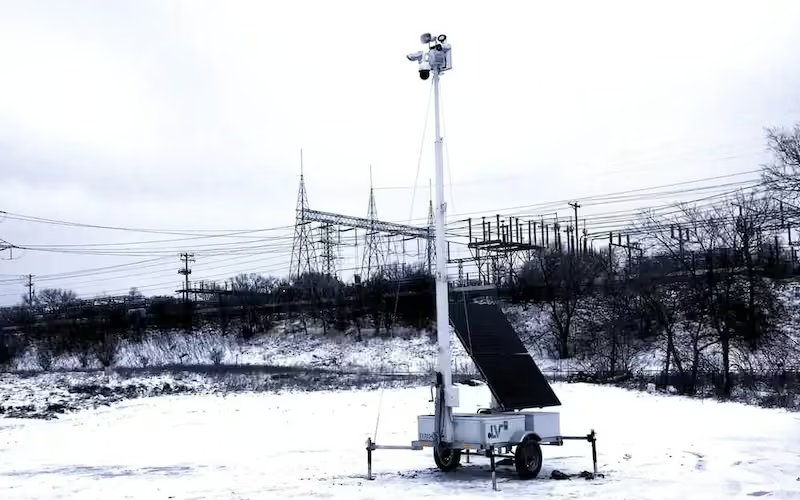
Security software, such as the platform offered by LiveView Technologies, should be versatile and able to be integrated with other security measures for more exhaustive safety and coverage. LVT's software, for example, uses motion detection that distinguishes a person from a passing car or a branch moving in the wind, so alerts reach your team only when something warrants a look.
A Walkthrough Assessment of Your School Grounds
Most security assessments start indoors, where the policies already exist. Start outside instead, and walk the perimeter at the two times of day that matter.
Walk it at dismissal. Where do students, parents and buses converge, and who is watching that convergence? Note every spot where a stranger could stand unobserved within sight of students.
Walk it after dark. Lighting gaps, unlit paths between buildings and parking areas where a camera sees a shape but not a face. Most footage that proves useless after an incident was shot at night.
Map the coverage honestly. Mark where your cameras actually see, not where they are mounted. Parking lot corners, loading docks, fence lines, athletic fields, bus loops and portable classrooms are the usual blind spots, because they are the hardest and most expensive places to run conduit.
Check what changes seasonally. Construction, graduation, game nights and summer programs shift where people gather. A fixed system cannot follow them.
Ask who responds. A camera that records an incident nobody sees in real time is an evidence tool. A camera that sends an alert to a phone is a security measure. Know which ones you have.
Different Responses for Different Threats
Your school’s security response must plan for varied threats, including active shooters, other intruder situations, natural disasters, and more. Teach emergency protocols to students, teachers, and staff regularly, and conduct emergency drills to prepare for each event.
Match each measure to the threat it actually addresses. Motion-activated cameras and intrusion detection handle after-hours trespass. Controlled access and visitor management handle unauthorized entry during the day. Mass notification handles the minutes after an incident begins. A measure chosen without a matching threat tends to be the first one dropped from the budget.
Partnering With Law Enforcement
One of the best things a school can do to build highly effective security efforts is to foster a relationship with local law enforcement. Collaborate with local agencies to create emergency response plans, and to discuss ways your partnership can prevent incidents.
You may also consider having a resource officer placed with your school, to patrol the building and be prepared for any threats. In addition to improving response times and prevention efforts, the presence of a resource officer in your school can be a powerful deterrent against criminal activity and threats.
Starting With School Culture
Even once you’ve installed the best technology and carefully crafted a security plan, the best thing you can do for the safety of your school and the people inside is to create a culture conducive to safety, transparency, and communication.
Ensure that students, faculty, staff, and parents are aware of the school’s emergency protocols. Conduct frequent training and emergency drills, and make an effort (in conjunction with law enforcement) to educate the community on how they can support school safety.
Help teachers create an atmosphere within their classes in which students feel comfortable airing issues and reporting suspicious activity. An environment filled with such trust and communication can help mitigate threats before they start.
Many incidents at schools, particularly those that end in violence and/or tragedy, stem from unresolved mental health issues. Create a culture that encourages students to speak openly and seek help in regards to their mental health. Work with parents to encourage such openness, as many issues can be better resolved within students’ own homes. Access government and charitable resources about mental health, and make it a priority within your school in an age-appropriate way.
The Importance of Technology
Your school’s security cameras don’t need to belong to the grainy, low-resolution, analog variety. Modern security practices are extremely beneficial to schools; continuous footage, cloud storage, artificial intelligence, motion detection and video analysis, intrusion detection, and other cutting-edge features can do a lot to help you prevent and investigate crime within your school. Each of these intuitive features can be found in a LiveView Technologies camera, and can catch crime at your school on a level that was never possible before.
Securing Needed Funding
Many schools, particularly within the public school system, all too often face a lack of funding that may impede their efforts to implement a security plan. Take a proactive role in securing the funds needed to keep your school safe; you may reorganize your school’s budget, appeal to district leadership, apply for federal aid, or seek donations from local figures and businesses.
School Security FAQs
What are the best security measures for schools?
There is no single best measure, but the ones with the broadest adoption are controlled building access and video surveillance, each used by more than nine in ten U.S. public schools. The highest-value addition for most campuses is not a new category of technology, it is extending existing coverage to the outdoor areas that were skipped because wiring them was too expensive.
Why is school security important?
Beyond preventing and responding to incidents, security affects the ordinary school day. Staff spend less time patrolling, administrators spend less time investigating after the fact, and students in an environment that feels safe are better placed to learn.
How often should a school security assessment be done?
At least annually, and again after any physical change to the campus: a new building, a construction project, a changed traffic pattern or a new after-hours program. Each creates blind spots the last assessment never saw.
Protect What’s Precious With LVT
School security is extremely important to students, faculty, staff, and parents. LVT surveillance systems offer a strong physical security program, providing a comprehensive solution for school monitoring. Real-time footage and alerts, as well as high-definition footage, enable quick response times and thorough investigations.
LVT school security solutions are equipped with AI analytics among other features which greatly increase safety. Discover a new level of security, and protect your school in the most comprehensive way with LiveView Technologies.