Maximizing Campus Security Resources

Securing a school campus presents a unique challenge for security professionals, especially for colleges and universities: Many are designed to be open, inviting, and shared with the surrounding community — the opposite of a traditional lock-and-key corporate site. That openness is the point, and also the challenge.
In this session, Capt. Marty King with the University of South Florida Police Department brings the perspective of a massive public university system — on-campus housing, commuting students, sprawling parking complexes, and a full-scale campus police department navigating intruders, strong investigation process, staffing shortages, and board-level budget conversations, all at once.
Featured Speakers
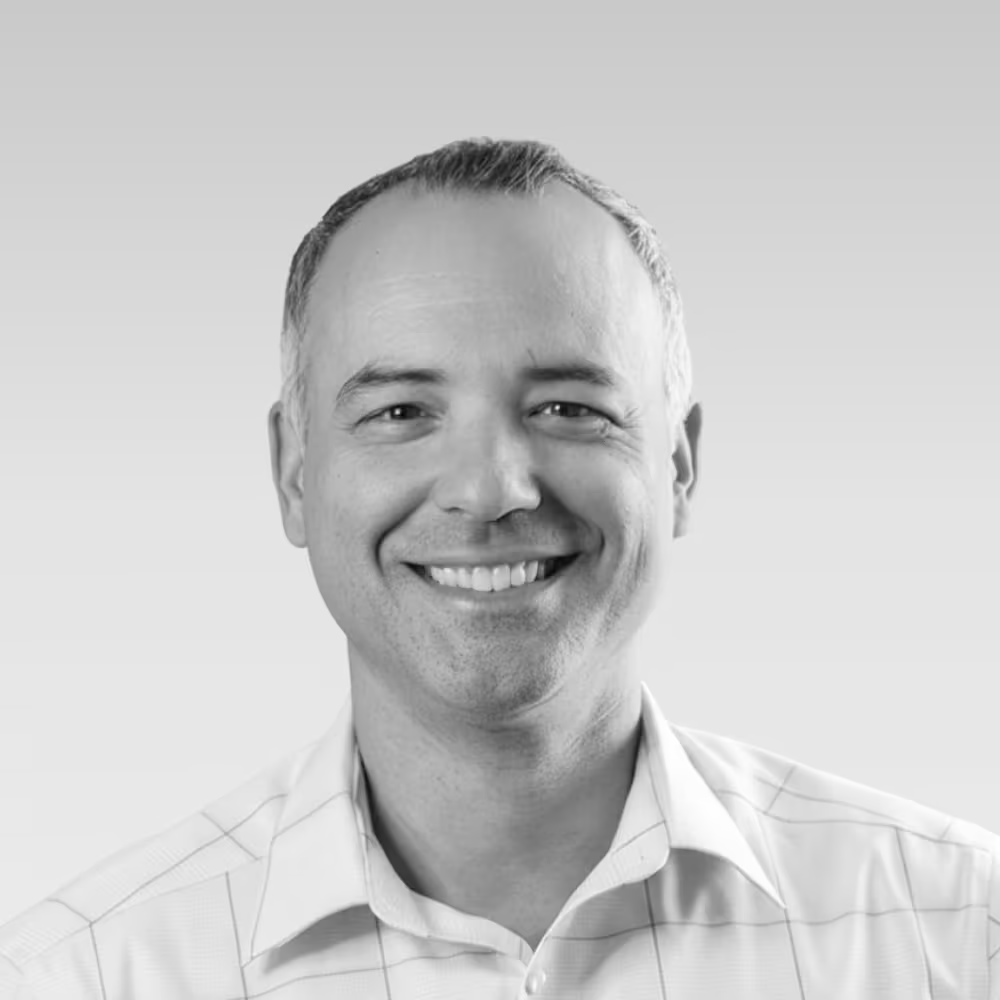
Aaron Luna
Aaron Luna brings 14 years of journalism experience to his role as LVT’s webinar host and webinar marketing manager. As a former news anchor and PBS host, Aaron spent over a decade covering law enforcement, crime, and local government—gaining an inside look at the security challenges facing both public agencies and private organizations. An expert interviewer who has engaged with high-profile newsmakers, Aaron understands the art of asking the questions audiences want answered. Today, he channels that same curiosity and clarity into every LVT discussion.
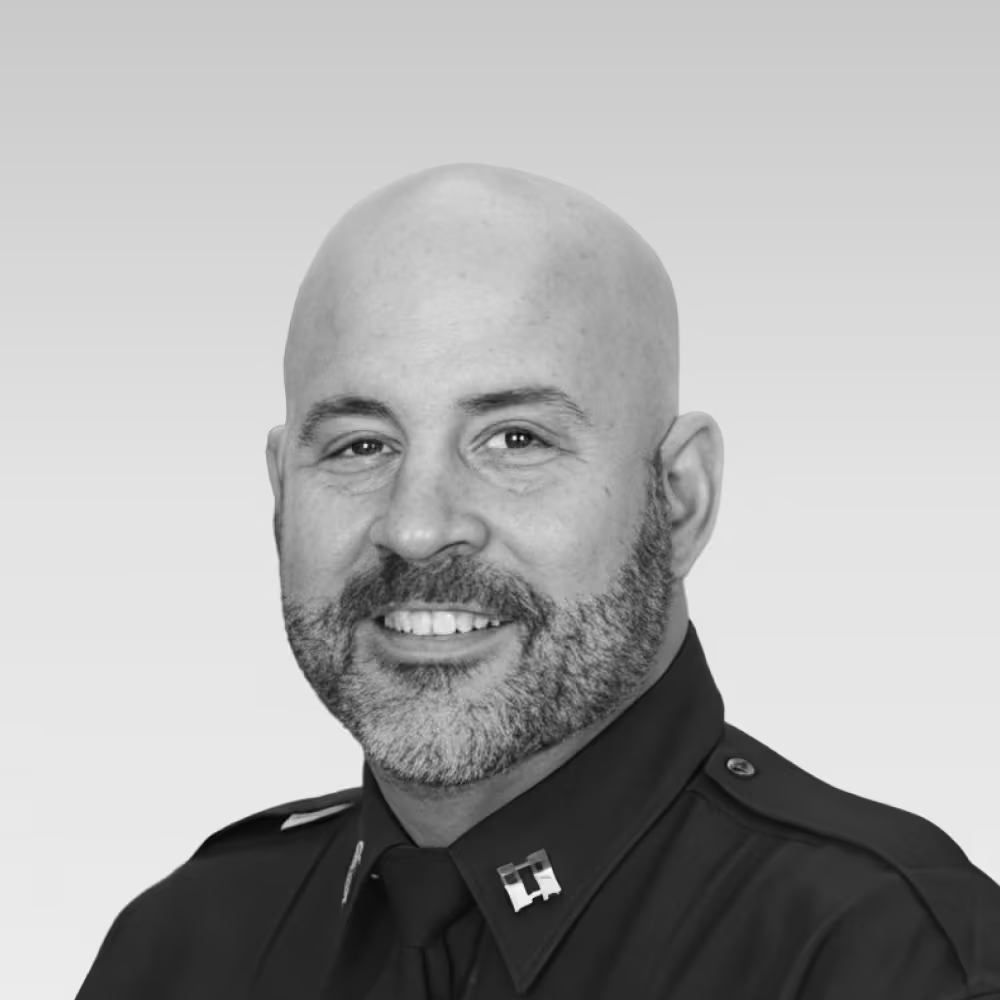
Captain Marty King
Captain Marty King has served the University of South Florida Police Department with distinction since 2000 and currently holds the rank of Captain. He serves as the Commanding Officer of the Special Operations Bureau, which encompasses Criminal Investigations, Crime Prevention, Special Events, the Marine Unit, Bicycle Unit, and Drone Unit. Over the course of his career, Captain King has held a wide range of assignments, including Uniform Operations, Field Training, Criminal Investigations, Bike Team, Tactical Response Team, and service as a high-liability instructor.
Protecting Your Local Campuses
Campus safety directly impacts enrollment, student retention, institutional reputation, and your overall community culture. In this session, we dove into the strategies university police and safety directors are using right now to secure their perimeters, maximize current personnel, and stop incidents before they escalate or happen.
What You'll Learn:
- The Open Campus: How to secure a footprint shared with the surrounding city — student housing, commuter lots, athletic complexes, and public right-of-ways included.
- Technology as a Force Multiplier: Logistical realities of law enforcement staffing, and how putting the right tech in the right place allows an officer headcount to stretch further.
- Evaluating Security Tools: Using a checklist to evaluate new tools—making sure they are intuitive, easy to manage, and genuinely makes your team’s jobs easier.
- Rapid Deployment for Dynamic Events: Strategic approaches for handling sudden, temporary security needs—from high-profile VIP visits to game-day events.
Full Transcript
Aaron Luna:
Our topic today is called Maximizing Campus Security Resources. We have a full room of educational security professionals here this afternoon. Let's set the stage. Higher education security. It's really a different animal from corporate security.
Campuses are designed to be open. They're meant to feel like communities. Sealed lock and key playbook really doesn't work. My name's Aaron Luna. I'm with LVT. I'm really pleased to have Captain Marty King joining us today. He's coming at this from a world of a public university system, tens of thousands of students. They're commuting. You have sprawling campuses, a large scale police force to match that as well. Captain King, thank you so much for being with us today. I appreciate your time here. I want to pull up just a few. I got your glamour shot as well, Captain King. So I'm just going to pull this up, give you a little background, give everyone a little background on what you've been through as well. You've been with the University of South Florida Department since 2000, serves as commanding officer of the Special Operations Bureau, which encompasses criminal investigations, crime prevention, special events, the Marine Unit, the bicycle unit, the drone unit over the course of your career.
Captain King, you've seen a wide range of assignments, including uniform operations, field training, criminal investigations. I could go on and on tactical response team, and you also serve as a high liability instructor. Just really want to thank you for your time today.
You've had quite the experience.
Captain Marty King:
Thank you for having me. I appreciate it. And it's been a great career so far.
Aaron Luna:
And you're currently with the University of South Florida. Just a couple of stats with the university to just kind of set the stage for everyone here. University of South Florida has roughly. Let me just pull this slide up. 50,000 students. This is from last year as well, founded in 1956. 14 colleges, you have three campuses, over 16,000 employees. Going to give you an idea. I'm just going to show you this video real quick. It's really quite a nice campus, extensive campus. It does cover a lot of ground. Looks really walkable. You probably have people coming in there from the community who just jog through or do whatever they're doing just to kind of have a nice little getaway as well. Tell me a little bit about your team, how you approach covering a campus this size in multiple different areas.
Captain Marty King:
Yeah, I appreciate it. Well, obviously working on a campus environment is a unique type of law enforcement. It's not only proactive law enforcement, but it's reactive at times, but there's a strong emphasis on community engagement and crime prevention. And so really to be successful in those elements, you've got to incorporate all the different sections in the agency working towards that one goal, understanding problems, finding solutions for those problems, and understanding that every four years your population turns over. And with that turnover, you're doing another refresh and starting again as incoming freshman classes come in, building the culture of expectations on a campus and what's permitted and not permitted. And a lot of these kids, they're away from home for the first time and slowly becoming young adults. So there's definitely challenges in that type of law enforcement to quickly get them to grow up and understand actions have consequences.
So it's definitely a team effort and team environment.
Aaron Luna:
And how does that team get distributed across the areas that you cover?
Captain Marty King:
Yeah, like typical police departments, we have a patrol section, criminal investigative section. Obviously the administration bureau is the backbone to supporting both those bureaus. And then working closely together, like I said, to identify the problems on campus, building strong partnerships with student organizations, administration, faculty, staff. The nice thing, unlike the population turning over, there's coworkers out here that I've known for 26 years in different colleges and universities out here. So to be able to build off those relationships and likewise, they can build off their partnership with the police department is a strong foundation to have.
Aaron Luna:
I would imagine you have a pretty strong partnership with surrounding law enforcement agencies as well.
Captain Marty King:
We do. We have great relationships within Hillsborough County. Being a big university environment, we have a lot of special events that take place on campus. We're in the process of building a 35,000 person stadium set to open August of 2027. So having external relationships that are strong is important to. We can't do it on our own. We're not a huge department, so having resources from city and county definitely is a force multiplier to get the job done.
Aaron Luna:
Do you have stipulations that require a certain amount of employees per the number of students on campus or that attend?
Captain Marty King:
So as far as the sworn side, there's no heavy mandate. We do have internal goals, an officer to student ratio we like to follow. Sometimes it seems like it's a challenge reaching those levels between budget constraints and recruitment efforts and other agencies as well. We're all fighting for the best employees and the best officers, so you have to be strategic about your recruitment, but we definitely could always use more officers out here and the population is always increasing. So unfortunately, it feels like we're always playing catch up to meet those numbers because of how rapidly we're growing out here, but we do have at least what we need to get the job done.
Aaron Luna:
How do you spread your team around? You have parking lots, you have buildings, you have areas that are covered with trees. So I mean, visibility isn't line of sight most of the time. Talk a little bit about your deployment, if you will.
Captain Marty King:
Yeah, that's a great question because obviously we leverage technology as much as we can, either fixed cameras or PTZs, but I think nothing beats traditional policing and that's getting out there on foot, walking through buildings and residence halls and open areas. I'm a big advocate of bicycle patrol, especially on a college campus. I think just the benefits of having someone mobile on a bike to get in between and around buildings, unlike traditional methods of maybe golf carts or other motorized ways to get around, you could come up on things in progress just by the stealth nature of a bicycle. And again, from a crime prevention perspective on a college campus, just like canine officers and dogs, everyone loves cops on bikes and they're very approachable, very friendly. And we encourage our officers during the bike patrols to engage the population as much as possible.
Aaron Luna:
Who's friendlier? Cops on bikes or cops on golf carts?
Captain Marty King:
I would say the bikes, yeah,
Aaron Luna:
Except
Captain Marty King:
For the heat of the summer.
Aaron Luna:
Yay. At least you got a little coverage there. Yeah. I want to show you this slide real quick. We pulled up some data about after hours campus security. 86% of colleges report violent incidents after hours being that 10:0 PM to 20 AM as high as risk. And typically that's when security presence is a little bit lower during those off hours. Obviously not as many people on campus. How do you go about addressing issues like that?
Captain Marty King:
Well, I think that's where your partnerships come into play. A lot of universities, including ours, have what we call the safe team, which are a student-run organization that from 6:00 PM to 2:0 AM operate golf carts to provide transportation from one point to another for students. We've had it for a couple of decades now. It was Uber before Uber basically. So that's one way. Leveraging technology. We have a USF Safe app, which allows students to set timers, remote timers if they're walking alone, and it requires them to check in when they get someplace. Otherwise, the police department will get notified that they didn't check in and we do a follow-up call. Again, fortunately, our squad size doesn't decrease in the evening between sworn personnel and security community service officers we have. We know at night, sometimes undesirable elements will tend to encroach in on our territory, and it's important that our officers stay engaged, again, with the bike patrols of just high visibility.
We like to drive with our cruiser lights on, which is kind of new the last few years for law enforcement. Instead of the flashing lights, they're solid red and blue. And that coupled with our campus blue light phones where no matter where you're standing, you could see the next blue light phone within the distance. So if in the event there is an emergency, we instruct our students to seek. Obviously, everyone has cell phones on them now, but in the midst of an emerging incident, they could run and hit the blue light phone. We'd know exactly where they are and be able to respond.
Aaron Luna:
And during those times when your staff isn't maximized or you have just an excess of people coming on campus for certain events, what sort of technology are you utilizing most often as a force multiplier to cover those areas you can't always get through on a bike or when people are super busy with those types of things happening?
Captain Marty King:
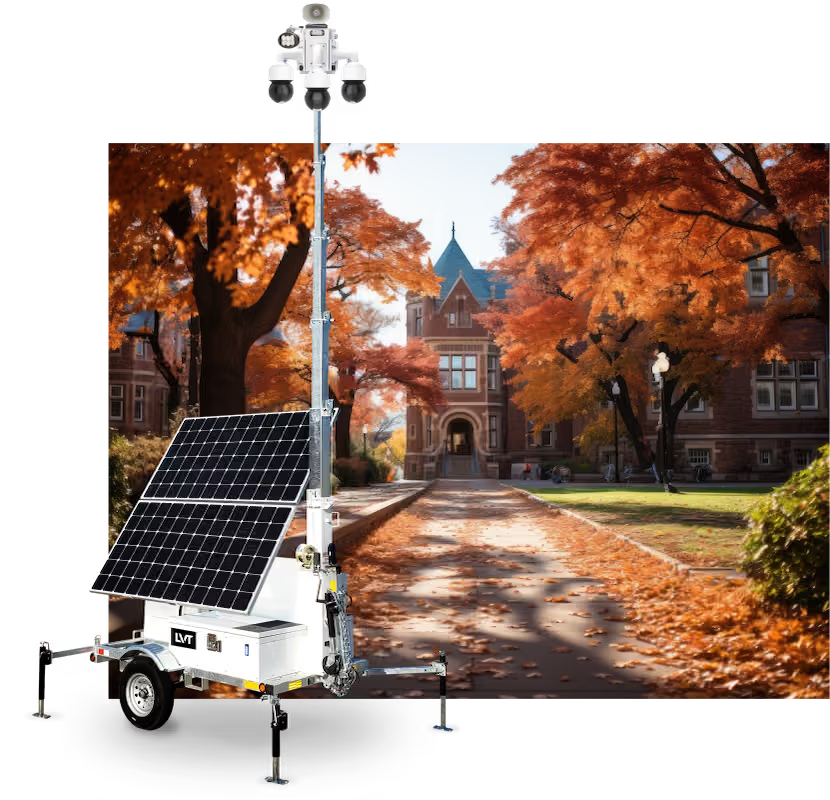
Yeah, absolutely. So a few years ago, we ended up investing in a couple LVT trailers, and that has been a force multiplier and a huge benefit. The flexibility of being able to deploy and redeploy depending on the situation. We have used those. We use them in a hybrid fashion, unlike maybe some other agencies. For special events, we redeploy them to monitor the exterior areas of our arena where we traditionally didn't have camera coverage. If we're doing surveillance operations for either burglaries or vehicle thefts, sometimes we deploy them overtly and covertly. So either we'll drop them in the center of a parking lot or we'll set them up some distance away with the technology to be able to zoom in on the parking lot to see what's going on. And then I also have used them for First Amendment protests and other protests on campus where they've maybe gathered in a location we didn't have optimal visibility. And again, my criminal investigation section uses it quite frequently in areas where we may have a rash of crimes taking place to provide, again, overt and covert surveillance.
Aaron Luna:
Talk to me a little bit more about the overt use of it. So you're putting it in a highly visible area to see the effects immediately, or you're hiding it to just monitor a situation. Am I getting that right?
Captain Marty King:
Yeah, so sometimes we'll incorporate other technology as well. So having it obviously in an overt section may be an area we're getting hit that we know we don't have a lot of coverage at. So if we can maybe push that to another area that we know is better covered, which allow us maybe to get a stronger identification because of the size and scope of the equipment, that may push them a couple buildings over. And then obviously from a covert function with the PTZ capabilities, if it's an area that we want to evaluate, we could do that from a distance, which has been nice.
Aaron Luna:
And how do students react? I mean, you have something that usually sits on the corner of a building, people start to get used to that, and then all of a sudden they have a unit in the middle of the parking lot. What have you heard from your students? Do they love it? Do they hate it? Are they just kind of blase fair to it?
Captain Marty King:
Yeah, I would say it's a little bit of love it and laissez-faire to it. I mean, we haven't had anyone complain that they feel like it's big brother watching. I would say initially before we had some police department graphics put on, we were questioned on what is it and whose ownership of it? So we had some badge decals and some signage go on it, which they now know it's a police product and providing oversight. But we've had a positive response from it. We've had a lot of success from it as well. So hence why we ended up purchasing a second unit last year.
Aaron Luna:
That comes with the cost. How do you show results or lack of results when you have a deterrent that works well? Obviously you're tracking that data, so you're being proactive instead of reactive. How do you pass that on to your administration and go for those funds and say, "Hey, this is working. We don't have as many incidents. This is why." Sometimes it's hard to quantify that type of data when you're asking for more money.
Captain Marty King:
Yeah, I think for us, it starts with risk, not so much the technology. We need to establish what the vulnerability or operational problem is before we find a solution. Being on a college campus, obviously property crimes is one of our biggest issues. Most of the time, bicycle thefts and vehicle thefts or burglaries. So with that operational problem that we have, and like most big cities, it comes in waves and ebbs and flows. We were able to provide an argument and justification of why an increase in technology would help us reduce those problems. And we have the data to show that. Not only the LVT cameras, but we've deployed other cameras as well at certain locations and bridging a lot of that technology into one platform as much as we can.
Aaron Luna:
I want to pull up a graphic real quick for you. So we're talking about remote parking areas, third most common location for violent crimes, primary target for vehicle theft. We were talking about that. When you put something in that, you see a 51% crime reduction with that proper surveillance. Do you find those numbers relatable?
Captain Marty King:
I would say they're very similar to what we've seen over the years. Yeah.
Aaron Luna:
You also talked about you guys are building a new football stadium. Football's a pretty big sport down there on your campus. Talk to me about some of the hurdles that go into securing an ever-changing environment when it comes to that kind of engineering.
Captain Marty King:
Yeah, so we've had the Yingling Center, which is a 10,000 person arena on this campus for the last few decades. And so with the stadium being a little over three times the size, it's really just the scalability of the event. Obviously 10,000 versus 35 to 40,000 is quite the difference. So everything gets multiplied by three or four. So we're building out our operational plans to provide the highest level of success and safety. And really what that entails is just making everything scalable, understanding all contingencies and what-ifs. And then we're in the early planning stages right now, but repping out as much as you can prior to game day. And like we mentioned in the beginning, this isn't just going to be a USF police endeavor. It's going to be agencies from all over the Tampa Bay area assisting, which is good because there's buy-in there and we all have the same common goal.
Aaron Luna:
Yeah. And so when you're working with the construction crew, they have their own security to watch over material, property, secure the site at night. How do you augment that? Are you using those mobile resources as well?
Captain Marty King:
We do. I mean, they do a pretty good job on their own, and I think communication is key whenever you have any large scale project taking place that has vulnerabilities. So we do stay in contact with the contractors regularly. They do keep the areas secure. They do have their own private security there, but we do supplement it. We have moved our cameras around and our LVTs at time to supplement areas they're a little more concerned with. Maybe there's an ingress or egress issue that's not buttoned up for the night or something that we've provided additional assistance with. But again, it's about communication. I think with anything, especially on a college campus, communication and partnership is the key to success.
Aaron Luna:
When is that construction scheduled to be finished?
Captain Marty King:
So it's scheduled to be finished in May 27 with the first game September 4th, and we're excited. We're excited for it.
Aaron Luna:
Are you hiring for this occasion? Or how does your department absorb the added population on campus during those days?
Captain Marty King:
Yep. So obviously, like I said, we're always hiring between retirements and people moving on and stuff, and then trying to keep up with the pace of the scale and size of the university we are hiring. But that's when we leverage the partnerships with the other agencies. I mean, they're going to be a vital supplement to game day staffing, which we're anticipating anywhere from 185 to 220 officers on game day. So it's going to be a large endeavor and it's going to be a lot of moving parts. And I'm sure the first year, just like anything, we're going to find a lot of things we did well and things that we can improve upon. But my goal overseeing special operations is to reduce that as much as we can, and that way we can mitigate any issues at the front end.
Aaron Luna:
When you're using hardwired security, hardwired cameras, and then you're also incorporating a mobile security unit, what does your command center look like? Screen fatigue is a thing. You're trying to monitor multiple things. How do you get that all one platform and make it as user-friendly as possible?
Captain Marty King:
Yeah, so that's been the challenge over the years is having numerous platforms that don't talk to each other and having you pull up different screens. And there's just not a lot of overlay with things. And obviously over the years, as most law enforcement professionals know between Genetec and Fusis and some of these other companies, we now have the capability to feed that technology into one platform. And that's really been a game changer. We're in the early stages of onboarding Fusys, so that technology's new to us, but it's a well-proven technology. And I think when you can reduce the amount of software platforms and pull as many different technologies into one platform, you have a much higher chance for success of monitoring and apprehension of issues if needed.
Aaron Luna:
With all the new technology coming in and the force multipliers that you're using and all these AI tools that you have, has that changed the way you fundamentally operate security on campus? Or is there one sort of catalyst that has said, okay, now we need to do something completely different, or it gives us the opportunity to do something completely different?
Captain Marty King:
Yeah, I think it's important to have the security to be layered, if you will, to have different elements of it. Nothing gets rid of old-fashioned police work and the effort that that takes. But the technology really needs to be seen as a tool. It's not the end-all, be-all. But I think most of us realize that our detectives and officers back in the day used to spend two, three, four hours reviewing video surveillance footage looking for someone in a blue shirt. And now that really could be accomplished in minutes or 30 minutes or less. So those are needed resources and the technology's great and this new wave of AI technology allows to clear time for detectives and officers. But at the end of the day, you still need to do the traditional boots on the ground, investigative aspects to solve anything.
Aaron Luna:
And as you know, technology is not always super reliable. Might get hit by lightning or something, and it caused your computer to fry that actually happened to you. So we know that you still have to have boots on the ground there. What are some of the costs with employing these new technologies with the extra camera, the MSUs out there, the mobile security units? What are some of the costs that you might not think about upfront that you've had to incorporate into your budget?
Captain Marty King:
Well, I mean, I think you have your initial outlay of expenditures, but a lot of times there's recurring cost that you have to factor in after either the contract expires or some things have service agreements that you're not aware of that could be costly and quite large. So I think one of the important things that we've done over the years is whenever we're interested in a technology, we don't overinvest in something right away. I'm real big on scalability, so we may try one platform out or one technology out, get some success out of it, and then realize now we could build upon it and make a larger investment. So I think to leadership, that's always a financially responsible approach to have the technology in place on a scalable level with the data showing the success and then being able to scale that out larger with the larger investment.
Aaron Luna:
What's your advice for security teams who really want to get the best value, but they don't have that blockbuster budget to spend? Where would you suggest they start?
Captain Marty King:
Again, scalable, maybe starting small that's within the budget parameters and validating the success. There are a lot of grants out there. If you look into a lot of the federal and state websites, there are grants out there that they are time-consuming and you got to be into writing grants because they are labor-intensive, but there is a benefit at the end. And it's, again, being able to maybe afford something and implement something that was just outside your budget. And so we've had a lot of success with the grant aspect of things as well.
Aaron Luna:
Everyone has a cell phone these days. How do you incorporate everyone's cell phone into your plan to secure the campus using other people's technology or the technology at hand, so to speak?
Captain Marty King:
Yeah, so again, with the increase of the technology over the years, there's nothing that our officers can't do on their cell phone now through the software that we have. CAD, RMS, camera systems, controlling the cameras. Our IT department has incorporated all the software platforms or pretty much most of them that are on the desktop within the officer's cell phones. So for the most part, I'd say about 90% of what they can do on their laptop or in their car, they can now facilitate through their cell phones as well. And again, that saves officers time from having to go back to their cars to get a camera or document something or pull something up on. If they're running a subject, they can now do it out in the field, away from the car. So definitely has been an increase in efficiency having that technology being able to have dual platforms between desktops and cellular applications.
Aaron Luna:
A lot of that technology comes with mobile alerts. How has that changed the way you respond to things as well? And is it always effective?
Captain Marty King:
So we have a layered approach with the mobile alerts. Depending on the type of incident occurring, we could take over all the desktops on the campus and blast out an alert there. We have sirens on campus. We have technology that sends out text messages, reverse phone calls, reverse 911 calls. So it's really dependent on the type of situation, how far reaching or widespread, how imminent the situation is. But yeah, I mean obviously everyone has their faces buried in their phones these days and there's not a lot of situational awareness unfortunately. So you got to leverage that technology since the phone's in their face. That's a good way to get ahold of people with either text alerts or reverse 911.
Aaron Luna:
And your security systems, did they send your officers or your command staff alerts as well like, "Hey, we've got this happening," or a large group of people are forming, or whatever you have the parameter set to.
Captain Marty King:
We do. We have that ability. We have the ability for people to text us, text 911 or text tips and stuff to us that we get. Obviously email's a huge thing for something that's maybe not as time sensitive, but we definitely support the two-way communication aspect of not only providing information to our community, but allowing the community to provide information back on something they need to. Unfortunately, sometimes they tell us something that's time-sensitive and we get it sometime later because they though email was the appropriate way. But that comes down into, again, communicating to them the importance in our crime prevention programming is the most appropriate way to communicate to law enforcement.
Aaron Luna:
Is there something out there that you've tried that you would tell every security professional, this is where you start, or this is what's going to be the most effective moving forward, or this is the start of a new technology that's going to change our job? I mean, there's so many options out there. I'm just curious if something really stands out to you.
Captain Marty King:
I mean, over the years, we've had our failures with things that we've tried that we thought were great and just didn't turn out the way we planned. I really think we're on the forefront with this AI technology of really changing the face of law enforcement between AI being able to write law enforcement reports now for police officers, which is new technology coming out to some extent, to evaluating the reports and how, what's the word I'm looking for? How solvable something is based on the elements of what the officer put into the report and whether it's worth pushing onto a detective for follow-up. I really think as this AI technology gets refined, it's really going to change the face of law enforcement and what resources we have.
Aaron Luna:
And it seems as most days everyone wants to see the video. You almost don't have a case if you don't have video.
Captain Marty King:
Absolutely. And I think it's important for universities and cities and counties to really invest heavily in the video technology aspect of whether it's key intersections or locations or parking lots. We've had several high profile incidents out here to include a couple homicides over my career here that if it wasn't for camera technology in parking lots, I don't know if those cases would've been solved. Between that and some license plate reader technology, they really within hours had us tracking down suspects and ultimately apprehending them.
Aaron Luna:
You guys have everything covered on the ground. You also have a drone program. How new is that for you guys?
Captain Marty King:
Yeah, so we've had it for four or five years now. We started out with the DJI drones. State of Florida had some restrictions on that, so that technology got pushed away and we had to focus more on federal approval drones. We've got five drones now that we use, again, for special events, missing people, and all aspects that we need to. We've used it for traffic crash investigations. So yeah, back in the day, in order to get any kind of aerial support, you'd need a helicopter or an airplane. And obviously that's far exceeds a lot of budgets for law enforcement agencies. So the drone program has been a game changer to get that elevated platform. And we anticipate for the incoming stadium next year and the large crowds I hear So that's something that we're going to get leveraged very nicely and a lot of use out of.
Aaron Luna:
Yeah, that was kind of my next question. How often do you use the drone program? And the weather's not always great in Florida, despite what everyone will tell you. There are some winds and things of that nature. Is it cost-effective, I guess?
Captain Marty King:
I would say you can't really put a cost on potential saving of a life. And for a perfect example, this weekend we had our summer commencement. We had upwards to 15 to 20,000 people out here throughout the day on a Saturday. We had the drone deployed. We used it for a missing person that had a disability that wandered away from his family for two hours, and he was ultimately located about a half a mile away in a parking lot. And then we deployed it for traffic surveillance to help us with the ingress and egress of vehicles. And then also just crowd monitoring and monitoring the size and scope of the crowd and where they were flowing and where we may need to reallocate some of our resources. So just this past weekend alone, it paid huge dividends of an aerial perspective that in the past we just wouldn't have.
Aaron Luna:
Yeah, that's great. I love that technology on the ground and in the air, just covering all angles is really cool. I just want to remind all our guests today, if you have questions, throw them in the chat. We'll probably get to our chat pretty quickly here. What's one thing that really excites you, Captain King, when you go to work every day?
Captain Marty King:
After doing this for 26 years, I could still say just the interaction with the students. Having two kids myself that are college age or in college, it even resonates with me now more than ever, just the impact that we have on these students' lives and the ability we have to influence their success. And our goal here is to create an environment where they can be successful. They're the future leaders of this country and this world. And the last thing we want them to do, and unfortunately in this day and age, these kids and these students have a lot of stressors with active shooters and active threat calls. If we could create an environment where they feel safer and not have to worry about that and they could focus on what their job is out here and this education, I think then that's where we're successful. Yeah.
Aaron Luna:
Is that the biggest fear that students have coming on campus that you hear from them, active shooter situation or mass casualty situation?
Captain Marty King:
Yeah, I would think so. And I think no matter where it happens, unfortunately in the United States, you feel vulnerable as soon as you hear about it. I know when I hear about it at another university or if it's a church or something, I immediately want to make sure that obviously we have our resources in place, that we're prepared. And so yeah, it is. And unfortunately in this day and age that as prevalent as it is, it does hit home whether it's local or somewhere across the nation.
Aaron Luna:
Yeah. I want to go take us to our Q&A portion as well. If anyone has a question, just throw it in the chat. We'll get to it if we can. A couple of questions we have so far. On average, how long does it take to bring your security team up to speed when you incorporate this new equipment? I would imagine that's part of your training, but what's the lag time?
Captain Marty King:
Yeah, I mean usually it's a couple weeks. We'll get some key people within the department spun up to get them as much as subject matter experts as we can. And then over that course of a couple weeks with those internal trainings from either the vendor or internally, once they're comfortable with it, we'll roll it out to whatever section of department is going to utilize this technology and make sure they're comfortable with it. So I'd say on average from initial implementation, we're probably looking at 30 to 45 days before it gets rolled out and utilized and people feel comfortable with it. And then the importance obviously is continued training on that. Sometimes I think agencies forget that as new officers come in, they may not receive that initial training. And if it's not done correctly or through the appropriate channels, it could get watered down. So I think it's important to not only do the initial training, but roll out regularly quarterly trainings on technology or equipment that's needed.
Aaron Luna:
Especially with the tech stuff, you're always going through updates and different program changes and things of that nature.
Captain Marty King:
Absolutely.
Aaron Luna:
Yep. Is there something you though was going to be super awesome, you were super stoked about, and then it kind of flopped on you? You don't have to name names, but if there was something that you thought was going to be good that didn't work out as well. Or maybe the other way around too.
Captain Marty King:
Well, there has been a couple of things. There's been some software platforms that we've used for threat assessment that we really thought would be game changers from the initial. And I think that's what I would say to those listening is the sales pitch is great. And I think it's really important that beyond the sales pitch that you get a trial of something 30 or 60 days before you make any commitments to really kick the tires. Because sometimes we've incorporated some stuff and it's not exactly the way it was sold. And the capabilities that they said were forthcoming in the near future weren't as near as we were led to believe. And so we had to end the partnerships or not proceed with the purchase. But yeah, there's been a couple that you just got to do your due diligence to make sure what you get is exactly what's being sold to you and not promise of next year we're going to have this provided.
Aaron Luna:
Yeah, try it before you buy it.
Captain Marty King:
Absolutely.
Aaron Luna:
Type of thing. Have you tried anything when you're talking about technical software, AI programs that claim to be able to identify a weapon on a campus, just someone walking through the weapon? Have you tried something similar to that?
Captain Marty King:
We have tried some of that. Again, we're on the heels of incorporating more technology of that nature. I do think over the last few years it's gotten much better and it's gotten refined. And I think that's just with the growth of technology and the implementation of AI and how rapidly that's evolving. At least over the last year or so, we've seen that that technology has gotten much better than a lot of false positives that we would see in the past that were simply other objects, not anything that would be of concern.
Aaron Luna:
Then you're scrambling employees and it turns out to be nothing and you might've missed something else. See if there's any other questions. Is there a product or procedure you wish you would've implemented earlier?
Captain Marty King:
I'd say being on a university campus and overseeing the special operations area, we put a lot of stock into student mental health and there's a lot of programs in place to obviously address things quickly before they evolve into something that's potentially concerning and to get students the resources we need. But we are on the verge of implementing that kind of same stuff for faculty and staff. I think sometimes they may be forgotten because the students take priority, but I think we got to balance the mental health of, and not only on a college campus, but just even in the city of the employees and the people in the city as well to provide the need of resources. So that's something maybe we could have done a lot sooner, but we're definitely addressing it now and we're on the right
Aaron Luna:
Path. Question coming in. Have you set up lockdown spaces within campus buildings in the event of an active shooter? And if so, are these spaces lockable from within the room such as with a thumb turn lock?
Captain Marty King:
Yeah, so we actually implemented, I think within the last three or five years, that a lot of key areas on campus in the buildings, large classrooms or the large venue halls have panic alarms in them. So it's just a button they hit and it provides a complete lockdown of the exterior doors. Only law enforcement has the access to get inside. And once they hit that, it also comes into our comm center to alert that a lockdown panic alarm has been activated in whatever building. And then obviously it's very similar to 911 call. We're assuming something significant is happening. We're deploying all resources as if it's a potential active threat. So that's technology that we have leveraged over the years that's been successful. Again, we've had some false positives, but the technology's there. It's just appropriate that those are trained up properly on when to use it.
But yeah, that's been good technology and something we're proud to have in place.
Aaron Luna:
Is there such a thing as advancing too quickly when it comes to school security using this new technology and the new resources out there?
Captain Marty King:
Yeah, I think that kind of goes back to what I said before about addressing the problem before you address what technology's needed. So again, I think it needs to be scalable. I think you need to have your resources in place, understand what the problem is, what's the best way to resolve it, and then slowly implement that as you build the success and see the data supporting that. Besides beyond going and making a full investment in something and realizing it didn't have quite the impact we expected, and now we're tied to a multimillion dollar contract for the next five years. I think just taking that layered approach to things and taking the baby steps at first until you can prove that technology resolves or could strongly support resolving the situation.
Aaron Luna:
I think that's it for questions at the moment. If we don't have anyone coming in, I think that'll probably wrap us up for today. Marty, as some parting thoughts as we wrap up, what's one piece of advice you'd give security directors gearing up for the new academic year?
Captain Marty King:
Again, I think just leveraging those partnerships with your campus resources, building a strong foundation of crime prevention on the front end to hopefully resolve any issues throughout the year instead of being reactive, addressing all the response protocols with the students coming on campus, what steps they should take, and supporting them as much as you can, and then just preparing to be highly visible as much as we can throughout the year and supportive.
Aaron Luna:
That's great. Captain King, thanks so much for your time today. Appreciate everyone who joined us. As a reminder, don't forget, we'll be reaching out to you to talk about your free gift, and there will be a full recording of this that you can find on our website as well. We'll be sending those through email as well. Thanks once again to everyone who joined us today. Captain King, enjoy the rest of your afternoon. Thank you.
Captain Marty King:
Thank you guys.

Test Out the Best Security Strategy
We offer a free consultation and a custom end-to-end security strategy for your unique situation. Connect with an LVT specialist to see if you qualify for a risk-free trial.
