Introducing LVT LPR Powered by Insight LPR

See how the partnership between LVT and Insight LPR is combining mobile security with high-accuracy license plate recognition. In this exclusive session, product leaders from both companies discuss the vision behind this collaboration, highlighting Insight LPR’s deep-rooted authority and 75-year combined experience in the license plate recognition space. As a provider trusted by the biggest names in public safety, Insight LPR brings 98% detection accuracy to the LVT platform. You will learn how this integration provides a critical new layer of evidence for investigations and creates a more proactive security posture for any site.
The conversation also dives deep into the shared values that made this partnership possible, specifically a mutual commitment to data privacy. Additionally, experts from LVT and Insight LPR demonstrate how easily this technology integrates into existing LVT Mobile Security Units (MSUs), allowing users to deploy enterprise-grade LPR on a pole mount or mobile unit in minutes. Whether you are looking to deter organized retail crime, prevent trespassing, or lock down sterile or remote sites, this webinar shows how to seamlessly add a powerful layer of intelligence to your full-site security strategy.
Featured Speakers

Matthew Jorgensen
Matthew Jorgensen is a senior product and design leader with over 15 years of experience building SaaS platforms, mobile applications, and AI-powered tools. Prior to joining LVT, where he serves as the Senior Staff Product Manager of Integrations, Matthew spent over three years at SalesRabbit, Inc., most recently as Chief Product Officer. Matthew brings a builder’s mindset to LVT, focusing on solving complex challenges where business goals meet human needs through strategic vision and hands-on execution.

Oscar Nunez
Oscar Nunez is an executive recognized for driving innovation and operational excellence across the public safety technology, auto lending, and finance sectors. With a career anchored in strong leadership, Oscar previously served as VP of Product Development & New Markets at Motorola Solutions and led loss mitigation for Uber as a Senior Operations Department Manager. His expertise lies in bridging strategic vision with data-driven insights to launch market-leading products while scaling high-performing teams. A specialist in navigating highly regulated industries, Oscar has a proven track record of managing multi-million-dollar budgets, forging nationwide alliances with law enforcement and insurers, and delivering scalable technology solutions that sustain high performance and compliance.
Key Takeaways from the Webinar:
- Proven Authority: Why Insight LPR is trusted by top public safety agencies and commercial enterprises
- Data Privacy First: How LVT and Insight LPR keep data off public networks
- Seamless Integration: A look at how easy it is to deploy LPR on a mobile unit or pole mount without complex infrastructure or expensive and time consuming permitting and construction
- Proactive Alerts: Discover the power of automated vehicle-of-interest alerts in under 10 seconds to stop incidents before they escalate.
- Full Site Security: Using advanced search and predictive analytics to transform data into prosecutable evidence.
Full Transcript
Jared Richardson: Welcome everybody to our webinar this morning on a privacy first approach to LPR. We got a pretty big announcement to make today. If you've been following along, you've already seen us talk about LVT's partnership with Insight LPR, which is what we're really going to be diving in today. But first, a few housekeeping items. I'm your host. My name is Jared with LVT. I'll introduce our experts in just one second, but I do want to tell you that this webinar is being recorded today. We will send out the recording to all registrants and attendees, so you'll get that in an email as soon as it's available later today. Also, look for a survey included in that email. We want to capture your thoughts on LPR. It's very important that you take just a few minutes. It's going to be two questions, really simple. If you have a question for myself or our panelists, I'd ask that you utilize the Q&A feature in the Zoom console. Myself and my colleagues are monitoring that, so we'll be able to see those pop up the minute you have a question and we can get to those during the presentation. Also, we'll have some time at the end for Q&A. But you know what? Let's get started. I want to introduce our experts on today's webinar first. Matthew Jorgensen, he's our senior staff product manager and integrations here at LVT. Matt, good morning. How are you?
Matthew Jorgensen: Doing great. Thanks.
Jared Richardson: Awesome. Glad to be here. And the man of the hour, Oscar Nunez, the chief product officer from Insight LPR. Oscar, I'm going to ask you to come off mute there and give us a big hello.
Oscar Nunez: Yeah. Hey.
Jared Richardson: All right.
Oscar Nunez: Thanks for having me.
Jared Richardson: Let's get into this. So two weeks ago, we announced a strategic partnership with Insight LPR, Oscar, LVT and Insight joining forces. But let's tell our audience a little bit more today about Insight LPR and how you guys got your start.
Oscar Nunez: Yeah, sounds good. Thanks for having me on here, Jared. Yeah, so let me take a couple minutes and tell you our story. Insight LPR isn't some just startup that happened overnight. I mean, our team literally is LPR. We live and breathe LPR. We've been in the space for a collective 75 years. The leadership team here at Inside LPR has been together in previous companies, and we are not dealing with theoretical problem solving. We're talking about boots on the ground experience, thousands of cameras deployed in the field, solving real cases type of experience. And there really isn't a problem in the hardware or software side of the house that we have not already encountered and solved for. So that should paint a picture of the type of experience that this team brings to the table. And let me walk you through our journey. So between 2010 and 2018, our team pioneered LPR, one of the LPR companies in the industry, and we weren't just another LPR vendor. We were innovators. We were pushing the boundaries of what LPR could do at that time. And in 2018, that company was acquired by Motorola, which that validates what we built was meaningful and it worked. So in 2022, things got interesting and we left. Yeah, we left Motorola, a massively stable company to start over. And people ask us, why? Why would you do that? The answer's pretty simple. We saw the industry shifting, we saw things changing, and we didn't agree with that. We saw a lot of closed ecosystems. We saw a lot of proprietary lock-in. We saw technology being used as leverage instead of in the service of customers, and we wanted to build something different. So that's exactly what we did. And in 2024, we developed our own military-grade solar-powered LPR camera, which was a first in its class. And we didn't do that. I mean, we did that in record time, but not because it was easy, it's because we had all the experience, knowledge, and hindsight that enabled us to really get to market quickly with something that was game-changing and we were proud of. So that's what we did. And today we've deployed or we have deployments in about 43 states across the country. We're partnering with industry leaders like LVT. We're processing billions of scans and we're doing it our way, which is open architecture, customer-driven data sharing, and we're really competing on innovation, not contracts. So that's a little bit about who we are.
Jared Richardson: Yeah, I love 75 years combined experience in the LPR space, Oscar, when it comes to all the experts that are sitting over there working on innovations at Insight LPR, and also just the foresight to come back into the space and want to continue innovating despite the success with Motorola, which I think is really, really impressive to call out and talk about. Matt, we've got some issues that a lot of the members of this audience, these companies that are interested in this technology that have even tried it before or are currently utilizing it. And we've seen just in the past year, I'd say some massive issues coming to the forefront here in terms of data privacy and systems that weren't necessarily locked down. Matt, tell us a little bit more about the space and what you're seeing.
Matthew Jorgensen: Yeah, I mean, I think we've all seen the headlines. I hear it all the time from prospective customers, from our customers of, we want to use LPR, but we're a little nervous because they see these headlines about data privacy and the breaches that happen. And it's one of the reasons we really wanted to partner with somebody who had the same ethos and thought patterns as LVT when it comes to data, which is closed networks. Data stays with customers. We don't sell it. We don't share it without customer permission. It's always in the customer's hands. And we've seen that there are cameras out there that are easy to, for lack of a better word, hack into, that really the security stance on them was not fully fleshed out. And I think that that happens sometimes when you're an early startup. And again, that's one of the reasons why I love Insight so much was because 75 years collective experience, 14 years of experience before they developed their first camera for insight that's military grade and just really awesome from the data privacy standpoint, which I think is huge.
Jared Richardson: And we're going to see that tech here. We got some images stuff coming up, so I just want to tease the audience. We haven't forgotten about that. But Oscar, why don't you tell us exactly what LPR is? Let's clear the air. Let's set things straight and talk about truth within the industry.
Oscar Nunez: Yeah, I mean, I'm glad we're able to talk about this topic. I think it's foundational and it's something that all of our audience and everyone out there really should understand before we dig into too much of the, what does LPR do and how is it used? I think it's important that we first establish what LPR data actually is. And so I'm going to take a step back and walk us through that a little bit. So LPR data is nothing more than a picture of a license plate, and a license plate is a piece of metal that is legally required to be visible and public. That's it. And so when license plate recognition cameras take a picture, they timestamp that picture, they set a geolocation for that picture, and they capture basic vehicle characteristics like your vehicle make or your color. Now, what LPR data is not, it is not personally identifiable. A license plate alone, if I gave you that, if I gave that to the general public, they wouldn't be able to tell me where that person who owns that vehicle lives or they wouldn't be able to tell me anything specific about the person who owns the vehicle. So connecting a license plate to a person is something that can be done, but that requires authorized access from the DMV records, which are strictly controlled by the DPPA. And so I just wanted to put that out there as kind of a starting point. And then I want to talk about how we control or what controls we have in place with regards to customer data. And so for all of our customers, whether you're a retailer or a law enforcement agency, you're in control, you're in the driver's seat, you decide when and how your data is shared or simply that it's not shared at all. So if a retailer captures a license plate of a vehicle in their parking lot, they decide if they share it, when they share it, and who they share it with. We provide the tools that make sharing easy, and that's what we do, but we don't sit here and pull the knobs and behind the scenes on behalf of the customer. And for law enforcement, we comply with CJIS security standards, which are the same strict protocols that govern the FBI database, and that means strict encryptions, access control, audit trails, background checks. So we have a high bar for ourselves that we use, and all of our commercial customers benefit from that high bar. And I mean, the bottom line is Inside OPR came to be to solve crimes and protect communities, not to track people, which unfortunately, some of the competitors out there are doing some things that are bringing this to light and making this a trending topic, but I just wanted to put out there how we manage data and what we do.
Jared Richardson: A follow-up to that, Oscar, when you guys see those examples of this being used in a way unintended or used in a way that disappoints what you guys have done and created and built over time, what's the reaction in the room over Insight when you guys begin to see those examples happening in real time?
Oscar Nunez: I mean, it's disappointing because it's the same. One bad actor messes it up for everyone. So perception is reality. And if the world believes that LPR data is misused, then everyone gets thrown into that bucket, even though we go above and beyond time and time again to separate and differentiate ourselves.
Jared Richardson: Yeah. You mentioned that high standard that Insight LPR is setting. And Matt, I want to bring you in too, because this combined partnership is all about setting new standards of accountability and responsibility as it pertains to LPR. So Matt, one of the things that we've really seen and we've talked about as we've formed this partnership is that concept of owning customers own their data, being able to really lock down access. Tell us a little bit more about how that plays out.
Matthew Jorgensen: Yeah. I mean, for those that are customers of LVT already, they know that that's our policy, that they control access to their data at all times and get to choose that. And so when we sought out to partner in the LPR space, we needed somebody who had that same mindset that we have because that is critically important to us to give back to our customers, that they have that level of control over their own data. And so just like in LVT with Insight, we've got those same rules in place where your data only gets shared when customers share it, when they choose to share data, whether that's with other retailers within their space or whether it's with law enforcement, again, similar to how we work at LVT, data only gets shared when they choose to share it with law enforcement or others. And there's a lot of ways that I think Insight makes that easy for customers when it comes to investigation and needing to share data, but also have the strict controls and layers of security to keep that data safe so that not anybody in an organization can access it, or more importantly, outside of an organization.
Jared Richardson: This slide maybe bring PTSD for actual operators in the room. When we're looking to onboard this technology and do LPR, traditionally time to value has been really slow. Matt, why is that? That seems to be the third glaring issue here.
Matthew Jorgensen: Yeah. As I've talked to many in this space, some of their reluctancy is this, the construction that needs to happen. Well, I got to run electricity, means I got to dig a trench. I've got to put a pole on the ground, which means depending on if I own the space, if it's a public space, I've got to jump through some hoops to do that. And then two weeks in, somebody backs into poll and knocks it over. We hear increasingly about this, poll was placed in the wrong place. Now I got to dig another transfer. I got to send out more engineers to go fix this thing. And at LVT, we're all about time to value. We're rapidly deployable. So we wanted that same thing, those same concepts. Again, when we look for an LPR partner to be able to rapidly deploy with us because this is not cheap. If you're running electricity and doing some of this, I've heard outrageous numbers, I'll just put it that way. But from tens of thousands to hundreds of thousands of dollars to dig a trench, to get infrastructure in place to do some of this.
Jared Richardson: Yeah. And you talked about it a little bit, even pulling permits can be quite the situation too, depending on what municipality you live in. Yeah,
Matthew Jorgensen: Absolutely. I mean- Yeah, go ahead, Oscar.
Oscar Nunez: Yeah, no, sorry. The evolution of LPR adoption is ongoing. It's never going to end, but if you look back and you look at how the adoption was 10, 15 years ago, I mean, this picture right here depicts it for sure. You're cutting through roadways, you're standing up huge poles, you're putting up a big communications box and a camera. Things got better. Over the years, things got better, they got smaller, they got lighter. And more recently in the last five to six years, you're seeing a lot of standalones go up. So you're seeing a lot of cameras go up on their own pole, which is definitely better than this trenching work that we're seeing here, but it still does require that permit and it requires the permissions from the landlord and it requires the city council approvals. And there's an ongoing checklist, and I know I'm probably getting ahead of myself on slides here, but there's an ongoing checklist of things that have to happen, but the partnership that we have now cuts right through all of that. Even though it's easy to deploy today on a poll, it is that much easier to deploy on a LVT MSU.
Jared Richardson: Yeah. Hey, it's almost like you're speaking my language in transitions there, Oscar. Let's talk about it continuing to get better. Let's talk about increasing time to value through this partnership. So Matt, the first bullet on this slide, rapidly deployable and we want to give customers mounting flexibility. Tell us a little bit about how this combined solution with LVT and Insight would work in that scenario.
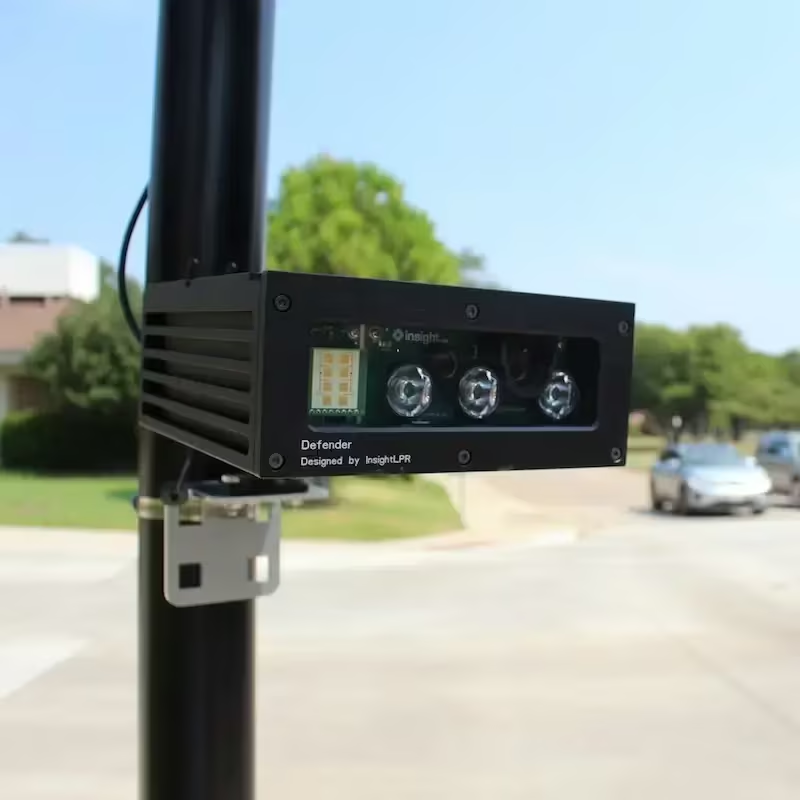
Matthew Jorgensen: Yeah, absolutely. I mean, everybody knows that we can pull mount, that most of these LPR solutions are pole mounted, powered. Even with the insight solution, we'll have a pole mount battery powered with solar, and it's great, but it's also more of a permanent picture and it takes a little longer to get done. And so in true LVT fashion, we said, how can we do this rapidly? How can we cut through that red tape that Oscar was talking about? And so we decided, hey, what if we mounted this to our mast? What if we put this on our mobile security unit? And one of the things we didn't want to do was just add another camera up on the top of our mast, which is 22 feet in the air. That angle becomes more difficult. It's not impossible, but more difficult to capture at times. And so we looked at bringing this down halfway down our mass, creating a specialized mount for this and connecting it to our own closed network for those security purposes. And now it becomes very easy to rapidly deploy these units without needing approvals from permitting. If you already got an LVT unit in your parking lot, probably don't even need to get landlord approval. Every situation is different, but this allows us to go really quick to provide solutions. And then where people want a more permanent solution, we always have those pole mounts and fixed structures that we can do, but this is going to allow us to get out in the field, capturing the data that's needed, securing those sites fast.
Jared Richardson: Yeah, that temporary nature of being able to just throw this on an MSU at your site, that really opens up a new layer of flexibility for a lot of customers that are running maybe a temporary laydown yard or something like that, right, Matt?
Matthew Jorgensen: Yeah, absolutely. I mean, we hear it all the time with those lay down yards, with temporary yards needing a solution, but they don't want to, again, they don't want to dig. There's no infrastructure there. They don't want to run infrastructure to it because they may only be at this site for six months, for three months, but they need something to secure that yard. They need to know who's coming in and out. And that's where, again, that rapid deployability was a must in our partnership here. And that same ethos of creating that open network of if you're bringing the tools you love to LVT, we'll work with them, but we're going to secure it. We're going to keep that network secure at all times, and that's our closed network. I mean, that's part of our secret sauce. I think we've got patents around this, it's amazing to keep the data secure.
Jared Richardson: Yeah. I think when it comes to that open ecosystem, closed network, some of the problems that we see in the space is that you need to buy all this new technology from this one vendor and know it does not integrate with the stuff that you have on site, or maybe you have a great relationship with a VMS provider, something that you really like, and you cannot leverage that. You have to go full bore into this. And you and Oscar, you touched on it too at the beginning. The open ecosystem is kind of key into this allowing people to use what works for them and then onboard new technology as it becomes available. What else are we seeing in that open ecosystem closed network space, Matt and Oscar?
Oscar Nunez: Yeah. So on the open ecosystems, I want to touch on that for a second. This is one that personally frustrates me immensely, and it's part of our philosophy is to have an open ecosystem. Again, we see what the competitors are doing and we see how bad that is, frankly. I've personally had the privilege of working with many law enforcement customers out there, and in conversations with them, I realize how siloed they are from data, from their own data, and how silo they are from data that's around them. So imagine you're a law enforcement officer working a missing child's case. Well, you're only as good as the data you have access to, and why is that? So you can literally go and solve this case tomorrow, but you don't have access to that data. And the reason you don't have access to that data is because of all these silos that have gone up. So we take the opposite approach of that and we are open integrations bidirectional, and we don't just say that, we back it up and we have plenty to point to show how we try to bring communities together and collaboration together to solve the cases that matter. Now, that's all dependent on the customer's preference. And obviously if the customer chooses not to share data with another organization or business, that's their prerogative, but it's not a system limitation. So that's definitely one that hits close to home for me.
Matthew Jorgensen: Oscar,
Jared Richardson: Let's- Sorry, go ahead,
Matthew Jorgensen: Matt. I think this is the exact opposite of what we see out there today, which is closed ecosystem, open network. And to me, that's to some of Oscar's points, but also from just security stands is closed ecosystem's one thing, but open network is a whole other can of worms that we can get into. And that's where those headlines that we talked about earlier are coming from, is data over the public internet. And that's the scary part when it comes to privacy and securing our data. And that's why we've gone all in on closed network and we run a very large closed network for our customers.
Jared Richardson: Yeah. And I think proprietary network is typically what we tell our customer base. So let's go into accuracy, Oscar, as I read all these slides. Yeah, I can jump into
Oscar Nunez: Accuracy and adverse conditions, which is something that is not talked about nearly enough. So accuracy is easy when you've got the perfect conditions. So if it's nice and sunny outside and there's no high winds or anything, LPR is not that difficult to achieve, but it's really the adverse conditions that we solve for. We talked about how we set a high bar for ourselves. When we designed our cameras, we designed them for law enforcement first, which has the highest bar. So you think about a bad guy is not going to be committing crimes in the perfect conditions. They're not going to be committing crimes always in the middle of the day. They're going to be doing it at night in the dark and taking the back roads that are not well lit. Or another pivot is hurricane weather. So you have a hurricane and it takes out your cameras. Well, does that mean crime stops? No, it doesn't. Or freezing temperatures up in the north. Does that crime stop? No, it doesn't. So we've solved for all of that with our design and our build out of our cameras, and that's something that we're very proud of. And- Sorry, go ahead.
Jared Richardson: Yeah. And you've made a very rugged solution, correct?
Oscar Nunez: Exactly. Yeah. So that's where I was going to go to next is that leads us to the rugged solution. I mean, we built something that is military grade. It was the complete opposite of what the industry is doing. The industry's putting out a ton of plastic poorly made cameras that we just didn't agree with. And a good example, and a good story that I reference is a drunk driver accident that's stuck in my head. So it was 3:00 AM on a Saturday morning, drunk driver loses control, hits a pole, takes down a whole streetlight, and down goes the camera. Well, that same morning, an officer shows up, picks up our camera, and puts it on the next pole. And guess what? You're back up and running with LPR.
Matthew Jorgensen: So
Oscar Nunez: Our camera is definitely rugged. It can withstand the big impacts, it can withstand the hurricanes and all of that.
Matthew Jorgensen: I say, I've heard a customer story somewhat recently about somebody who was frustrated with the security state taking a baseball bat to a camera, specifically an LPR camera that you referenced a cheap plastic housing, all of that, and it was done. That camera was done. And I've thought about that a few times of, if I were to take a bat to this camera, I think I would hurt the bat and my hands more than I would this camera. And it is very rugged. And when you say it can withstand hurricane forces, I believe it. Yeah.
Jared Richardson: Hey, we do have a question from the audience that I want to slide in because it's a topic we were just talking about too, Matt. The question is, when we operate or when you operate in a closed ecosystem, open network systems, how can you guarantee privacy in open networks?
Matthew Jorgensen: I mean, that goes maybe a bit beyond my expertise here, but you can't guarantee privacy necessarily in open networks. That's why we have the closed network. And in a closed network, you're not allowing any outside traffic in. You have to be on that VPN and you have to have that permission. So it's locked down access versus open network. If you have the right credentials, if you know what you're looking for, data's just passing over the public internet and you just have to know how to reach out and grab it and to collect that. And that's where we see a lot of these data breaches, whether it's LPR data or any others, is typically there's a gap in security because they haven't shown up all their open networks or gone to a closed network. And everything even a closed network, but when it comes to privacy and security of what we do, closed network privacy, data security is paramount.
Jared Richardson: Yeah, maybe take a minute or two to talk about how our proprietary network works.
Matthew Jorgensen: Oh, I mean, we operate our own. All of our units have their own SIM cards that we own, network that we own with major carriers, but I'm not probably the best person to speak on this. We've got other people that this is what they do all day long at LVT, but I look at it as tubing that connects or pipes that connect data warehouses and essentially an open system is going to have holes in it for data to come in at any part of the transit where there is one way in and one way out. There are no holes in it. You can't break through at any given point. And so we've developed that over the 20 years that we've been doing this at LVT,
Jared Richardson: Really
Matthew Jorgensen: Keeping that-
Jared Richardson: I think the bottom line is customer data doesn't touch- Doesn't
Matthew Jorgensen: Touch. ... open
Jared Richardson: Networks.
Matthew Jorgensen: Exactly. It doesn't
Jared Richardson: Touch public networks.
Matthew Jorgensen: Correct.
Jared Richardson: Right. We do have a combined customer that we're already seeing wins from this on the inside LPR space, on the LBT space within property management, especially as we talked about these large commercial spaces like malls. So Dalen Rodriguez, the GM over at Dan Mall, giving us this example of how it's working for her. The accuracy of the license plate reads, the speed of data capture and the seamless integration with our mall operations have all made an immediate impact. Their team now has real-time insights that help them respond proactively to traffic and operational needs. So we're hearing about this working for these enterprise customers in commercial, in retail. Oscar, there's lots of other use cases here that we could run through, and I'd love to hear a little bit more about insights expertise in these areas.
Oscar Nunez: Yeah, thanks. So law enforcement, as everyone knows, was one of the early adopters of LPR. So they were by far the biggest LPR adopter in the space, and they still are a large adopter, but over the last five years or so, they've relied more on the public sector to the private sector to come and take a step forward in helping them deploy more cameras. Law enforcement doesn't have all the dollars they need to solve all the crimes they need. So that's opened up an opportunity for retailers, schools, remote locations. And really, honestly, the use case list is endless. The sky is the limit. There's a ton of conceptual use cases that we're exploring above and beyond the stuff that's on here, but it's definitely making a difference. So it's making schools safer. Some schools are using it for access control. Some schools are using it just to know when people who shouldn't be on site are coming on site. I mean, there's tons and tons of use cases within each of these categories, but I think the biggest adopter lately has been the retail space. They're the ones that are being riddled with the retail crime, the organized retail crime, and LPR is a huge tool for that. I
Jared Richardson: And Matt, one of the things that we're really excited about exploring in this combined offering is what we can deliver to remote sites, sterile sites, especially when we're mounting insight on an MSU.
Matthew Jorgensen: Yeah, I mean, a lot of times we think about LPR as being really active. It's busy sites that we want to keep track of, but really we want to keep track of who's entering and who's exiting. And so for sterile sites, this works great because you can set up those alerts to get that alert and say, "Hey, a vehicle came on site and they'not supposed to be here." And now you have that data. And it looks like we have a question in the chat that I'll try to answer here within this, which is 70% of crimes involve a vehicle, 80% go unsolved due to lack of evidence. And so I'll answer that first part, which how we look at this is the power of it being on our unit and being out there in, say, a remote site is if it was just LPR, yeah, you'd have some data and you'd have to jump through some more hoops to understand who was that vehicle registered to, what did they do on site becomes a mystery unless you've got other cameras. And when it's mounted to our unit, it becomes this really strong pairing that gives you full site awareness still. So yes, now you can see the vehicle came on site at this time. You can go cross-reference that within our LVT unit and look at the footage of what did they do when they got here? How long were they here? Was crime committed? Was it just somebody came in, turned around? And that's where in the future, I'm really looking forward to our announcement of another product earlier this month of Guardgate meant for gate access, restricting access. Pairing that in the future with LPR I think is going to be awesome. It's going to be a very powerful tool, especially for these remote or sterile sites.
Jared Richardson: Yeah. To our audience too, we'll give you some information on the Guardgate announcement coming up in the follow-up email, which is great. So Matt, when we're talking about the combined thing, and apologies if you already got to this, but we have a question coming in from Ed. Adding insight to the MSU, would it affect the quality of the PTZ cameras already in place? Is there a downgrade on quality at all?
Matthew Jorgensen: Yeah, no, this is a great question. What we wanted to do is give you everything that you've come to love about LVT and add LPR to that without losing any of the analytics from up above or any quality from up above. So how this works is we're piggybacking data and power off of the LVT unit to power the LPR unit as a separate piece. So there's no downgrade in quality. There's no increased latency or anything like that from adding this camera.
Jared Richardson: I want to give everybody a peek into how this works. Get a few more questions and we'll get to them at the end. But Matt, maybe run us through a little bit about how this works inside the consoles.
Matthew Jorgensen: Yeah, so this should hopefully look familiar to everybody, but being our VMS. And so we want to create as seamless as a partnership as we can here. For our customers, we know that you operate typically multi-vendor, pretty complex systems, and the last thing you want to do is have another system to log into. And so one of the things we did was say, yeah, let's bring that together in an integration. And we want to make sure that you can view your LPR cameras, where they're at, if they're tied to an MSU or not within our tools at LVT. And you can see here, this little LPR chip here in the window where when that gets clicked, we're going to seamlessly put you over into the new LPR software for LVT here. And so no more logins. Your login for LVT works over here. We keep all that data secure and keep it very simple for you to jump in. And now you can do all of your investigation research here, manage your hot lists, get your reporting done, and even have a robust audit log. So again, going back to that privacy piece, even within our own organizations, we want to make sure that people are utilizing these tools in the right way. And so we can turn on different features, and one of those would be reason for search. So you can track every search that happens, why it's happening, and who did it, just to make sure that that data is staying private and safe, and accompanies your organization's standards, privacy policies, and data retention policies.
Jared Richardson: Yeah, it's all about driving accountability. And a quick note too, that we blurred license plates on these are real plates to protect the innocent. If you guys want to see the full quality of what this looks like, there'll be an opportunity for you to raise your hand after this webinar and hop on a demo. We'll be glad to show you exactly how this looks in your environment. And then Matt, we altered this plate to make it safe to show on screen, but just a little bit more about the quality here of what you can expect in the scan, correct?
Matthew Jorgensen: Yeah, absolutely. High quality, I mean, we found very high quality even at night. And Oscar, you can probably talk to about some of that accuracy earlier. I don't know if there's anything else you want to add here, but we'd love to show our customers the quality and accuracy that we're getting. And Oscar, you can probably talk far better than I can about how you're doing this.
Oscar Nunez: Yeah, no, I'll jump in here, Matt. So when it comes to, we talked about inclement weather, severe conditions. We also talked about perfect conditions. So regardless on the condition that you deploy our cameras in, we are going to perform exceptionally well in the day and exceptionally well at night. And most of our competitors do a good job at performing well in the day, but it's the night where the proof is really in the pudding. And so what Matt's alluding to here is we've done plenty of champion challenges where we deploy our camera up against our competitors, and sometimes there's four cameras up on a pole, and there's a third party who evaluates the performance of those cameras to award a contract. And we've beat every single one we've participated in, we've won, and most of that is at night. At night, most of our competitors, if you see a LPR read, it is a black square with just a white little license plate, meaning you can't see the vehicle, you can't see any vehicle characteristics, you can't see anything. If you're lucky, you captured the plate. Whereas our night reads are just far superior. You can see the license plate clearly, you can see the vehicle. Depending on lighting conditions, you can see the color of the vehicle. So it's a very different experience to the customer. And so we're obviously not going to be able to show you all of that here, but we welcome anyone who's interested to reach out. We can show you our day and night scans, or if you're interested in doing some kind of champion challenge, we're interested in doing that with you as well. Always kick the tires, especially if you're in the market for LPR, always kick the tires before you buy it. And so we're very open to doing all of that.
Jared Richardson: Yeah. And Oscar, it sounds like you guys may have another shootout coming up here pretty soon too, where we'll get some new data on that, correct?
Oscar Nunez: We do. Yeah. So we have a shootout coming up in hopefully the next few weeks and we'll be sharing those results with you guys. And again, just if you're interested in more, just reach out. But Jared, I want to back up a little bit and talk about just the overall experience on how it works. For the folks that are on the line here that are already LVT customers, your experience will be seamless. So Matt already hit on that. You're not going to have to log out of one system, log into the next one, you're not going to have to do all this swivel chair action. The integration that we're building is robust to where your experience is really not going to be negatively impacted. You're just going to be equipped with additional tools that you didn't have before. You deployed LPR cameras on your MSU units. So just wanted to touch on that to paint that bigger picture for the audience.
Jared Richardson: Yeah. Matt, one of the other questions we're getting too, we'll get the hot lists in a second too, and Oscar, you just touched on this too. We've heard a lot of feedback where people are like, oh, you guys are offering this, you're offering new solutions coming to market. Is LVT getting out of the MSU space? And Matt, to your point earlier, we were talking about empowering security teams with the technology they wanted.That couldn't be further from the truth, correct?
Matthew Jorgensen: Absolutely. I mean, you'll see over this next year, all of our announcements that are coming, but we didn't start in the MSU space, and that's not where we're stopping. That's just one arrow in our quiver that we use, and it works well, but we know that every site's unique and needs something a little different from a security standpoint usually. And so we want to be able to fulfill on those for our customers and truly bring this idea of intelligent site management to life.
Jared Richardson: Excellent. Matt, let's talk a little bit about hotlisting and some of the other features that people would be able to roll out on this combined offering.
Matthew Jorgensen: Yeah, and this is great. And I'll kick it to Oscar here in a second to drive more in depth, but this is one of the strongest features of LPR. I need to know when a bad actor is on site. So whether you're keeping that list in Aura or ThinkLP or some other case management tool, evidence.com, you can export those, bring them right into the software and have that ready to go. It'll alert through email and text for those specific hot lists, you can manage those hotlists down to who can access that, who gets alerted. And this is where the sharing really comes into play in a cool way, where not only can you share within your organization, but if you're working a case with a detective, let's say, you have that opportunity to share externally as well. And you may just have a hotlist with one plate on it for that specific case that you're working with a detective, and you want them to know anytime any one of your LPR cameras out in the field scans a certain license plate, you can do that as a one-off and still keep that data secure. And so that to me is one of the coolest things is when Donsker says we've made it easy to share, that's just one of the tools that we can utilize now to help in investigations.
Oscar Nunez: Yeah. And Matt, I'd like to add a little bit to that. I mean, we've talked a lot about data sharing and people, I think, generally think about LPR data when you hear data sharing, and that's all true. But one additional layer I want to introduce here is the concept of hotlist sharing. So we in our system have the same concept that we do with data, we have it for hotlist. So say you're working in some co-op group solving major organized retail crimes across the country, you guys can all collaborate on one centralized hotlist that everyone contributes to and everyone subscribes to, and that's separate from the hotlist that you manage personally for your property or for your business, but you can be part of this collaborative group. So just wanted to plug that in there as well.
Jared Richardson: Awesome. Well, we are coming down to it here. A few more minutes for Q&A. Again, you can utilize the Q&A feature in Zoom. We're monitoring it or typing answers live. It's pretty busy in there, which is great. But I did have a question from earlier that I wanted to get to announce to you live for you, Matt. When we talk about adding insight to the MSU, and we see other competitors in the space that are now talking about adding LPR to MSUs, making big announcements later this month, you really at that point are only as good as the MSU you're attached to. So let's talk a little bit, Matt, maybe you can even highlight what customers are seeing from a differentiator standpoint on the LVT MSU.
Matthew Jorgensen: Yeah, I mean, you hit it right on the head, which is you're only as good as your MSU, and we've spent years developing it. We were the first to market. We sort of invented this space at LVT. And so we've been through all the heartaches of what it takes to keep an MSU up in the middle of winter in Seattle where the sun doesn't shine when these are solar powered. And so going through that and now adding more things to our MSU, we have a good understanding of what it takes to keep units up. And we have the industry leading uptime on our MSUs, meaning power is really what we're talking about and making sure that your units stay up all the time as much as we possibly can. And I think that's where we'll see competitors run into issues. That's where we already see them. I hear stories all the time from people who have tried other trailer manufacturers, and I always love hearing this because it's like, yeah, go try it. I'd love to hear what you're finding. And almost every time it's a nightmare story of, yeah, they're struggling with power. They can't keep the unit up. And it's like we've been through those struggles and we've learned from them and we've built a very robust MSU that I don't think anybody in the industry comes close to touching yet. That's not always going to be the case, but that's why we continue to innovate and push forward.
Oscar Nunez: And Matt, we must be doing something right if others are seeing what we're doing and following along.
Matthew Jorgensen: Absolutely. Absolutely.
Jared Richardson: Yeah. Matt, maybe talk about Uptime. Maybe we can share at LevyTV, we like to say industry leading up time because when you need it, if you're looking to something for an investigation or you're looking to add proactive deterrence to space, the thing's got to work. So that's a question. When it comes to evaluating other people in this space, what are the questions that people need to ask?
Matthew Jorgensen: Yeah, I mean, I would ask about Uptime for sure right off the bat, but are they ... I would look at their solar panel specs. I'd look at what kind of batteries they're using. Look at, are there any backup power options? Am I able to plug this unit into a wall if I have to? Things like that where you don't want this unit to go down. Now, things happen. Everybody is going to have a unit go down at some point, regardless of who manufactured it or who did it. But the reality is if you're not looking into these things, not all solar panels are equal, not all batteries are equal. There's a lot of learnings we've gone through, and I won't spill all our secret sauce, but there's a lot of learnings just within power consumption. And so simply plugging in an additional camera seems easy until it goes down, until that camera takes your whole unit down because you didn't do the proper power adjustments or calculations to really account for that power draw.
Jared Richardson: Yeah. All right, last question, and then we'll let Oscar go. He's a busy man. He's got lots of things to do. So when is this generally available, Matt? For people out there, whether it's insight customers that want to add LVT, if it's LVT customers have been asking us about LPR for a while, when can we start kicking the tires on this? So
Matthew Jorgensen: We'll be looking at May 15th as our go- live date for general availability. Of course, we'll be doing some testing before that, but that is our goal is May 15th for general availability to our customers to be able to add this. And come see us at ISC West. If you're going to be at ISC West, come see what it looks like in person. We'll have some units there mounted to our MSUs.
Jared Richardson: And Oscar, the folks from Insight will be joining us. They're going to be joining us. Come say hi, I shake Oscar's hand as well. Yeah. And we are talking about a limited interest, getting people signed up for a limited interest ahead of May 15th. So if you're on the call right now and you're like, "Hey, I want to raise my hand. I want to start talking to reps about this. Now I'm interested in it. " lvt.com/lpr. Again, that's lvt.com/lpr. Pop in your information. We'll get our reps reaching out to you today. We can begin to kick off this conversation. So all right, any closing thoughts, Oscar, Matt, we'll start with you, Oscar, about this partnership and what you're most looking forward to.
Oscar Nunez: Yeah, I guess closing thoughts, I'd say anyone interested, reach out. And like I said earlier, we're happy to do some champion challenges. As far as the partnership goes, I couldn't be more excited and I couldn't be more pleased with the collaboration that we've had with the LBT team. I mean it when I say everyone over there is truly top-notch. There's no BS. You guys have been pleasant to work with. You guys have made all of our ... Bringing this partnership to life just easy. So I want to throw that out there and thank you guys for having me on here.
Jared Richardson: We appreciate the words. I think likewise too, when it comes to working with the Insight team, it's been awesome. Really looking forward for the direction this is going. And we're going to do part two to this webinar. We got some other announcements coming up. We want to look at the future state of where this is going and more importantly, address some of the questions that you guys have had. So thank you so much everybody for joining. We really do appreciate your time today. Again, lvt.com/lpr, let us know what questions you have and look for the email later. We'll have the on- demand version of this webinar and also a short survey that we'd love to hear from you. So thank you so much. Thank you to Matthew and Oscar and everyone else joining the call today. I appreciate you joining. Have a great rest of your day.

Test Out the Best Security Strategy
We offer a free consultation and a custom end-to-end security strategy for your unique situation. Connect with an LVT specialist to see if you qualify for a risk-free trial.
