The Reality: Unprecedented Energy Demand
%20(1).avif)
U.S. electricity demand is surging as AI data centers, manufacturing, and electrification drive unprecedented grid expansion. Utilities are responding with over $1 trillion in planned capital investment, creating thousands of high-risk projects. As theft, physical attacks, and regulatory scrutiny rise, LVT provides real-time security, site visibility, and access control.
For nearly two decades (2005–2019), U.S. electricity demand was essentially flat, growing at a mere 0.1% annually. Today, utilities are facing a new reality, a massive increase in demand. Nationwide, the EIA forecasts retail electricity sales growing at an annual rate of 2.2% in 2025 and 2026, nearly triple the 0.8% average seen from 2020–2024. The growth is far steeper in the hottest regions: PJM now expects its summer peak load to climb 3.6% a year, reaching roughly 222 GW by 2036 (Utility Dive, Jan 2026), while ERCOT (Texas) demand is projected to grow 11% in 2025 and 2026 on average, with 2026 alone potentially seeing 14% growth as large data centers and crypto-mining facilities come online (EIA, July 2025).
What is driving this surge?
- AI and Data Centers: The scale of hyperscaler investment jumped again in 2026. Amazon, Google, Meta, and Microsoft alone guided to as much as $630 billion in combined 2026 capex, a 62% increase over the record $388 billion they spent in 2025 (Data Center Richness, Feb 2026). Widen the lens to the top five or top fourteen operators and full-year 2026 data center investment approaches $700–725 billion (American Industrial Magazine, 2026; Axis Intelligence, 2026).
- The power side of that spending is the real story for utilities: Goldman Sachs Research projects U.S. data center power demand climbing from 31 GW in 2025 to 41 GW in 2026 and 66 GW in 2027—roughly doubling capacity by the end of 2027 (American Industrial Magazine, 2026). The U.S. already faces a structural data center power shortfall of 9.3 GW in 2026, forecast to widen to 45 GW by 2028—equivalent to the annual electricity needs of roughly 34 million U.S. households (Axis Intelligence, 2026).
- Industrial Manufacturing and Electrification: The rapid reshoring of manufacturing and the growth of electric vehicle (EV) infrastructure continue to add incremental load on top of the AI-driven surge.
The Challenge: The Multibillion-Dollar Capital Project Surge
To keep the grid from collapsing and to connect these massive new loads, utilities are forced to build at a scale never seen before and the forecasts keep getting revised upward.
- The Macro Numbers: S&P Global's Regulatory Research Associates now forecasts $1.295 trillion in aggregate U.S. utility capex for 2026–2030, up from a $1.169 trillion forecast issued just four months earlier—a 29% jump from the roughly $200 billion utilities spent in 2025 alone (S&P Global, April 2026). An independent review of 51 investor-owned utility earnings calls by PowerLines landed even higher, at $1.4 trillion through 2030, a 21% increase over the prior five-year outlook (PowerLines, April 2026).
- Volume of Projects: Industrial Info Resources is currently tracking more than 6,000 major power industry projects under construction globally, worth $1.68 trillion, as cited in the IEA's "World Energy Investments 2026" report (Industrial Info Resources, June 2026). In the U.S., this translates to thousands of simultaneous, highly sensitive construction sites.
- Specific Utility Examples (2026 capex guidance vs. 2025, per Visible Alpha/S&P Global consensus estimates):
- American Electric Power (AEP): projected to increase capex 48% to $12.5 billion.
- Entergy Corp.: lifting spending 49% to $11.5 billion.
- Duke Energy: raising spending 22% to $17.2 billion.
- Southern Company: raising spending 20% to $15.3 billion.
- (Source for all four: S&P Global / Visible Alpha, April 29, 2026)
The Pain Points for Utilities
Because utilities are scaling up construction so quickly, they are running into a number of significant bottlenecks.
- Critical Asset Protection and Substation Security: Remote substations, grid-enhancing infrastructure, and new generation plants are prime targets for copper theft, vandalism, and domestic terrorism. This is no longer a marginal risk—see the section below.
- Logistical Blindspots and Critical Delays: Managing hundreds of active, remote construction sites spread over thousands of miles makes project oversight, safety compliance, and supply chain tracking nearly impossible from a central office.
- Public and Regulatory Scrutiny: Utility bills have increased roughly 40% since 2021 (PowerLines, April 2026), and regulators and public consumer groups are fiercely auditing this CapEx spending as a result. Utilities cannot afford costly delays, safety incidents, or equipment losses that drive costs higher still.
The Escalating Threat: Physical Attacks on the Grid
The threat data is no longer anecdotal. It's a documented, accelerating trend with a regulatory mandate attached.
- Attacks are up roughly tenfold in a decade. NERC's E-ISAC (Electricity Information Sharing and Analysis Center) reported more than 3,500 physical security incidents across the North American grid in 2025 alone (Landsky, June 2026). A February 2026 incident in Boulder City, Nevada, saw a vehicle intentionally driven through a substation's perimeter fence—a live example of the exact vehicle-intrusion threat gated access control is built to stop.
- Copper theft alone costs U.S. utilities an estimated $920 million a year (Security Industry Association, May 2026), and the Department of Energy's broader estimate puts total copper theft losses to American businesses and utilities above $1 billion annually. Copper prices briefly passed $14,500/tonne in January 2026, driven by AI data center construction and electrification demand. And the incentive to steal is rising with it (Future Fibre Technologies, 2026).
- Real, recent outages tied directly to these attacks. A March 2026 copper theft at an Appalachian Power substation in Wheeling, West Virginia cut power to thousands of customers (Future Fibre Technologies, 2026); a December 2022 gun attack on two Moore County, NC substations knocked out power to 40,000+ people for five days and cost Duke Energy tens of millions in emergency repairs and lost revenue. The on-site cameras recorded it in real time with nobody watching (Intellisee, May 2026).
- The regulatory mandate is tightening, not loosening. NERC CIP-014, the primary physical security standard for transmission substations, requires risk assessments, documented physical security plans, and "two or more physical access controls" where feasible. Updated requirements taking effect in 2026 through CIP-003-9 expand governance for low-impact systems and tighten vendor access controls (Intellisee, May 2026).
How LiveView Technologies (LVT) Solves This Problem
LVT is uniquely positioned to be the "eyes on the ground" for these utility giants as they navigate this historic build-out, and LVT's product line has expanded to match the threats above.
1. Securing Remote, Off-Grid Substation Build-outs
- The Problem: New substations and transmission lines are frequently built in remote areas before permanent power or fiber communications are established. They house millions of dollars in raw materials (like high-value copper) and heavy machinery.
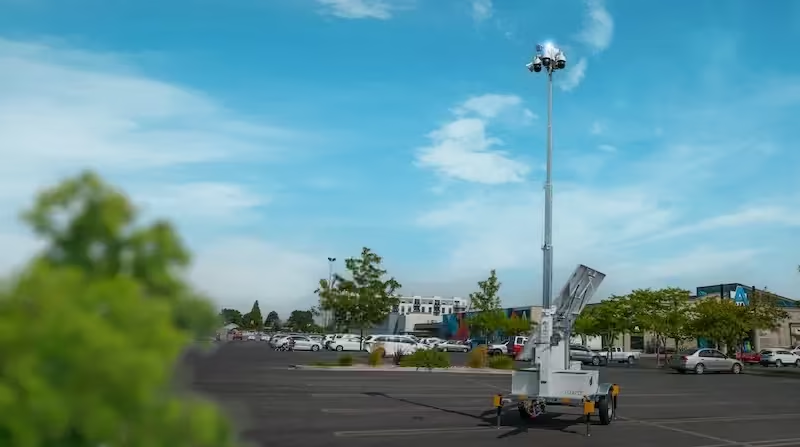
- The LVT Solution: LVT Units are solar-powered and utilize cellular (with expanded satellite backup for zero-coverage sites), so they can be deployed on day one of a project. They provide instant, active perimeter security with thermal imaging, strobe lights, and talk down capabilities to stop theft before it delays a project. For larger substation yards that need full-site coverage rather than a single perimeter, Live Unit Surround, LVT's newly launched wall/roof-mounted system with distributed deterrent heads, extends that same active-deterrence model across every side of the site (GlobeNewswire, March 2026).
2. Controlling Site Access and Deterring Vehicle-Based Attacks
- The Problem: Incidents like the February 2026 Boulder City vehicle-ramming attack show that fencing and cameras alone don't stop a determined vehicle-borne intrusion, and NERC CIP-014 explicitly calls for physical access controls, not just monitoring.
- The LVT Solution: GuardGate, LVT's portable barrier solution, regulates vehicle access to a site, performs remote visual validation via video and intercom, and logs every opening and closing for audit purposes. It directly satisfies the "two or more physical access controls" language in CIP-014 while giving security teams a documented, defensible record (LVT press release).
3. Streamlining Project Management and Site Visibility
- The Problem: Project managers at companies like Duke or AEP are stretched thin, managing dozens of simultaneous projects. Truck rolls to physically check on site progress are expensive and time-consuming.
- The LVT Solution: LVT provides real-time, 24/7 video streaming and time-lapse capabilities. Executives and project managers can log into the LVT Platform to visually verify if a contractor completed a concrete pour, track supply deliveries, and ensure safety compliance (like proper PPE usage) without leaving their desks.
4. Mitigating Delays and Proving Regulatory Compliance
- The Problem: A single stolen transformer, a copper theft incident, or a delayed milestone can push a project back months, costing millions in regulatory penalties, missed deadlines for data center client handoffs, and a CIP-014 / CIP-003-9 compliance finding.
- The LVT Solution: By minimizing theft, tracking site logistics, and providing an indisputable visual and access-log record of site incidents or weather delays, LVT helps utilities keep their multi-billion dollar CapEx portfolios on schedule while building the documentation trail regulators expect.
%20(1).avif)