Tackling Complex Tasks with Agentic AI

Agentic AI is redefining how businesses use autonomous systems to act on high-level goals without constant human oversight. These systems handle repetitive tasks, coordinate workflows, and respond to real-time threats with speed and precision. In security, this means faster response times, reduced manual labor, improved compliance, and better situational awareness. In other words, safer sites and more empowered teams.
Imagine you're getting married. You've hired a wedding planner named Ava. Ava isn’t like other wedding planners. She doesn’t need you to check in, approve every detail, or answer endless questions throughout the day. You only have to tell her:
"I want everything to go smoothly. Make sure everyone is comfortable, the cake gets cut on time, and my mom doesn’t cry too much."
That’s it. Ava handles the rest.
She helps the caterer when the oven goes on the fritz. She redirects guests when it starts raining and the ceremony needs to move indoors. She notices the ring bearer is missing and finds a replacement without bothering you. She even cues the band and adjusts the lighting. The only thing you need to do is enjoy your big night.
You didn’t micromanage. Not even a little. She just got it done.
The Magic of Commander’s Intent
In the military, this is called “commander’s intent.” Commander’s intent decentralizes decision making, encouraging initiative to ensure the end goal is met. But if the armed forces depend on personnel strictly following orders, why is this even needed?
Because, as the saying goes, “no plan survives first contact with the enemy.”
Conditions can change rapidly in combat. Troops on the ground might lose contact or face unexpected resistance. Commander’s intent gives them the authority to improvise. Instead of freezing when a plan breaks down (as it inevitably will), units understand the purpose behind the plan. This lets them make smart, autonomous choices even in the most complex situations.
Regardless of whether they are scattered or under stress, all units know how to work toward the same end goal and can make decisions accordingly. This reduces the risk of confusion between teams and dramatically improves the chances of mission success.
So, what do Ava and the Army have in common? There’s no need to give them step-by-step instructions. They know the end purpose and can get the job done accordingly.
Ava, The Army, and Agentic AI
Like proactive wedding planners and laser-focused troops, agentic AI knows the high-level goal, monitors the environment, makes decisions on the fly, and executes complex, multi-step tasks without the need for constant hand-holding.
It’s a shift from reactive to preemptive systems.
In a time when threats and tech are evolving at a dizzying pace, agent-based AI is reshaping how organizations manage complex tasks across industries. From streamlining operations to revolutionizing security, this next generation of artificial intelligence is autonomous, adaptive, and action-oriented.
Why It Matters for Security
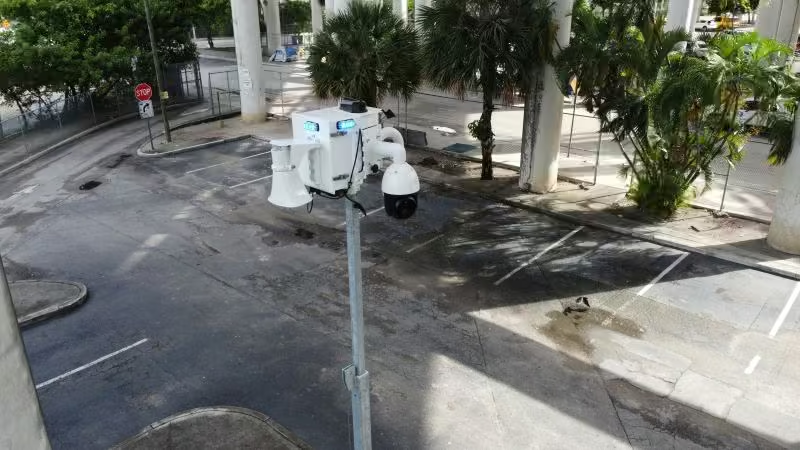
Nowhere is this shift more important than in the world of security. AI has become the driving force behind a new generation of intelligent site security solutions. It powers real-time surveillance, risk detection, and rapid response without waiting for human intervention.
Instead of relying on operators to manually review footage, flag anomalies, and issue alerts, agentic AI continuously monitors multiple data streams. These systems can:
- Detect motion or behavior patterns that indicate a potential threat
- Cross-reference data from access control logs, thermal sensors, or past incidents
- Trigger deterrents like audio alarms, floodlights, or alerts to local authorities
- Generate reports documenting the situation, actions taken, and final outcomes
The result is an always-on, always-learning platform that reduces response times, minimizes human error, and provides greater protection to security teams (and peace of mind to business leaders).
No Hands! Automating Complex Tasks
Complex tasks typically involve multiple inputs, decision points, and outcomes. For example, monitoring multiple video feeds for irregular behavior, verifying safety compliance across a large construction site, or managing access control across different facilities.
For human teams, this kind of work can be overwhelming, mind-numbingly repetitive, or time-consuming. With autonomous AI, however, these tasks become easily managed. How?
- Pattern recognition: detecting trends in movement, timing, or behavior that precede incidents
- Threat prioritization: ranking alerts based on severity and context
- Workflow coordination: integrating with other systems like emergency communications or access control
- Documentation: creating logs and reports for audits, insurance, and compliance
Replacing Repetition with Intelligence
Much of what security teams do can be repetitive. Reviewing the same entry points. Logging similar data. Responding to false alarms.
Agentic systems eliminate the noise by taking over repetitive tasks and escalating issues only when needed. They become “digital coworkers” that handle the background monitoring, freeing up human employees to focus on higher-value tasks like designing workflows, programming safety protocols, overseeing compliance, or intervening in ethical situations.
Autonomous AI doesn’t replace people; it empowers them. The collaboration between human oversight and agent-based systems is the sweet spot. It ensures compliance while still leveraging speed, precision, and scalability.
How Can AI Think and Act So Quickly?
Natural language processing. Agentic AI’s use of natural language processing (NLP) allows the system to understand written or spoken commands in human languages.
That means a security manager could type or say, "Show me all incidents involving unauthorized vehicles from the last 30 days," and the system would instantly generate a report without SQL queries, filters, or complicated dashboards.
NLP makes AI more accessible than ever before. Anyone on your team can use it—not just IT experts—because conversations with AI agents feel intuitive and natural. Thanks to a continuous "Sense-Plan-Act" loop, you get insights instantly, without data wrangling.
Let’s say an unidentified person approaches a restricted zone at 3:12 AM. The system:
- Detects motion via surveillance camera
- Verifies body heat using thermal imaging
- Cross-references access logs to confirm no authorized personnel are scheduled
- Sounds an audio warning and activates floodlights
- Sends an alert to the on-call security team with location, footage, and response options
- Begins documentation for compliance and insurance
This all happens in seconds. No one had to click a button. No one had to review the footage. No one had to wonder what to do next.
Enhancing Situational Awareness
Autonomous AI excels at bringing together disparate data sources: video, audio, thermal, access control, environmental sensors, and even social media if needed.
It’s a force multiplier for situational awareness. Security teams can see everything happening across multiple locations and know what matters most in real time. And because the system evolves with every new event, it only gets smarter over time.
This is especially useful in complex environments like hospitals, distribution centers, transit hubs, event venues, and other areas with critical infrastructure.
Measuring the ROI of Agentic AI
This may sound all well and good, but is it worth the money? Yes! The return on investment for agentic AI can be measured in multiple ways. For instance, fewer incidents and less shrinkage because of faster response times. Lower operating costs due to reduced manual labor and improved compliance with real-time documentation.
When security teams feel supported, morale goes up, burnout goes down, and you save money on recruiting and hiring. (Not too shabby when turnover costs range from 50% to 200% of an employee's annual salary. You do the math.) Plus, you get better strategic planning because of real-time data-driven insights.
Speaking of data-driven insights, organizations can track performance using Key Performance Indicators (KPIs) like:
- Number of threats detected vs. false alarms
- Average response time to incidents
- Time saved in reporting and documentation
- Incident outcomes before and after implementation
Together, these metrics provide a concrete picture of how agent-based AI delivers value—not just by reducing risk, but by making security operations smarter, faster, and more sustainable.
Get the Best of Agentic AI and Security with LVT
Agentic AI redefines what’s possible by taking complex tasks off human shoulders and placing them in the hands of intelligent, adaptive systems. And the best part? It’s only getting better. As technology evolves, so will autonomous AI’s capabilities.
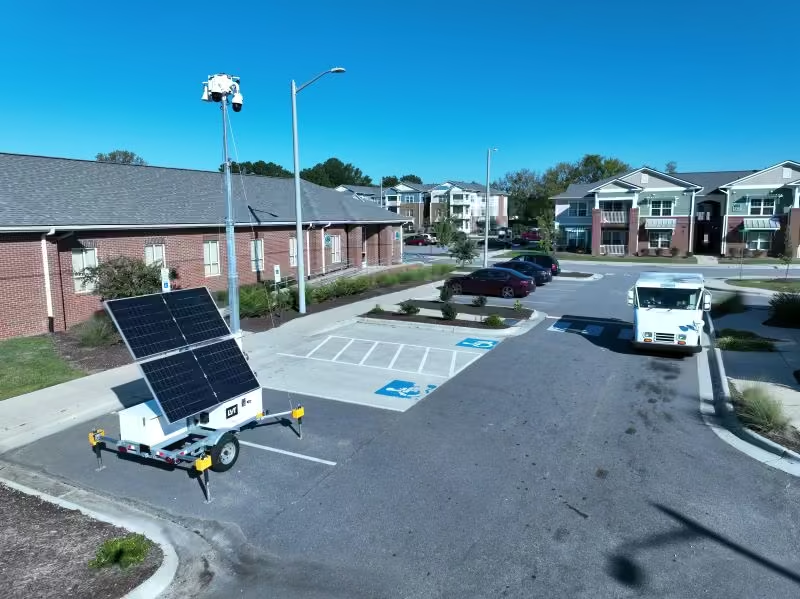
It may sound like science fiction, but it’s happening right now at LiveView Technologies (LVT). The future of intelligent site security and operational management is faster, smarter, and more secure.
Ready to see agentic AI in action? Contact LVT today for a free demo and discover how autonomous systems can help you tackle your toughest security challenges with 100% confidence. No micromanagement required.