Parking Lot Security Cameras: Types, Placement, and Cost

We cover some of the best types of parking lot security camera systems for enhanced safety in your business spaces.
Security cameras are crucial for ensuring the safety and security of parking lots, giving property owners, visitors, and employees greater peace of mind through reliable video surveillance. They deter criminal activity, help in the monitoring of traffic, support stronger security measures, and provide valuable evidence in cases involving vandalism, trespassing, or vehicle theft. The choice of security cameras depends on various factors, including the size of the parking lot, the required field of view, the level of detail required, and the environmental conditions. Parking lot security cameras deter crime, support the people already on site, and produce the evidence that resolves an incident after the fact. The right mix depends on the size of the lot, how much of it is open drive lane, how much detail you need at the gate, and what the site looks like after dark. This guide covers the camera types used in commercial lots and garages, where to place them, and what drives the cost.
The short answer: most commercial lots use four camera types, not one. Fixed and bullet cameras cover fixed points such as entrances, exits, and payment kiosks. PTZ cameras cover open drive lanes and let an operator follow an incident live. License plate recognition cameras sit at entry and exit gates. Infrared or low-light cameras handle the overnight hours, when most parking lot crime happens. Placement matters as much as the camera: mount overview cameras high enough to see across the lot but angled steeply enough to capture faces and plates, and cover the perimeter as well as the aisles.
Types of Parking Lot Security Cameras
Fixed Cameras
Fixed cameras, also known as stationary cameras, are mounted in a fixed position and provide a continuous view of a particular area, making them useful when a consistent field of view is needed for entrances, exits, payment kiosks, or pedestrian walkways. These cameras are ideal for monitoring specific entry and exit points, payment kiosks, and other critical areas in a parking lot or parking garage. Fixed cameras enhance efficiency by providing a consistent and reliable video feed, making it easier for security personnel to monitor and respond to incidents in real-time, including situations that may require escalation to internal teams or law enforcement.
Bullet Cameras
Bullet cameras are typically more cost-effective than other types due to their simple design and ease of installation. These cameras are ideal for covering large areas like commercial parking lots with minimal investment. By strategically placing bullet cameras around the parking lot, operators can achieve comprehensive coverage without the need for expensive equipment or extensive cabling.
Dome Cameras
Dome cameras are known for their durability and vandal-resistant design, making them a cost-effective solution for parking lots prone to vandalism or harsh weather conditions. Their discreet appearance also helps in blending with the environment, reducing the likelihood of tampering. The long-term savings from reduced maintenance and replacements contribute significantly to cost savings.
PTZ (Pan-Tilt-Zoom) Cameras
PTZ cameras offer the flexibility to pan, tilt, and zoom, allowing for comprehensive coverage of large parking areas. With the ability to remotely adjust the camera's view, security teams can quickly zoom in on suspicious activities or track moving objects across a wide area, improving visibility for potential incidents, suspicious behavior, or early threat detection. This functionality significantly improves the productivity of security operations by reducing the need for multiple cameras and enabling more effective monitoring.
License Plate Recognition (LPR and ANPR) Cameras
LPR cameras are designed to capture clear images of vehicle license plates. These cameras are highly efficient in automating the process of vehicle identification and monitoring entry and exit points. By integrating LPR cameras with parking management systems, parking lots can streamline operations, reduce manual intervention, and improve the overall user experience for visitors. Plate capture is what turns a catalytic converter theft or a hit-and-run into a case rather than an incident report.
ANPR cameras automatically recognize and record vehicle license plates, streamlining access control and monitoring. These cameras are particularly useful for enforcing parking regulations, managing entry and exit points, and identifying vehicles involved in suspicious activities. By automating these processes, ANPR cameras enhance security and ensure compliance with parking policies.
For organizations also evaluating identification technologies such as facial recognition, any use should be reviewed against local laws, privacy requirements, and internal compliance policies.
High-Resolution Cameras
High-resolution cameras, such as 4K or 8K models, provide superior image quality and detail. These cameras are essential for capturing clear footage that can be used for identifying suspects, license plates, and other critical details in case of incidents. When paired with approved tools such as video analytics or AI analytics, high-resolution footage can also help teams identify patterns faster. Enhanced image quality ensures that security teams have the necessary evidence to support investigations and comply with legal requirements.
Infrared (IR) Cameras
Vehicle break-ins cluster after dark, which is what makes low-light performance the deciding spec rather than a nice-to-have. Infrared cameras are equipped with IR LEDs that enable them to capture clear images in low-light or complete darkness. These cameras are crucial for parking lots that operate 24/7, ensuring continuous surveillance regardless of lighting conditions. IR cameras enhance security by providing reliable footage at all times, aiding in crime prevention and incident response.
Check out LVT’s infrared and thermal imaging cameras
Wireless Cameras
Wireless security cameras eliminate the need for extensive wiring, making them a flexible video surveillance option for lots where permanent infrastructure is limited. These cameras can be easily relocated as needed, allowing for adjustments based on changing security needs or layout modifications. The reduced infrastructure costs and ease of installation make wireless cameras a budget-friendly option for parking lot security. Also, having the option of remote access and monitoring of parking lot security cameras is a luxury that allows users to view their properties at any time of the day or night.
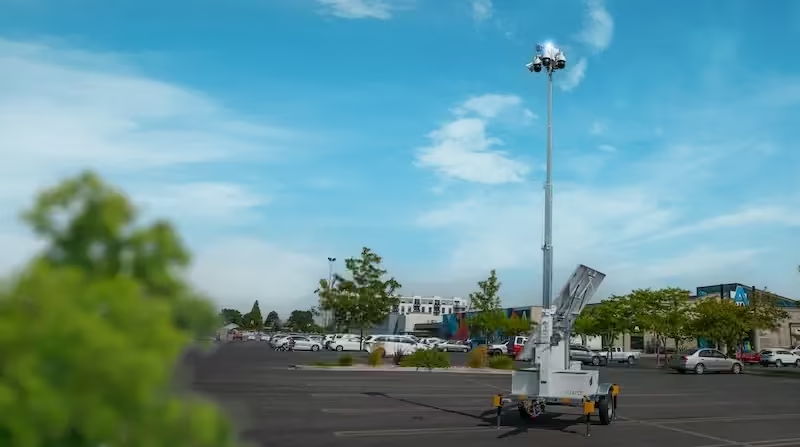
LVT’s security units have no external wires, making them 100% mobile. From the most remote to the busiest of locations, LVT will have eyes where you need them.
Solar-Powered Cameras
Solar-powered security systems harness energy from the sun, reducing the reliance on traditional power sources. Solar-powered security cameras are ideal for remote or large parking lots where running power cables is impractical or costly. Solar-powered cameras contribute to environmental sustainability by lowering carbon footprints and minimizing energy consumption.
Integrating security cameras with energy-efficient LED lighting systems can enhance nighttime surveillance while reducing energy usage. LED lights consume less power and have a longer lifespan compared to traditional lighting options. This combination not only improves visibility for cameras but also supports environmental conservation efforts by reducing overall energy consumption.
Choosing cameras made from environmentally friendly materials supports sustainability initiatives and reduces the environmental impact of electronic waste. Opting for eco-friendly security solutions demonstrates a commitment to environmental stewardship while ensuring effective surveillance.
LVT units run on solar with generator backup and connect over cellular, so they can go anywhere on a lot regardless of where power and network already run. See LVT solar-powered security cameras.
Cloud-Based Storage and Monitoring
Cloud-based security camera systems offer advanced features such as remote monitoring, real-time alerts, and secure data storage. These systems provide enhanced security by allowing authorized personnel to access footage from anywhere, facilitating prompt responses to incidents while helping teams reduce false alarms in parking facilities through smarter alerting and review workflows. Cloud storage also ensures compliance with data retention policies and provides a reliable backup in case of physical damage to on-site storage devices.
Where to Place Parking Lot Security Cameras
The best camera in the wrong position produces footage nobody can use. Four rules cover most commercial lots and garages.
Entry and exit points. Every vehicle on the property passes through them, which makes them the highest-value position on the site. Mount plate capture cameras at the gate angled along the lane rather than across it, so plates sit square to the lens.
Perimeter and property line. Fence lines, landscaping edges, and the backs of buildings are where people enter on foot and where vehicles get broken into. Perimeter coverage removes the blind spots that aisle-facing cameras leave.
Mounting height and angle. Height buys field of view and costs you detail. Too high and you get the roof of a car and the top of a head. [SME review] LVT to confirm the mounting height and downward angle its units are specified for, and whether to publish a recommended range.
Lighting and the overnight hours. Incidents cluster after dark, so the real test of a parking lot camera is what it produces at 2 a.m. Infrared and low-light range matter more than daytime resolution.
Where a lot has no power or network at the perimeter, a mobile unit removes the constraint: the camera goes where the risk is, not where the conduit already runs.
What Parking Lot Security Cameras Cost
The camera is rarely the expensive part. Four things drive the number.
Infrastructure. Trenching power and running cable across an existing lot is often the largest line on the quote and the one that varies most between sites. A lot with no conduit costs several times what a lot with existing runs costs, for the same cameras.
Camera count and mix. Plate capture and PTZ cameras cost more per unit than fixed cameras, and a lot usually needs a few of each rather than many of one.
Monitoring. Recording is cheap. Somebody watching, verifying, and responding is not, and that is the part that decides whether the system prevents an incident or only documents one.
What it replaces. Measure against the guard hours, losses, and liability it displaces, not against a camera price list.
Choosing the Right Mix for Your Lot
No single camera covers a parking lot on its own. Most commercial sites end up with fixed cameras at the fixed points, PTZ over the open lanes, plate capture at the gates, and infrared for the hours when incidents actually happen. Fixed cameras, PTZ cameras, and LPR cameras enhance productivity by providing reliable and flexible monitoring solutions. Cost-effective options like bullet, dome, and wireless cameras help reduce expenses while maintaining robust security. Environmental benefits are realized through the use of solar-powered cameras, energy-efficient lighting, and recyclable materials. High-resolution cameras, infrared cameras, and cloud-based systems offer enhanced security and compliance with regulatory requirements.
By carefully considering the unique needs of each parking lot and selecting the appropriate security cameras, operators can create a secure and efficient environment that benefits both users and management. Investing in the right security technology not only protects assets and people but also contributes to overall operational success and sustainability.
See how LVT mobile security units cover parking lots and garages without trenching power or running cable.
Parking Lot Security Camera FAQs
What are the best security cameras for parking lots?
There is no single best camera, because a lot has several jobs to cover. Most commercial sites combine fixed or bullet cameras at entrances and payment points, PTZ over open drive lanes, plate recognition at the gates, and infrared for the overnight hours.
Can parking lot cameras read license plates?
Only cameras specified for it. A general overview camera shows that a vehicle was present but rarely produces a readable plate. Plate capture needs a dedicated camera, positioned along the lane rather than across it, with a shutter fast enough to freeze a moving vehicle.
Do parking lot security cameras work without power or internet at the site?
Wired systems do not. Solar-powered mobile units do: they generate their own power and connect over cellular, so they can go on a lot with no conduit and move when the risk moves.
What do parking lot security cameras look like?
It depends on whether they are meant to be seen. Dome and bullet cameras on poles and building edges are designed to blend in. Mobile security units do the opposite: a tall mast, visible solar panels, often flashing lights, because a camera an offender notices prevents more than a camera that only records.
%20(1).avif)
%20(1).avif)